On this page
A single prism always does two things at once. It bends the beam (deviation) and it spreads the colours apart (dispersion). JEE and board questions often ask you to keep one and cancel the other. Here the colours still separate but the mean ray comes out parallel to where it went in.
What does dispersion without deviation mean?
For a thin prism of small angle A, the deviation is δ = (μ − 1)A, the result NCERT derives in section 9.6 of its Class 12 Physics chapter on ray optics. Because μ depends on colour, violet is deviated more than red. The angular dispersion of a thin prism is the difference, (μv − μr)A.
Dispersion without deviation means the mean colour (usually yellow) leaves the combination parallel to the incident ray, while violet and red still leave at slightly different angles. You get a spectrum but no overall bend. If the terms are new to you, our post on dispersive power and angular dispersion of a prism builds them up from scratch.
What is the condition for zero deviation with two prisms?
Put two thin prisms in contact, the second turned upside down relative to the first. The first bends light towards its base and the second bends it the other way, so the deviations subtract. Count A′ as negative because the second prism is inverted, and the total mean deviation is (μ − 1)A + (μ′ − 1)A′. Setting this to zero gives the condition:
(μ − 1)A + (μ′ − 1)A′ = 0
In magnitudes, this says A′ = (μ − 1)A / (μ′ − 1), with the second prism inverted.
Why is the dispersion not cancelled as well? Because the two glasses spread colours by different amounts for the same deviation. That ratio is the dispersive power, ω = (μv − μr)/(μ − 1). Optical designers use its reciprocal, the Abbe number, V = (nd − 1)/(nF − nC), measured at the red C line (656.3 nm), yellow d line (587.56 nm) and blue F line (486.1 nm). Flint glass has a lower Abbe number than crown glass, so for the same deviation it disperses more. When the deviations cancel, the net dispersion is δ(ω′ − ω), where δ is the deviation produced by either prism alone.
Worked example: a crown and a flint prism
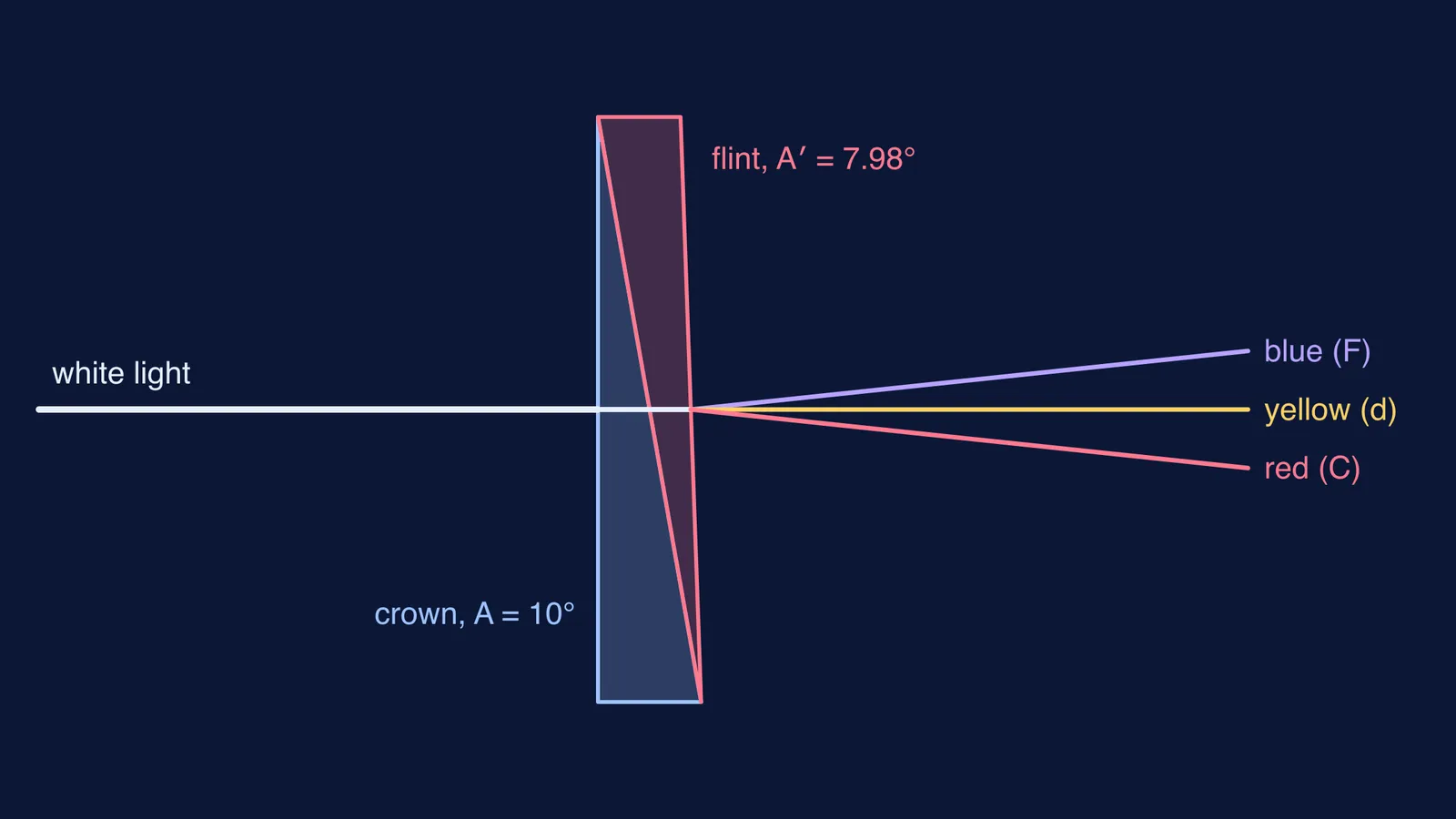
We will use two real Schott glasses. Crown glass N-BK7 has nd = 1.5168 and Abbe number 64.17 (refractiveindex.info, N-BK7). Flint glass N-SF2 has nd = 1.64769 and Abbe number 33.82 (refractiveindex.info, N-SF2). The crown prism has angle A = 10°.
Deviation by the crown prism: δ = (1.5168 − 1) × 10° = 5.168°.
Flint angle for zero deviation: A′ = 5.168° / 0.64769 = 7.98°, placed inverted.
Crown dispersion: nF − nC = 0.5168 / 64.17 = 0.00805, so the crown spreads F and C by 0.00805 × 10° = 0.0805°.
Flint dispersion: nF − nC = 0.64769 / 33.82 = 0.01915, so the flint spreads them by 0.01915 × 7.98° = 0.1528° the opposite way.
Net dispersion: 0.1528° − 0.0805° = 0.072°, on the flint's side.
Check with the shortcut: 5.168° × (1/33.82 − 1/64.17) = 5.168° × 0.01398 = 0.072°.
The yellow ray leaves parallel to where it entered. Blue light (the F line) tilts towards the base of the flint prism, because the flint's dispersion wins. The Amici prism, a direct-vision prism first made public in 1862, pairs a crown-glass prism with a flint-glass prism so that one centre wavelength comes out parallel to the incoming beam, though slightly offset from it.
How is this different from an achromatic combination?
The two set-ups cancel opposite things. For dispersion without deviation, you set the mean deviations equal and opposite. For deviation without dispersion (an achromatic prism), you set the dispersions equal and opposite: (μv − μr)A + (μ′v − μ′r)A′ = 0. Then a net bend remains. The same idea in lenses gives the crown and flint doublet in our post on the achromatic lens combination.
How do exam questions test this?
Use this five-step check on any two-prism question:
Read which quantity must be zero: deviation or dispersion.
Write one signed sum, with the inverted prism's angle negative.
Use the mean μ (yellow) for deviation, and μv − μr for dispersion.
Confirm the angles are small, so δ = (μ − 1)A holds.
State the direction of what is left over, not just its size.
For more practice, try the numericals in prism dispersion problems. If your setup is right but the sign keeps going wrong, the Fermi Problem Library has worked problems with a step-by-step solver that explains the reasoning rather than printing an answer. If dispersive power itself is shaky, start with the lesson in the Fermi Concept Library.