On this page
A.R. Williams wrote this piece for National Geographic, and NCERT reprints it as Chapter 3 of the Class 11 Hornbill reader (NCERT Hornbill, Chapter 3 PDF). It is a report: a famous mummy leaves its tomb for one night, goes through a scanner and comes back.
What happens in Discovering Tut: the Saga Continues?
The chapter opens on a windy evening in Egypt's Valley of the Kings. At 6 p.m. on 5 January 2005, the mummy of Tutankhamun, a pharaoh who died in his late teens more than 3,300 years ago, slides head first into a CT scanner set up in a trailer outside his tomb (NCERT Hornbill, Chapter 3).
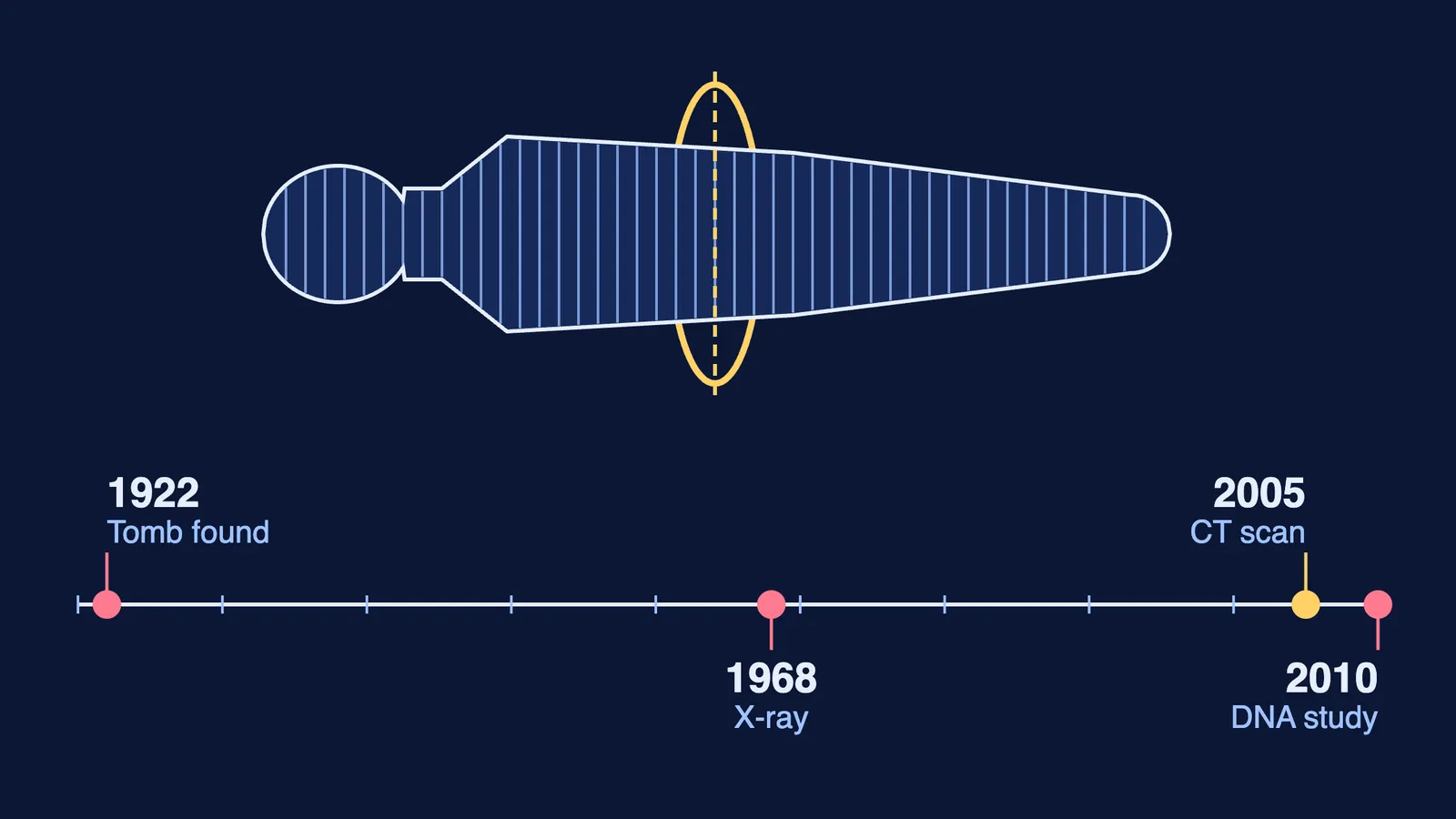
Williams then steps back:
1922: the British archaeologist Howard Carter finds the tomb, full of gold and everyday things for the afterlife, such as board games.
The damage: hardened resins glued the body to its gold coffin, so Carter's team chiselled it free and cut off the head and most joints to remove the gold. The author partly defends him: thieves would otherwise have torn it apart.
1968: an anatomy professor X-rays the mummy and finds that the breastbone and front ribs are missing.
The family: Akhenaten promoted worship of the sun disc and attacked the god Amun. The boy king renamed himself Tutankhamun, restored the old ways, ruled about nine years and died unexpectedly.
Back in 2005, the scanner stops working because sand clogs a cooling fan, and a nervous guard jokes about the "curse of the pharaoh". Substitute fans save the night, and Tut is back in his tomb within three hours.
What did the 2005 CT scan of Tutankhamun show?
The chapter explains computed tomography simply: hundreds of cross-section X-rays are combined, like a sliced loaf put back together, into a three-dimensional virtual body. The scan made 1,700 digital images, and the head was scanned in slices 0.62 millimetres thick (NCERT Hornbill, Chapter 3). On screen appear a grey head, neck vertebrae, a hand and the rib cage.
The chapter asks how Tut died and how old he was, but reports no scan verdict; it says only that he died in his late teens. The text gives the scan, not the verdict.
The verdict came later. In March 2005, Zahi Hawass, then head of Egypt's Supreme Council of Antiquities, announced that the team found no sign of a blow to the back of the head and put Tut's age at death at about 19 (NBC News, March 2005). Some of the team read a break in the left thighbone as an injury shortly before death that might have become infected; the same group thought it possible, though less likely, that the embalmers caused it (same report).
A later study in JAMA examined 16 royal mummies between September 2007 and October 2009 using CT and DNA tests (Hawass and colleagues, JAMA 2010). It found genetic signs of the malaria parasite in Tutankhamun, diagnosed a bone disorder (Köhler disease II), and named a mummy from tomb KV55, most probably Akhenaten, as his father. The authors judged bone death (necrosis) plus malaria the most likely cause. Our guide to science careers in archaeology covers how archaeologists use DNA and dating methods.
What are the main themes of Discovering Tut?
Archaeology has changed. Carter's era hunted treasure; today's team asks how a young man lived and died.
Technology as a witness. Each new tool reads the same body again and finds something new. X-rays also power the airport baggage X-ray scanners you walk past.
Respect for the dead. Workmen carry Tut like pallbearers and return him to his tomb.
Myth against evidence. The curse is a joke; the breakdown was sand.
Power and its end. A king buried in gold is one of almost 600 mummies Egypt's survey had recorded.
How do you answer exam questions on Discovering Tut?
The CBSE English Core curriculum for 2026-27 asks for two 3-mark short answers from Hornbill (one prose, one poetry) in 40-50 words, and one 6-mark long answer from Hornbill in 120-150 words (CBSE English Core curriculum 2026-27). Try these, written by us.
Short (40-50 words): Was Howard Carter careless or cornered? Plan: the resin problem, the cutting, the author's defence about thieves, then your view.
Short: Why does the writer mention a scanner breaking down? Plan: sand in a fan, the curse joke, and the irony of modern machinery failing in an ancient valley.
Long (120-150 words): Show, using the chapter, how new tools keep rewriting an old story. Plan: a claim; Carter's methods; the 1968 X-ray; the 2005 CT scan; then note that the chapter leaves questions open, so evidence builds slowly.
Give each point its own sentences and end with your judgement, not a retold plot.
The scan rests on X-rays and the follow-up study on DNA, both school science topics. If either is hazy, the Fermi Concept Library has every concept in physics, chemistry, biology, mathematics and computing, each with its own lesson and its place in the map. For DNA and the deep past, read what DNA shows about the woolly mammoth.