

On this page
If you picture archaeology as brushes, trenches and history notes, you are seeing only half of it. Once something is dug up, the questions become scientific: how old is it, what is it made of, what did these people eat, and who were they related to? Answering those takes the same physics, chemistry and biology you are studying in Class 11 and 12.
What does a scientist do in archaeology?
The Department of Archaeology at Deccan College in Pune gives a good picture of the range. Its scientific labs page lists units for archaeological chemistry (fluorine and sediment analysis, ceramic technology), palaeobotany (food grains, seeds and husk impressions), palynology (pollen and spores), archaeozoology, anthropology, sedimentology and petrography.
The archaeozoology lab there holds reference skeletons of 300 animal species, and the anthropology lab keeps more than 500 Neolithic-Chalcolithic skeletal elements, according to the same Deccan College page.
The work groups like this:
Physics: dating methods and instruments that measure isotopes.
Chemistry: what pottery, metal, soil and residues are made of, and where the raw material came from.
Biology: seeds, pollen, animal bones, human skeletons and ancient DNA.
Earth science: how layers of sediment formed, which tells you the order of events at a site.
How does radiocarbon dating work?
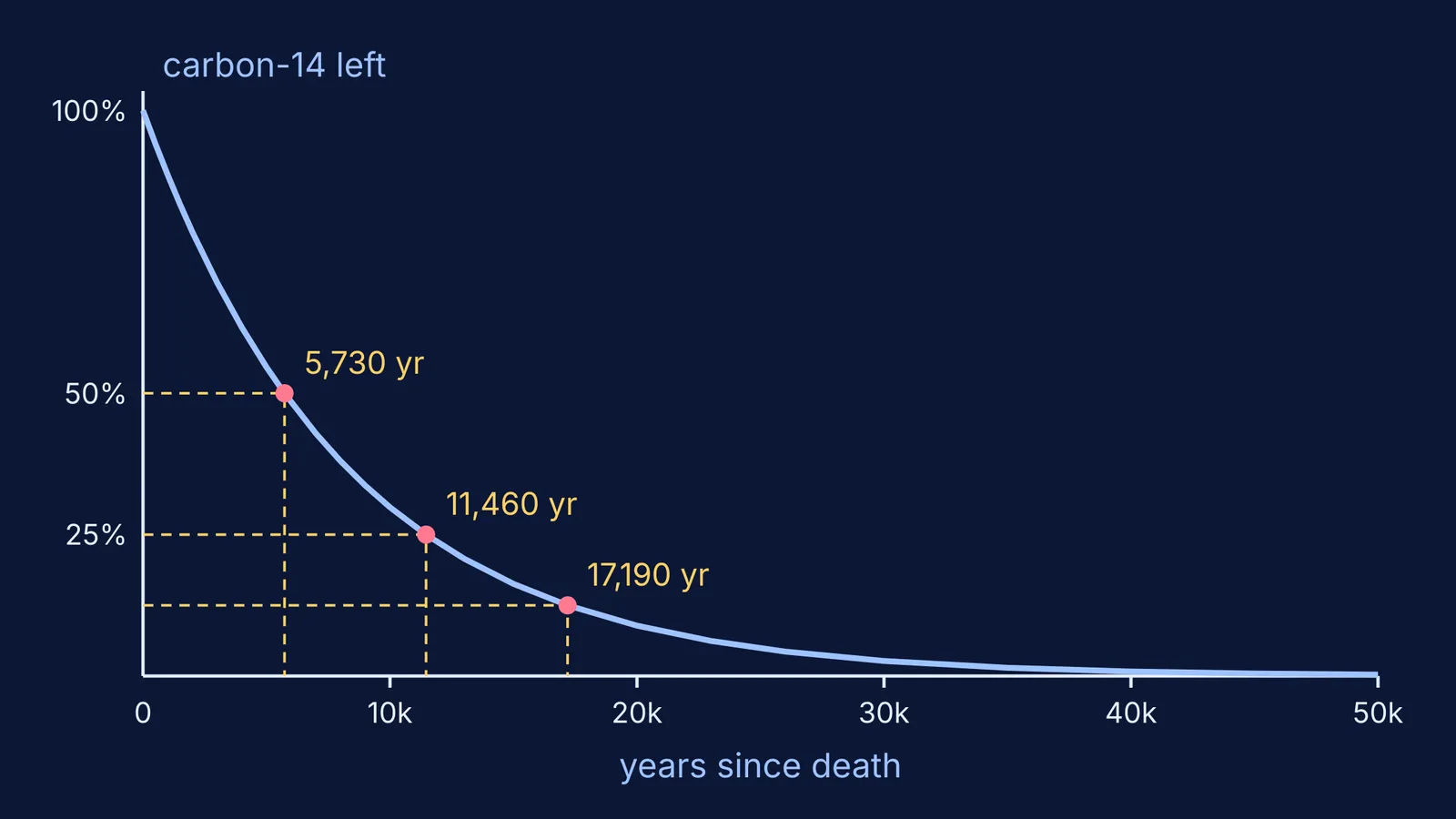
Radiocarbon dating measures how much carbon-14 is left in something that was once alive. Carbon-14 forms in the upper atmosphere when cosmic rays hit nitrogen, and living things keep taking it in; when an organism dies, intake stops and the carbon-14 decays, as this LibreTexts chemistry module/Nuclear_Chemistry/Applications_of_Nuclear_Chemistry/Radiocarbon_Dating) explains.
The half-life of carbon-14 is 5,730 years, and the method works for materials up to about 58,000 to 62,000 years old (LibreTexts/Nuclear_Chemistry/Applications_of_Nuclear_Chemistry/Radiocarbon_Dating)). Willard Libby developed the method at the University of Chicago and received the 1960 Nobel Prize in Chemistry for it, the same module notes.
Here is a worked example using that 5,730-year half-life:
A charred seed from a hearth has 25% of the carbon-14 found in a living plant.
100% to 50% is one half-life; 50% to 25% is a second.
Age = 2 × 5,730 = 11,460 years.
When the fraction is not a neat half, use the first-order decay law (the same maths as first-order reactions in Class 12 chemistry): t = (5,730 ÷ ln 2) × ln(N₀/N), which is about 8,267 × ln(N₀/N). The LibreTexts module/Nuclear_Chemistry/Applications_of_Nuclear_Chemistry/Radiocarbon_Dating) gives a real case: living material shows 14 decays per minute per gram, the Dead Sea Scrolls showed 11, and the formula gives roughly 2,000 years.
If you want the same idea applied to rocks and fossils, our explainer on how fossils are dated with rock layers and radioactivity goes further. If half-life itself still feels shaky, the Fermi Concept Library has a lesson for every concept in physics, chemistry and biology, so you can fill that gap before moving on.
Where do chemistry and biology come in?
Ancient DNA is where biology comes in. A 2019 study in Cell by Vasant Shinde and colleagues reported an ancient genome from the Indus Valley Civilisation and found the individual had little if any ancestry from Steppe pastoralists.
Plant remains tell a similar story: the Birbal Sahni Institute of Palaeosciences in Lucknow highlights archaeobotany research that uses radiocarbon-dated carbonised seeds to study ancient farming and trade.
Chemistry sits underneath all of it. If you like the subject but are not sure where it leads, our career map for students who love chemistry sets archaeological science beside the other options.
How can a science student get into archaeology in India?
There is no single national entrance route. A common path is a degree in a related science, then specialisation:
Undergraduate: a BSc in chemistry, botany, zoology, geology, anthropology or physics.
Postgraduate: an MA in archaeology, such as Deccan College's MA in Ancient Indian History, Culture and Archaeology, listed on its department page alongside a PhD programme and diplomas in heritage sites management and scientific conservation and in underwater archaeology.
Government training: the Archaeological Survey of India offers a Post-Graduate Diploma in Archaeology (PGDA) through its Archaeology Institute, with online registration and application described in the ASI application guide.
Research: a PhD, then work in a university, a research institute or a museum.
If the lab side of things interests you as much as the past, compare this with forensic science courses and careers in India, which uses many of the same methods.
What can you do from Class 11?
Keep your science subjects; they are your entry ticket, not a detour.
Learn isotopes, half-life, first-order decay and DNA properly, since they overlap with your Class 11 and 12 syllabus and with this field.
Visit an ASI site museum and look for how the finds were dated.
In your BSc, ask a professor about short field or lab projects.
Before your final year, read the current notices from Deccan College and the ASI.
If you are not sure where to begin on the science, Fermi's AI tutor can work out what you already know and build a plan for the session, so you start with a clear next step.


