

On this page
What degrees qualify you for forensic science in India?
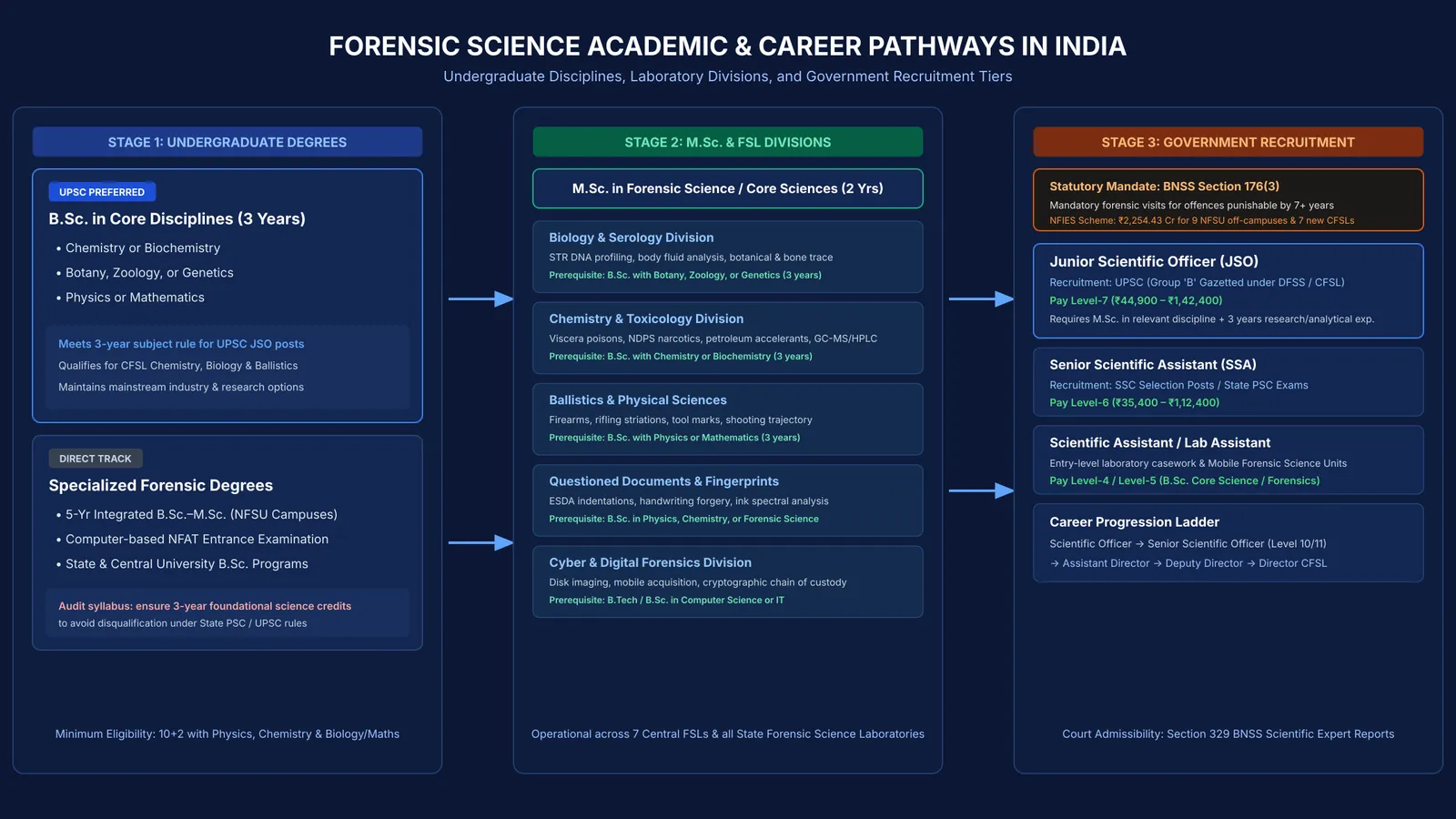
For students exploring scientific careers beyond medicine and engineering, forensic science offers a direct bridge between laboratory investigation and the legal justice system. In India, students typically enter the field through one of two academic routes. The first route is a direct forensic qualification, such as the five-year integrated B.Sc.–M.Sc. in Forensic Science or a specialized postgraduate degree offered by the National Forensic Sciences University, an Institution of National Importance established under the Ministry of Home Affairs. Admission to NFSU campuses across Gandhinagar, Delhi, and regional centres is conducted through the computer-based National Forensic Admission Test (NFAT).
The second route begins with a traditional Bachelor of Science (B.Sc.) in a core discipline—such as chemistry, biochemistry, botany, zoology, or physics—followed by a Master of Science (M.Sc.) in Forensic Science or an allied specialization. As families begin talking about STEM careers beyond engineering and medicine, choosing between these two tracks is the most important decision an aspiring forensic scientist will make.
Why do UPSC and State FSL rules favour core science degrees?
Many students assume that an undergraduate degree titled "B.Sc. Forensic Science" is the fastest ticket to a government laboratory. However, official recruitment notifications tell a different story. Recruitment rules set by the Union Public Service Commission for Group 'B' Gazetted posts—such as Junior Scientific Officer (JSO) in the Central Forensic Science Laboratories (CFSL) under the Directorate of Forensic Science Services (DFSS), paid at Pay Level-7 (₹44,900 to ₹1,42,400)—impose strict subject prerequisites.
Under UPSC guidelines, a candidate holding an M.Sc. in Forensic Science is eligible for the Chemistry or Toxicology division only if they studied chemistry as a subject across all three years of their bachelor's degree. Similarly, applicants for the Biology division must have studied botany or zoology for all three years of their undergraduate degree, while the Ballistics division requires three years of physics or mathematics. Many private institutions offer generic forensic bachelor's degrees that touch lightly on fingerprinting, handwriting, and crime scene photography without providing the deep subject credits required by state public service commissions.
How does Section 176(3) of the BNSS change forensic hiring?
The operational demand for forensic scientists in India changed fundamentally on July 1, 2024, with the enactment of India's new criminal codes. Under Section 176(3) of the Bharatiya Nagarik Suraksha Sanhita (BNSS), 2023, crime scene visits by forensic experts and the videography of evidence collection became legally mandatory for any offence punishable by imprisonment of seven years or more. Under Section 329 of the BNSS, formal reports signed by government scientific experts, chemical examiners, and laboratory directors serve as admissible evidence in criminal proceedings.
To build the capacity required by this statutory mandate, the Union Cabinet approved the National Forensic Infrastructure Enhancement Scheme on June 19, 2024, with a total financial outlay of ₹2,254.43 crore spanning 2024–25 to 2028–29 under the Ministry of Home Affairs. This scheme funds nine new off-campuses of the National Forensic Sciences University and seven new Central Forensic Science Laboratories, creating a sustained demand for scientific assistants, digital forensic analysts, and Mobile Forensic Science Unit (MFSU) personnel across all states.
What are the main laboratory divisions and everyday roles?
Forensic science in India is organised across distinct functional divisions within Central Forensic Science Laboratories (located in cities including New Delhi, Kolkata, Chandigarh, Hyderabad, Bhopal, Pune, and Kamrup) and State Forensic Science Laboratories:
Biology and Serology: Examines physiological fluids, blood spatter, hair, and bone fragments. This division conducts short tandem repeat (STR) DNA profiling, tracing back to Lalji Singh's pioneering work in DNA fingerprinting using gel electrophoresis for DNA fragment analysis.
Chemistry and Toxicology: Screens visceral tissue and seized contraband for poisons, illicit drugs under the NDPS Act, petroleum accelerants, and explosives using gas chromatography-mass spectrometry (GC-MS) and high-performance liquid chromatography (HPLC).
Ballistics and Physics: Examines firearms, spent cartridges, rifling striations, tool marks, and glass fracture patterns to reconstruct crime scenes and shooting trajectories.
Questioned Documents and Fingerprints: Uses electro-static detection apparatus (ESDA) and spectral comparators to detect forged signatures, altered handwriting, and latent fingerprints.
Cyber and Digital Forensics: Recovers deleted evidence, images storage media, verifies mobile device acquisitions, and maintains cryptographic chains of custody.
Entry-level roles begin with Scientific Assistant or Laboratory Assistant positions (often recruited through Staff Selection Commission Selection Posts or State PSC exams), advancing to Senior Scientific Assistant, Junior Scientific Officer, and Assistant Director.
How should students choose their academic pathway?
Students planning a forensic career should follow a structured three-step evaluation:
Audit your undergraduate syllabus: If choosing a specialized B.Sc. in forensic science, confirm that the university curriculum includes foundational chemistry, biology, or physics coursework across all semesters, matching the statutory criteria set by the Union Public Service Commission.
Build laboratory analytical competencies: Forensic casework depends on instrumentation. Prioritize programs that offer hands-on training with spectrophotometers, chromatographs, and PCR thermal cyclers rather than theoretical crime scene lectures.
Master foundational scientific reasoning: Competitive entrance exams like the NFAT and state recruitment tests evaluate foundational science rather than popular trivia.
When strengthening conceptual fundamentals in organic chemistry, molecular genetics, or physical mechanics, the Fermi Concept Library offers dedicated lessons for every concept in physics, chemistry, biology, mathematics, and computing to help students anchor theory before lab work. For students working through analytical numericals or reaction stoichiometry, the Fermi Problem Library provides worked problems with a step-by-step solver that explains the reasoning rather than printing an answer. When visualizing invisible processes such as molecular separation or projectile paths, the Fermi Simulation Lab provides interactive simulations for ideas that are easier to see than to read.


