On this page
Most of India's railway carries passenger and goods trains on the same track. A dedicated freight corridor (DFC) splits them: it is a separate line where only goods trains run, built heavier, longer and taller than an ordinary line. The physics behind those three words, heavier, longer and taller, is Class 11 mechanics you already study.
What is a dedicated freight corridor?
The Dedicated Freight Corridor Corporation of India (DFCCIL) describes its job as creating high-capacity, high-speed, freight-only rail corridors.
The Eastern DFC runs 1,337 km from Ludhiana in Punjab to Sonnagar in Bihar, according to DFCCIL.
The Western DFC runs 1,506 km from Dadri in Uttar Pradesh to JNPT in Mumbai, according to DFCCIL.
The same page says the corridors are designed for 1,500-metre-long trains and 25-tonne axle loads, and that the Western corridor, built for containers, supports double-stack container trains. Each of those numbers is a physics decision.
What does axle load mean on a railway?
Axle load is the share of a wagon's weight that one axle, with its two wheels, presses onto the rails. A 25-tonne axle load, the DFC figure from DFCCIL, means each axle pushes down with a force of about 25,000 kg × 9.8 m/s², roughly 245 kN, or about 123 kN through each wheel.
Why allow more per axle? Because each wagon can then carry more cargo, so the same load needs fewer wagons and fewer wheels. The price is paid by the track, which has to be stronger: heavier rails and a well-built bed of stones to spread that force into the ground. Our post on why railway tracks have stones shows how ballast does that job. Roads face the opposite trade-off, which is why heavy trucks have many wheels: spreading the load protects the road surface.
Why do double-stack trains need higher overhead wires?
A double-stack train puts one container on top of another, so each wagon carries twice the boxes. That makes the train tall: Railway Technology gives the height of trains on the Western DFC as 7.1 m.
An electric train draws current from a wire above it through a pantograph, as our explainer on how electric trains get power from overhead wires describes. The wire has to clear the top container with a safe air gap, or current can jump across. So the overhead wire on a double-stack line is hung higher than on an ordinary line, and the bridges and tunnels above it must be taller too.
Why does rail use less energy than road?
The International Energy Agency reports that rail carries 8% of the world's passengers and 7% of global freight transport but uses only 2% of transport energy (IEA, The Future of Rail).
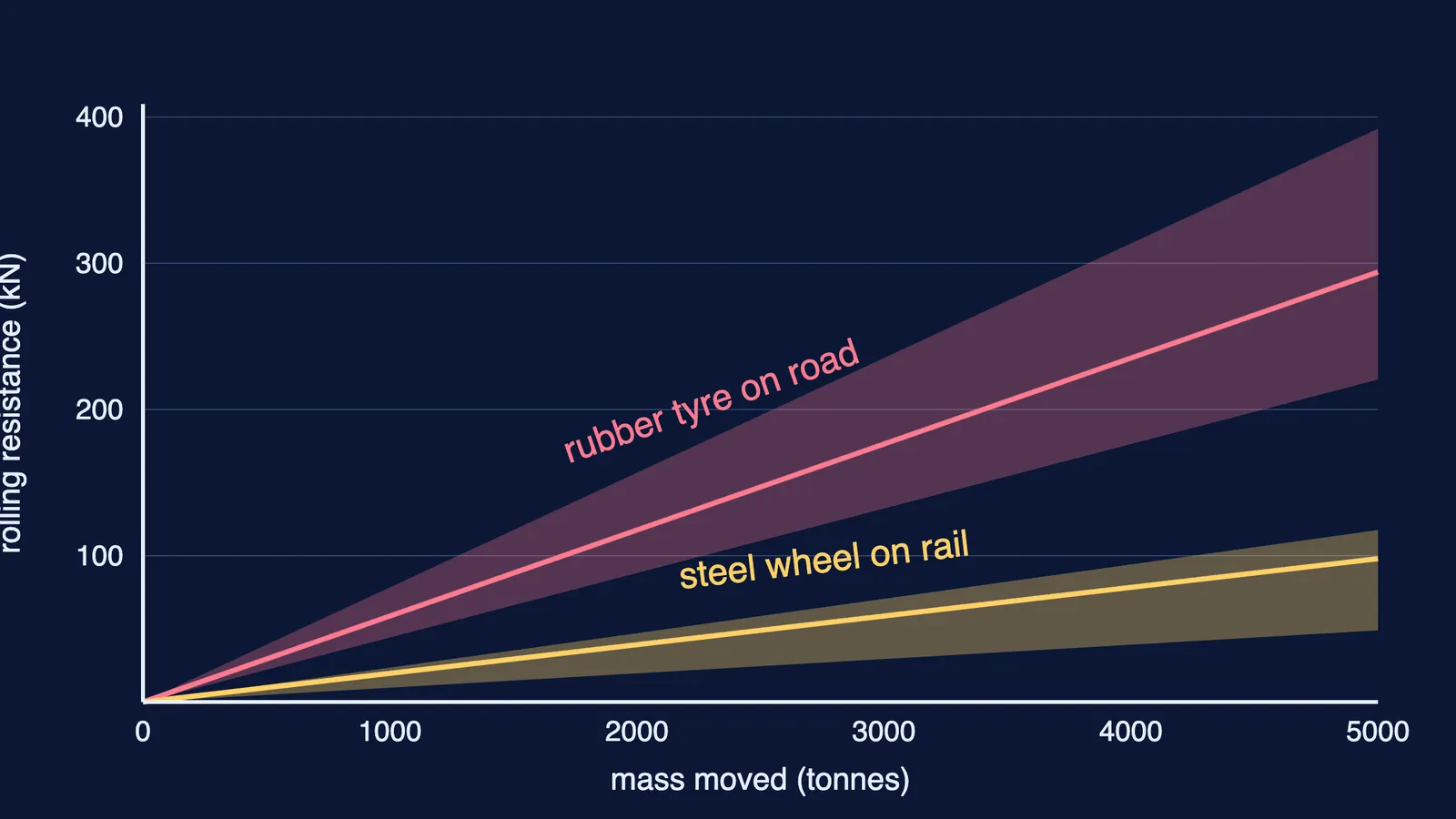
One big reason is rolling resistance. A hard steel wheel on a steel rail barely squashes, while a rubber tyre flattens and springs back every turn, losing energy as heat. The coefficient of rolling resistance is about 0.0010 to 0.0024 for a railway steel wheel on steel rail and about 0.0045 to 0.0080 for large truck tyres (Wikipedia, Rolling resistance).
Worked example: pushing 1,000 tonnes for 100 km. Rolling resistance is F = C × m × g. Take round values inside the ranges above: C = 0.002 for rail, 0.006 for truck tyres.
Rail: F = 0.002 × 1,000,000 kg × 9.8 m/s² = 19.6 kN.
Road: F = 0.006 × 1,000,000 kg × 9.8 m/s² = 58.8 kN.
Work over 100 km (W = F × d): rail 19.6 kN × 100,000 m = 1.96 GJ; road 5.88 GJ.
Convert (1 kWh = 3.6 MJ): about 544 kWh for rail against about 1,633 kWh for road.
That is three times the energy just to keep the wheels rolling, before air drag, braking and engine losses. Air drag usually widens the gap, since a train presents one front for many wagons while each truck pushes its own.
How can you use this in your physics prep?
Turn every infrastructure number into a force: the DFC's 25 t per axle becomes 245 kN.
Redo the worked example for a 5,000-tonne train at a steady 20 m/s and find the power needed (P = F × v).
Change one variable at a time (mass, C, distance) and predict how the answer scales before you calculate.
If a step like P = F v still feels like a formula rather than an idea, the Fermi Simulation Lab has interactive simulations for ideas easier to see than read. For numericals like the one above, the Fermi Problem Library has a step-by-step solver that explains the reasoning. And if you are not sure where mechanics revision should start, Fermi's AI tutor can work out what you already know and build a plan for the session.