On this page
Dal Lake in Srinagar is not drying up the way a pond does in May. It is filling in. Nutrients from sewage and farmland, and silt washed down from the hills around it, feed water plants that crowd out the open water. Over the years, open water turns into weed beds, then marsh, then land. Satellite maps, a government audit and water samples all point to the same driver: too many nutrients, a process scientists call eutrophication.
Why is Dal Lake shrinking?
Eutrophication is a rise in a lake's productivity, meaning its plant and algal growth, caused by pollution with nitrogen and phosphorus, as a Waikato Regional Council review of lake restoration defines it.
A study of the lake's catchment from 1980 to 2018 found that Dal's water quality had "remarkably deteriorated due to increased nutrient and sediment loads from the catchment" as forest cover fell and built-up land grew (Rather and Dar, Applied Water Science, 2020). In the same study, nitrate-nitrogen, total phosphorus and chemical oxygen demand all rose between 1990 and 2018.
The government's own auditors point to the same causes. A CAG report on lakes in Jammu and Kashmir names malfunctioning sewage treatment plants and improper de-weeding, and says rising nutrient inflows led to excessive weed growth and further loss of open water (ThePrint, April 2026). The audit found that sewage was not treated to the prescribed standards, even though more than Rs 45 crore had been spent on treatment plants.
What do the measurements show?
From satellite images: NASA's Earth Observatory, citing the Srinagar study above, reports that between 1980 and 2018 the lake's open water shrank in area by 25 percent (NASA Earth Observatory, 2023).
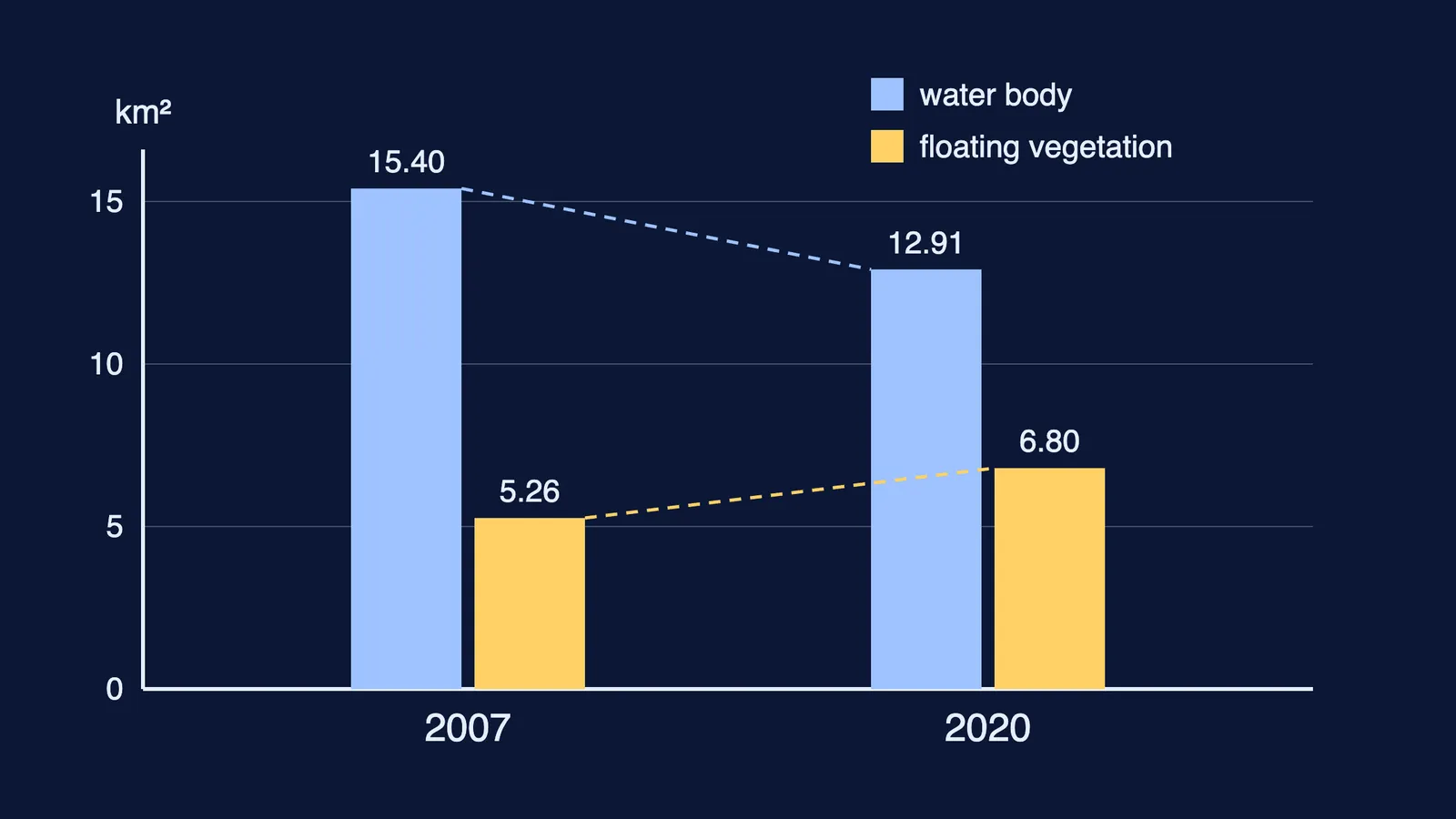
From the audit's land-use maps: submerged vegetation and open water together fell from 15.40 to 12.91 sq km between 2007 and 2020, while floating vegetation grew from 5.262 to 6.796 sq km (ThePrint, April 2026).
From water samples: a study that sampled five sites in every season from 2019 to 2021 found dissolved oxygen falling steadily, while total phosphorus and nitrate-nitrogen rose, which points towards eutrophication (Water Science and Technology, 2024).
Here is a worked example using the audit's numbers. The water body lost 15.40 − 12.91 = 2.49 sq km. The audit reports this as a 10.15% decline; measured against the water body's own 2007 size, it is 2.49 ÷ 15.40 ≈ 0.16, or about 16% in 13 years. Over the same years floating vegetation gained 6.796 − 5.262 ≈ 1.53 sq km, an area equal to about 62% of the water lost (1.53 ÷ 2.49). Crop land and plantation (up 0.56 sq km) and built-up land (up 0.28 sq km) grew too, and the audit says encroachments expanded floating gardens and housing.
How do weeds and silt turn water into land?
The chain is the same in any lake that receives too many nutrients:
Sewage and runoff from farms and roads add nitrogen and phosphorus.
Algae and water plants grow faster than grazers can eat them. Floating weeds spread across the surface, like the water hyacinth that clogs India's lakes and rivers.
When the plants die, the bacteria that break them down use up dissolved oxygen, the same process measured as biochemical oxygen demand in polluted water.
Silt from the catchment settles among the roots and dead plant matter, and the lake bed rises.
Shallow water becomes marsh and then land. This is the sequence your biology textbook calls hydrarch succession, from open water to climax, sped up by people.
If you get stuck on any link in this chain, such as the phosphorus cycle or why warm water holds less oxygen, the Fermi Concept Library has a lesson for every concept in biology and chemistry, each with its place in the map.
How does lake restoration work?
The Waikato review of lake restoration groups the methods into four kinds: controlling the nutrients that flow in, controlling the nutrients already stored in the lake bed, biomanipulation, and changing how water flows through the lake. Controlling external loads is fundamental, and most successful cases cut them by at least 50%. Even after large cuts, lakes in northern temperate regions typically took 10 to 15 years for nutrients stored in the sediment to fall enough. Dredging, capping the sediment and adding materials that bind phosphorus can shorten that wait.
For Dal Lake, that puts sewage treatment and the catchment first. The CAG audit found that only four of the 15 micro-watersheds identified for catchment work had been taken up (ThePrint, April 2026). De-weeding clears water for a season, but while nutrients keep flowing in, the weeds grow back.
If you are starting a school project on a lake near you and don't know where to begin, Fermi's AI tutor can work out what you already know and build a plan for the session.