On this page
Picture a pond and a bare rock on the same hillside. One has too much water for trees, the other has no water and no soil. Given enough time, both can become the same kind of forest. That is the idea behind hydrarch and xerarch succession.
First, a syllabus check. The NCERT Class 12 Ecosystem chapter (2026-27 reprint) has five sections, 12.1 to 12.5, and none of them is on succession. Check your own syllabus; state boards, B.Sc. botany and older papers still ask it.
What is the difference between hydrarch and xerarch succession?
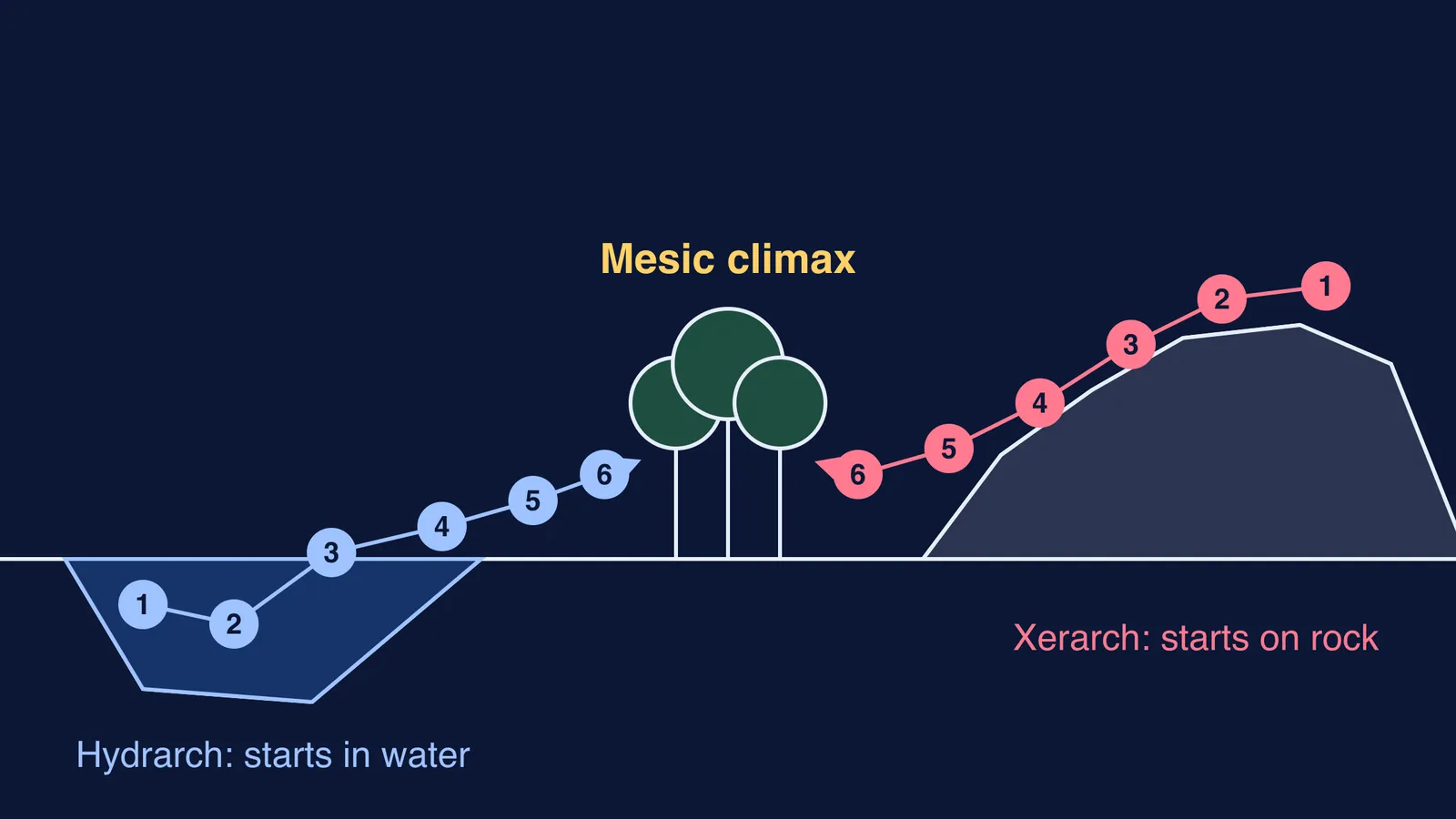
Hydrarch succession (the series of stages is called a hydrosere) is succession that starts in water, such as a pond, pool or lake, according to an e-PG Pathshala ecology module written by authors at BHU, Varanasi. Xerarch succession is succession that begins on a dry place with an extreme shortage of water, and its stages are together called a xerosere, as a botany lecture from M.D. College, Mumbai defines it. Both are primary succession, starting on new ground with no earlier community; our guide to primary, secondary and climax communities covers the basics.
Start: hydrarch in open water; xerarch on bare rock.
Pioneers: phytoplankton (algae, diatoms, bacteria) versus crustose lichens.
Problem to fix: too much water versus no soil and little water.
What the stages do: fill the pond until it is land versus build soil on rock.
End: the same forest climax, which tends to be mesic.
What are the stages of hydrarch succession?
The e-PG Pathshala module gives seven stages for a pond in a dry tropical region:
Phytoplankton: algae, diatoms and bacteria multiply; dead cells mix with silt into soft mud.
Submerged: rooted plants under water, first Potamogeton, Nitella and Chara, then Ceratophyllum and Hydrilla.
Floating: rooted Nelumbo and Nymphaea, then free-floating Lemna, Wolffia, Azolla, Pistia and Salvinia, which shade out submerged plants.
Reed swamp: Typha and Sagittaria grow in from the edges, roots in water, shoots in air; the pond turns to marsh.
Sedge meadow: Carex, Juncus, Cyperus and Eleocharis form a mat and transpire heavily, so the area becomes more mesic.
Grassland or woodland: herbs, then shrubs, then trees.
Forest: the climax, tropical, temperate or rain forest depending on climate.
What are the stages of xerarch succession?
The same module gives seven stages on bare rock:
Crustose lichen: Rhizocarpon and Rinodina crust the rock; their acids weather it and dust collects in cracks.
Foliose lichen: leaf-like lichens such as Dermatocarpon hold more water, shade out the crusts and add humus.
Moss: Polytrichum, Tortula and Grimmia fill cracks; the moss mat holds water.
Pteridophyte: Selaginella and Adiantum move in.
Herb: annual weeds, then perennial grasses such as Poa, Aristida and Andropogon.
Shrub: Acacia, Prosopis, Capparis and Zizyphus shade the herbs and widen rock cracks.
Forest: sparse trees at first, then a layered climax forest.
The M.D. College lecture skips the pteridophyte stage, lists six and names Parmelia as another foliose lichen. Use whichever version your textbook gives. For why lichens survive on bare rock, see how a lichen's fungus and alga live together.
Why do both end in a mesic climax?
Each stage changes its habitat in a way that suits the next community. In a pond, dead plants and silt raise the bottom, so the water gets shallower. On rock, lichens and mosses make soil and hold water, so the habitat gets wetter. One series loses water, the other gains it, and both move towards the middle.
The e-PG Pathshala module says climax vegetation tends to be mesic, and that within the same broad climatic belt, stages starting in water and on rock lead to the same type of climax community. This fits Frederic Clements' monoclimax theory, that climate decides the climax; read more in our post on Clements and the climax community.
How do you write a 5-mark answer comparing them?
Use this plan, one short part per mark:
Define both in one line each, naming the starting habitat.
Name the pioneers: phytoplankton and crustose lichens.
Draw two arrow flow charts, pioneer to forest.
Add one line on how each changes its habitat: silting up versus soil formation.
End with the shared mesic forest climax, set by regional climate.
Then cover the lists above, write both series from memory, and check. Common slips are putting lichens in the pond series, missing the floating stage, and calling the end point aquatic or xeric.
If words like seral stage, pioneer or climax still feel shaky, the Fermi Concept Library has a lesson for every concept in biology, each with its place in the map. Once the ideas are clear, work through problems in the Fermi Problem Library, where a step-by-step solver explains the reasoning rather than printing an answer.