

On this page
If your biology chapter says succession ends in a stable climax community, you are using a picture Frederic Clements drew more than a century ago. In Plant Succession: An Analysis of the Development of Vegetation, published by the Carnegie Institution of Washington in 1916, he argued that vegetation grows up the way a single plant does: through fixed stages to one mature form (full text on the Internet Archive).
Who was Frederic Clements?
Frederic Edward Clements (1874–1945) was an American plant ecologist who worked at the University of Nebraska, the University of Minnesota and the Carnegie Institution of Washington (biography on Wikipedia). With Roscoe Pound he developed the quadrat method around 1898: sampling vegetation in square plots, a method still widely used. His climax theory dominated plant ecology in the first decades of the twentieth century.
For an earlier American study of succession, see how Henry Cowles read the sand dunes of Lake Michigan.
What is a climax community, according to Clements?
In Clements's scheme, a climax community is the final, stable vegetation that the regional climate allows. Every sere, he wrote, “finally must terminate in the highest stage possible under the climatic conditions present” (Plant Succession, 1916).
His most quoted line comes later in the book: “The climax formation is the adult organism, the fully developed community, of which all initial and medial stages are but stages of development.”
He chose the word sere for one whole run of succession: “a unit succession” running “from the appearance of the first pioneers through the final or climax stage”.
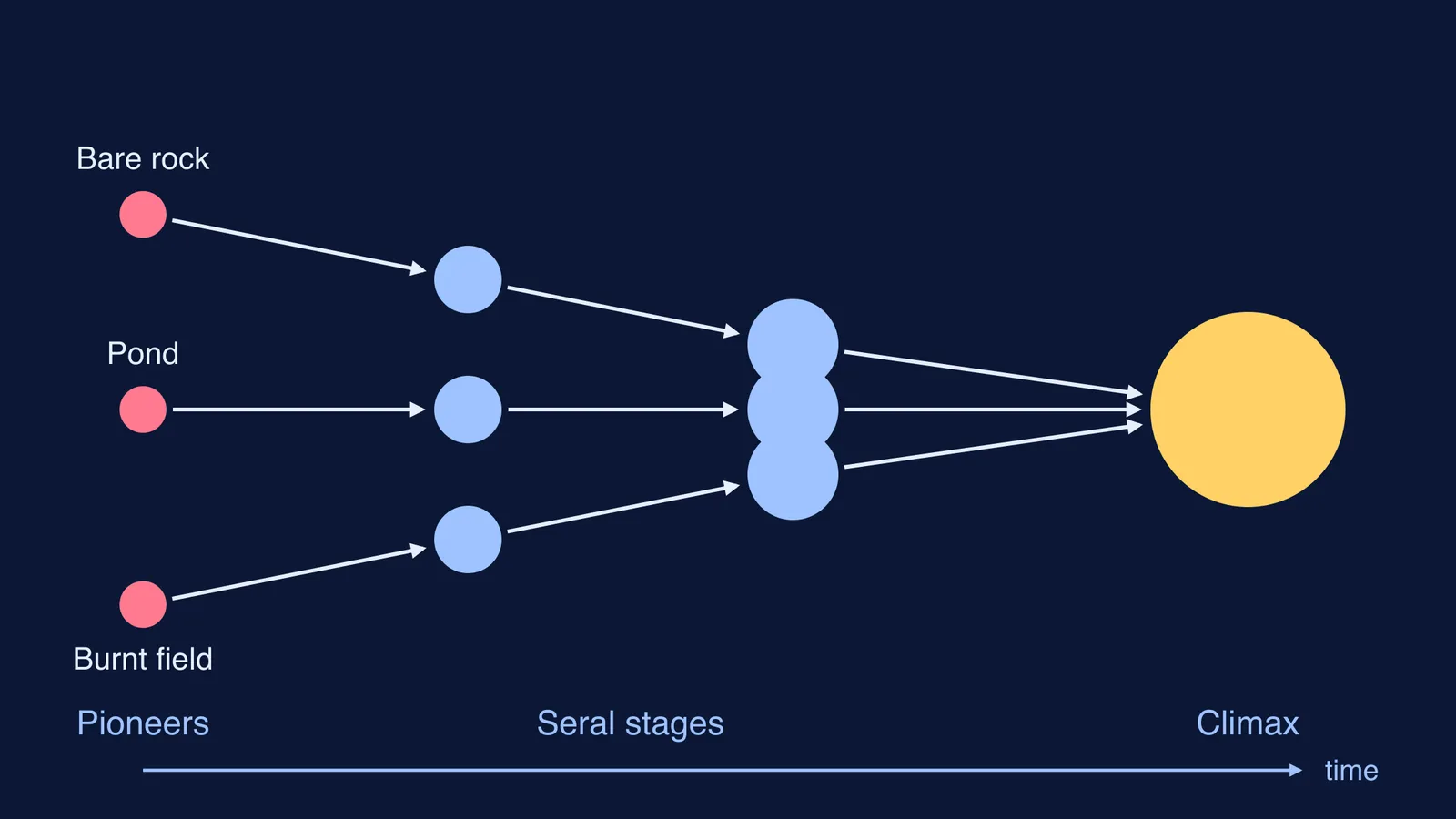
His boldest claim was convergence. On dunes, a wet hollow and a dry crest start “seres of totally different initial stages”, which “converge more and more as they develop, and terminate in the same climax”. Writing about lakes in one climate region, he said their succession could be changed “only by a decisive change in climate which produces a new climax formation”.
How do Clements's six processes map onto Class 12 succession?
Clements broke every sere into six processes: nudation, migration, ecesis, competition, reaction and stabilization (Plant Succession, 1916). Applied to bare rock becoming forest:
Nudation: a bare area appears, such as rock exposed by a landslide.
Migration: spores and seeds arrive by wind, water or animals.
Ecesis: Clements's word for establishment in the new home. Lichens and mosses take hold first as pioneers.
Competition: as more plants arrive, they compete for light, water and space.
Reaction: the plants change their own habitat. Pioneers break down rock and add organic matter, building soil for herbs, then shrubs.
Stabilization: the community settles into the climax, a forest where the climate allows one.
The pond version (hydrarch) and the rock version (xerarch) are two seres. Clements's claim was that in one climate both end at the same climax, which is what the diagram above shows.
Our guide to primary, secondary and climax communities covers the textbook version in detail.
Was Clements right about the climax?
Only partly. In 1926 the botanist Henry Gleason published The Individualistic Concept of the Plant Association, arguing that vegetation depends on how each species responds on its own, so communities are looser and more varied than Clements's organism suggested (summary on Wikipedia). Clements never responded in print.
Arthur Tansley pushed back too. In his 1935 paper The Use and Abuse of Vegetational Concepts and Terms, he proposed that communities be regarded as “quasi-organisms”, and introduced the word ecosystem to treat organisms and their environment as one physical system (Tansley on Wikipedia).
By the 1970s, historian Malcolm Nicolson writes, “few plant ecologists in the English-speaking world worked routinely with the idea that vegetation existed in distinct and definite natural kinds” (Web Ecology, 2001).
What survives is the useful core. Disturbed ground does change in a broadly ordered way, and pioneer, sere and climax remain the words textbooks use to describe it.
How do you write a succession answer that scores?
Use this five-step frame for a long answer:
Define: succession is the gradual, broadly predictable change in the species of an area over time.
Name the start: primary (no soil yet) or secondary (soil survives a fire, flood or abandoned farm).
Walk the sere: pioneers, then seral stages, then climax, with one named example per stage.
Give the mechanism: each stage changes the habitat and makes room for the next (Clements's reaction).
End at the climax: a stable community in balance with the climate.
If the stages blur together, watching them change helps more than rereading. The Fermi Simulation Lab has interactive simulations for ideas that are easier to see than to read, and the Fermi Concept Library gives each biology concept its own lesson and its place in the map.
Try the five-step frame on one past question tonight.


