On this page
Three vectors, one λ, and the word coplanar: the whole problem is one determinant and one line of algebra, plus a quick check that catches slips.
What does it mean for three vectors to be coplanar?
Three vectors are coplanar when, drawn from the same starting point, they all lie flat in one plane. The scalar triple product a · (b × c) equals the determinant of the 3×3 matrix whose rows are the components of a, b and c. Its absolute value is the volume of the parallelepiped (a slanted box) built on the three vectors, and when it is zero the vectors are coplanar, because that box is flat and has no volume (Triple product, Wikipedia). Wolfram MathWorld states the same idea for points: four points are coplanar exactly when the tetrahedron they form has zero volume (Coplanar, Wolfram MathWorld).
The rule: a, b, c are coplanar if and only if [a b c] = 0. Our post on the volume of a tetrahedron with the scalar triple product uses the same determinant with a non-zero answer.
How do you find λ if three vectors are coplanar?
Worked example: find λ if a = 2i − j + k, b = i + 2j − 3k and c = 3i + λj + 5k are coplanar.
Write each vector's components as one row: (2, −1, 1), (1, 2, −3), (3, λ, 5).
Set the determinant of these three rows equal to zero.
Expand along the first row with the signs + − +.
The three terms are:
First: 2 × (2·5 − (−3)·λ) = 2(10 + 3λ) = 20 + 6λ
Second: −(−1) × (1·5 − (−3)·3) = +1 × 14 = 14
Third: +1 × (1·λ − 2·3) = λ − 6
Add them: 20 + 6λ + 14 + λ − 6 = 28 + 7λ. Setting 28 + 7λ = 0 gives λ = −4.
Watch the second term: the entry is −1 and its position sign is minus, so the two minuses make a plus. It is the same + − + pattern you use when expanding a cross product by determinant without sign errors.
How do you check that λ = −4 is right?
Put λ = −4, so c = 3i − 4j + 5k. If the three vectors are coplanar, and a and b are not parallel, then c can be built from the other two as c = xa + yb. Match the components:
i: 2x + y = 3
j: −x + 2y = −4
k: x − 3y = 5
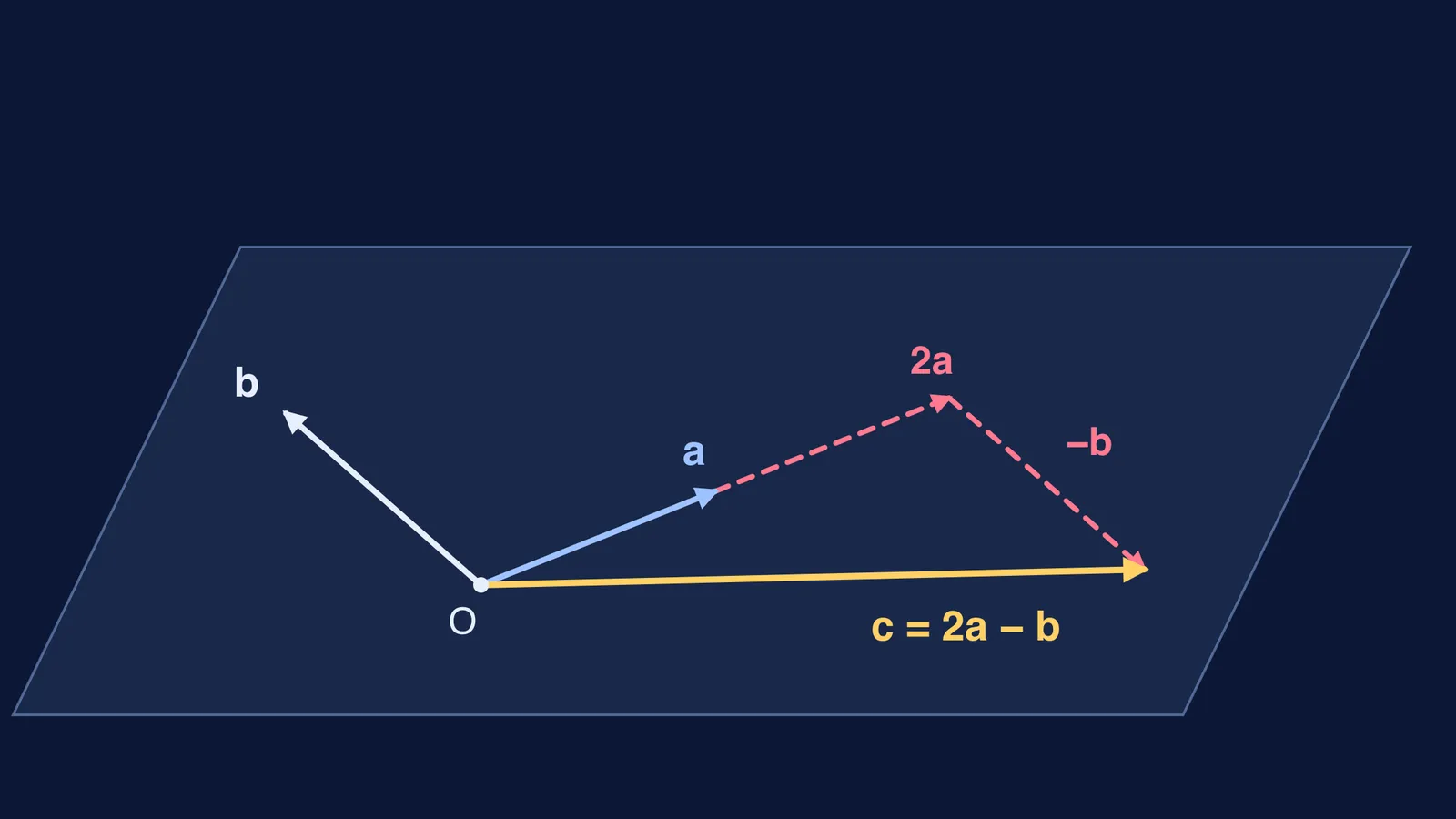
The first two equations give x = 2 and y = −1. Now test the third: 2 − 3(−1) = 5. It holds, so c = 2a − b and the answer is confirmed. The diagram at the top shows exactly this: go along a twice, step back by b, and you land on c without leaving the plane.
What if λ appears in more than one place?
Then the determinant becomes a quadratic or a cubic, and you can get more than one λ. Take a = λi + j + k, b = i + λj + k and c = i + j + λk. The determinant is λ(λ² − 1) − 1(λ − 1) + 1(1 − λ) = λ³ − 3λ + 2, which factors as (λ − 1)²(λ + 2). So λ = 1 or λ = −2.
Check each root. At λ = −2, adding the three vectors gives a + b + c = 0, so c = −a − b. At λ = 1, all three are the same vector i + j + k: they are coplanar too, but only because they all lie along one line. Some questions ask for non-collinear or distinct vectors, which rules λ = 1 out, so read the wording before you write both answers.
Which mistakes cost marks on this question?
Before you move on:
Each row is one vector's i, j, k components, in the same order for all three. A missing component is 0, so i − k is (1, 0, −1).
The middle term of the expansion carries a minus sign.
Do not mix this up with perpendicularity: two vectors at right angles need a · b = 0, a different condition covered in finding λ so that two vectors are perpendicular.
If the determinant gives a quadratic or cubic, factor it fully and test every root.
Finish with the c = xa + yb check.
If you keep losing the sign on the middle term, work a few more in the Fermi Problem Library, which has worked problems with a step-by-step solver that explains the reasoning rather than printing an answer. For the idea underneath, why zero volume means one plane, the Fermi Concept Library gives each concept its own lesson and its place in the map.
Next time: write the three rows, expand, solve, then check.