On this page
Pour water into a cone that stands point-down and the level shoots up at first, then slows as the tank widens. Board exam and JEE Main questions often ask how fast it is rising at one moment. The whole problem turns on one line of similar triangles that you write before you differentiate.
How do you set up a conical tank related-rates problem?
The free OpenStax textbook Calculus Volume 1, section 4.1 on related rates gives a five-step method: assign symbols and draw a figure, state what is given and what you want, find an equation linking the variables, differentiate both sides with the chain rule, then substitute the known values.
For a cone, the equation is V = (1/3)πr²h. The catch is that both r (the radius of the water surface) and h (the depth of the water) change as the tank fills. You need to get rid of one of them.
Similar triangles do it. The water forms a smaller cone with the same shape as the tank, so r/h always equals R/H, the tank's top radius over its full height. In the OpenStax funnel example, a funnel 2 ft tall with a 1 ft top radius gives r/h = 1/2, so r = h/2 and the volume becomes V = (π/12)h³ (OpenStax, section 4.1).
Worked example: how fast does the water level rise?
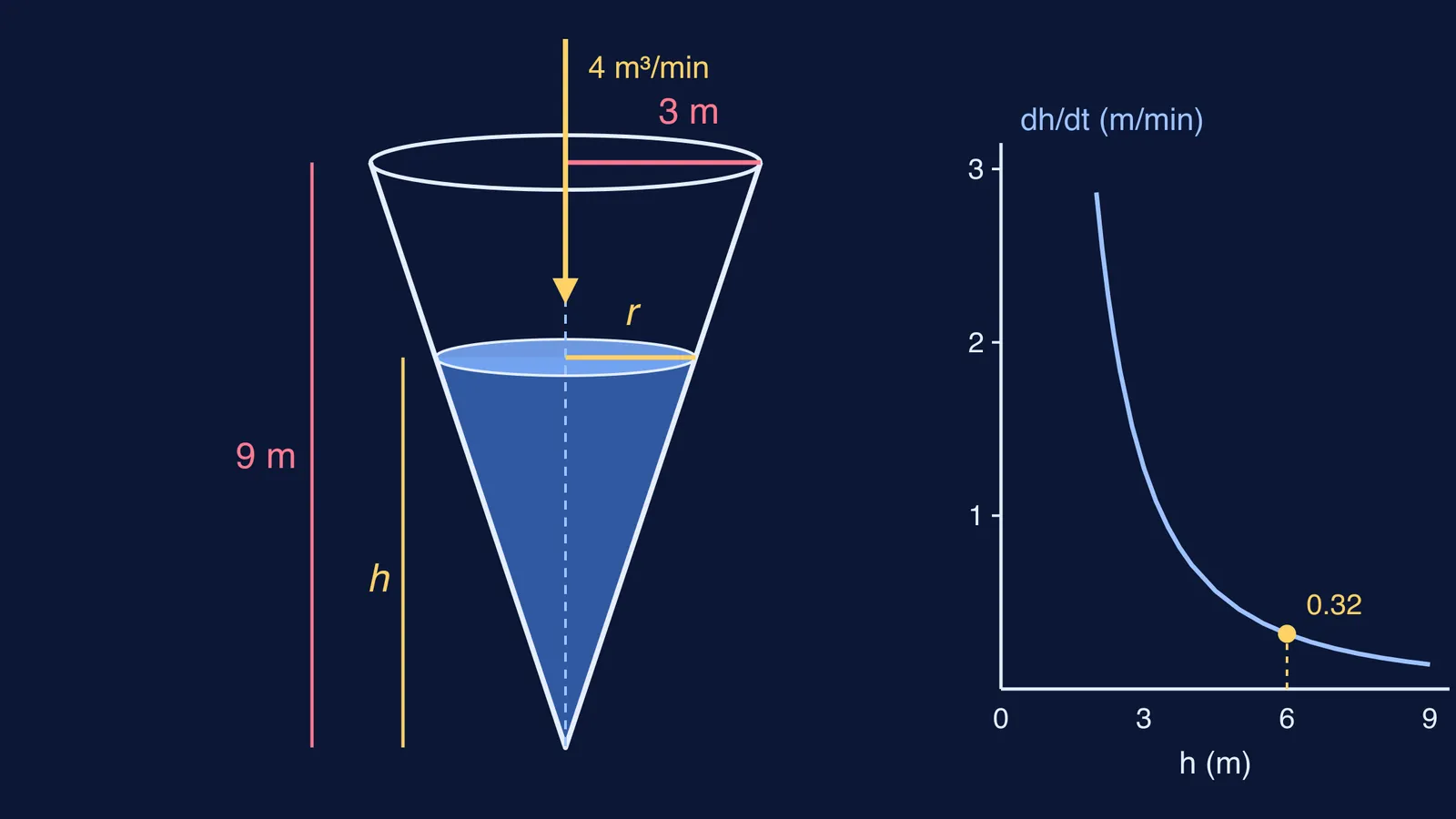
An inverted conical tank has a top radius of 3 m and a height of 9 m. Water is poured in at 4 m³/min. How fast is the level rising when the water is 6 m deep?
Symbols: V is the volume of water, r is the radius of the water surface, h is the depth. Given dV/dt = +4 m³/min. Find dh/dt when h = 6 m.
Similar triangles: r/h = 3/9, so r = h/3.
Remove r: V = (1/3)π(h/3)²h = πh³/27.
Differentiate with respect to time: dV/dt = (3πh²/27)·dh/dt = (πh²/9)·dh/dt.
Substitute: 4 = (π·36/9)·dh/dt = 4π·dh/dt, so dh/dt = 1/π ≈ 0.318 m/min.
So the level rises at about 32 cm per minute at that moment. Since r = h/3, the surface radius grows at dr/dt = 1/(3π) ≈ 0.106 m/min.
Why does the level rise more slowly as the tank fills?
Put a general depth into step 4 and you get dh/dt = 36/(πh²). At 3 m deep, that's 4/π ≈ 1.27 m/min. At 6 m it's 0.32 m/min, and at the brim (9 m) it's about 0.14 m/min. The rate depends on 1/h², so doubling the depth from 3 m to 6 m cuts the rate to a quarter. The same 4 m³ each minute spreads over an ever wider surface. The curve in the diagram above shows this.
Where does the sign slip happen?
Now say the tank is draining instead, losing 2 m³/min. Then dV/dt = −2, because the volume is going down. At h = 3 m: −2 = (π·9/9)·dh/dt, so dh/dt = −2/π ≈ −0.64 m/min. The minus sign tells you the level is falling. OpenStax gets a negative answer the same way for its draining funnel: −0.153 ft/s (section 4.1).
Common slips to watch for:
Writing dV/dt = +2 for a tank that is draining. You get +0.64 and say the level "rises".
A double negative: "the level falls at −0.64 m/min". Say either "dh/dt = −0.64 m/min" or "falls at 0.64 m/min".
With an inflow and a leak at the same time, forgetting to combine them first. Filling at 4 and leaking at 1 means dV/dt = +3.
Putting h = 6 in before you differentiate. The right side becomes a constant and its derivative is zero.
Treating r as fixed at 3 m. That gives V = 3πh and dh/dt = 4/(3π) ≈ 0.42 m/min, which is wrong because the surface radius at that depth is only 2 m.
How should you practise related rates?
Work the same steps on a sphere in our post on the rate of change of a balloon's radius as its volume grows. Then compare it with approximating values using differentials, which uses the same derivative in a different way. For another cone problem where similar triangles do the heavy lifting, try the maximum volume of a cone inscribed in a sphere.
If you keep getting the method wrong rather than the arithmetic, the Fermi Problem Library has worked problems with a step-by-step solver that explains the reasoning rather than printing an answer. If the chain-rule step itself feels shaky, the Fermi Concept Library gives each concept in mathematics its own lesson.
Tonight, take the 3 m by 9 m tank, change the inflow to 6 m³/min and the depth to 4.5 m, and check your answer with the surface-area shortcut.