

On this page
Calculus has one small trick that turns hard arithmetic into easy arithmetic: over a short distance, follow the tangent line instead of the curve. Below are three classic Class 12 problems worked the way you would write them in an exam, each with a check on how close the answer really is.
What does dy ≈ f′(x)dx actually mean?
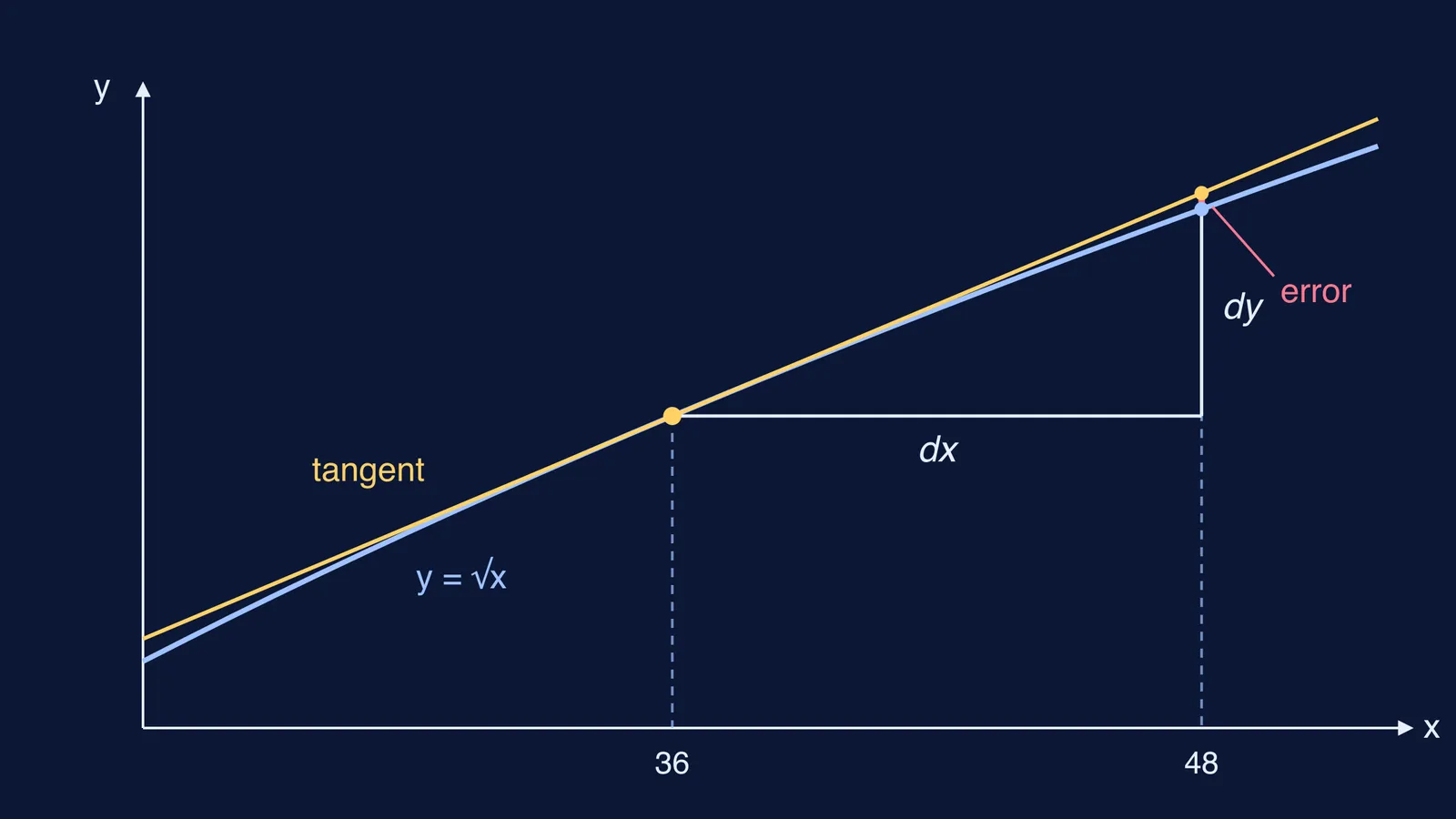
If y = f(x) and x changes by a small amount dx, the change in y is close to f′(x)·dx. In geometric terms, you step along the tangent at x instead of along the curve. The diagram above shows y = √x with its tangent at x = 36. Over a short step the two lines are almost the same, and the small gap between them is the error you accept.
So every approximation question has the same shape: f(a + dx) ≈ f(a) + f′(a)·dx, where a is a nearby number you can work with in your head. If you want to see why the tangent stays so close to the curve, our post on finding √4.1 with a tangent line zooms in on it.
How do you approximate √36.6 using differentials?
This was a worked example in the older edition of the NCERT Class 12 chapter on applications of derivatives, and its answer is 6.05 (worked solution on Teachoo). Here are the four lines:
Take f(x) = √x and the nearest perfect square, a = 36, so dx = 0.6.
Differentiate: f′(x) = 1/(2√x), so f′(36) = 1/12.
Multiply: dy ≈ (1/12)(0.6) = 0.05.
Add: √36.6 ≈ √36 + 0.05 = 6.05.
Now check it. 6.05² = 36.6025, which is 0.0025 more than 36.6, so the true root sits just below 6.05, at about 6.0498. The estimate is off by roughly 0.0002.
How do you find (0.009)^(1/3) with differentials?
This was part (iv) of Question 1 in the old Exercise 6.4, with the answer 0.2083 (solutions on GeeksforGeeks). The hard part is choosing a. The nearest number with a clean cube root is 0.008, because 0.2³ = 0.008.
Take f(x) = x^(1/3), a = 0.008 and dx = 0.001.
Differentiate: f′(x) = 1/(3x^(2/3)). Since 0.008^(2/3) = 0.04, f′(0.008) = 1/0.12 ≈ 8.33.
Multiply: dy ≈ 8.33 × 0.001 ≈ 0.0083.
Add: (0.009)^(1/3) ≈ 0.2 + 0.0083 = 0.2083.
To check, cube 0.208 to get 0.008999. That is just under 0.009, so the real cube root is slightly above 0.208 and slightly below our 0.2083.
How do you find the approximate error in a sphere's volume?
The older NCERT example reads: "If the radius of a sphere is measured as 9 cm with an error of 0.03 cm, then find the approximate error in calculating its volume" (worked solution on Teachoo).
V = (4/3)πr³, so dV/dr = 4πr².
Here r = 9 cm and dr = 0.03 cm.
dV ≈ 4π(81)(0.03) = 9.72π cm³, about 30.5 cm³.
Compare that with the volume itself, (4/3)π(729) = 972π cm³. The error is one-hundredth of it. The radius error was 0.03/9, or one three-hundredth, and cubing the radius triples that fraction. The same rule explains why percentage error doubles when a quantity is squared.
Two slips cost marks here: writing 9.72 cm³ without the π, and giving the error in cm instead of cm³. The units come from V, not from r.
Is approximation by differentials still in the CBSE syllabus?
Not as a topic of its own. CBSE's Mathematics curriculum for 2025-26 lists Applications of Derivatives as rate of change of quantities, increasing and decreasing functions, and maxima and minima. The current NCERT chapter (Reprint 2026-27) moves from rate of change to increasing and decreasing functions and then to maxima and minima, with no section on approximations.
The idea is still there, though. Example 35 in the same chapter heats a disc of radius 3 cm whose radius grows at 0.05 cm per second. When the radius is 3.2 cm, it finds the approximate growth in area as dA = 2πr·dr = 0.320π cm² per second. That is dy ≈ f′(x)dx in another form. Physics uses the same move for small angles and powers, as our guide to small-angle and binomial approximations shows.
If one step in your working keeps going wrong, the Fermi Problem Library has worked problems with a step-by-step solver that explains the reasoning rather than printing an answer. If the tangent-line idea itself feels shaky, the Fermi Concept Library gives each concept its own lesson.
For practice, try (26)^(1/3) from the same old exercise. Take a = 27 and see whether your answer lands just below 3.


