On this page
Blow air into a balloon at a steady rate and the radius does not grow at a steady rate. It shoots out at first, then creeps. Calculus tells you exactly how fast it creeps, and the same question appears in the NCERT Class 12 Maths textbook.
How are dV/dt and dr/dt connected?
Volume and radius are tied together by one formula, V = (4/3)πr³, and both change with time. So you differentiate that formula with respect to time t, not with respect to r. The OpenStax Calculus Volume 1 section on related rates does exactly this for a spherical balloon and gets V′(t) = 4π[r(t)]² r′(t).
Read it aloud: the rate at which the volume grows equals the balloon's surface area, 4πr², times the rate at which the radius grows. That makes physical sense. A thin new layer of thickness dr, spread over a surface of area 4πr², holds a volume of about 4πr² dr.
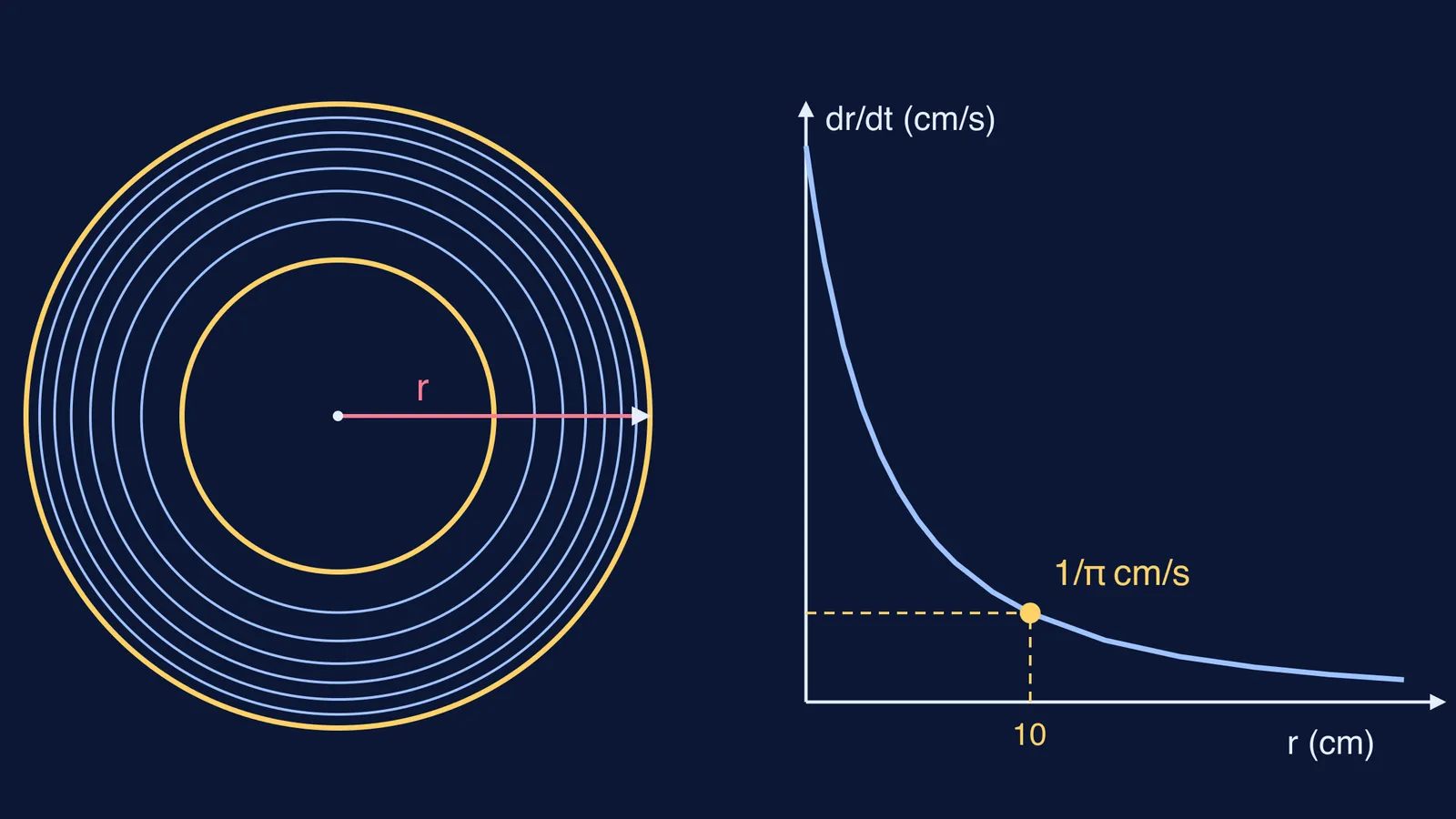
Rearranged, the formula you will actually use is dr/dt = (dV/dt) / (4πr²).
Because r itself changes with time, the step from V to dV/dt is the chain rule. If the chain rule still trips you up, our guide to common chain rule mistakes is worth reading first.
What is dr/dt when r = 10 cm?
Suppose a pump pushes in 400 cm³ of air every second and the balloon stays spherical. Follow the five steps OpenStax lays out in its related rates problem-solving strategy:
Name the variables: V(t) in cm³, r(t) in cm, t in seconds.
Write what you know and what you want: dV/dt = 400 cm³/s; you want dr/dt at the instant r = 10 cm.
Write the equation that links them: V = (4/3)πr³.
Differentiate both sides with respect to t: dV/dt = 4πr² · dr/dt.
Substitute only now: 400 = 4π(10)² · dr/dt = 400π · dr/dt, so dr/dt = 1/π cm/s, about 0.32 cm/s.
You can check the method against the NCERT textbook. Class 12 Maths, Exercise 6.1, Question 8 pumps in 900 cm³ of gas per second and asks for dr/dt at r = 15 cm; the answer is 1/π cm/s, as this worked solution to NCERT Exercise 6.1 Question 8 shows. It matches our answer because 4π(15)² = 900π, just as 4π(10)² = 400π.
The very next question is a trap. Exercise 6.1, Question 9 asks how fast the volume changes with the radius at r = 10 cm, which is dV/dr = 4πr² = 400π cm³/cm, according to this solution to NCERT Exercise 6.1 Question 9. No time is involved there, so no dt appears. Read "with respect to what" before you start.
How fast is the surface area growing?
The surface area of a sphere is S = 4πr². Differentiate with respect to time, using the same chain-rule step as OpenStax's balloon example: dS/dt = 8πr · dr/dt.
At r = 10 cm with dr/dt = 1/π cm/s, dS/dt = 8π(10)(1/π) = 80 cm²/s.
There is a shortcut that skips dr/dt entirely. Put dr/dt = (dV/dt)/(4πr²) into dS/dt = 8πr · dr/dt and you get dS/dt = 2(dV/dt)/r. With dV/dt = 400 and r = 10, that is again 80 cm²/s.
Why does the radius slow down as the balloon grows?
In the OpenStax result, r² sits in the denominator of dr/dt, so doubling the radius cuts the rate to a quarter. The surface-area rate falls too, but only as 1/r. With air going in at a steady 400 cm³/s:
At r = 5 cm: dr/dt = 4/π ≈ 1.27 cm/s, and dS/dt = 160 cm²/s.
At r = 10 cm: dr/dt = 1/π ≈ 0.32 cm/s, and dS/dt = 80 cm²/s.
At r = 20 cm: dr/dt = 1/(4π) ≈ 0.08 cm/s, and dS/dt = 40 cm²/s.
A similar slowdown shows up when water fills a cone, where the level rises fastest at the narrow tip. See our walk-through of how fast the water rises in a filling cone.
What should you check in any balloon question?
Is the rate with respect to time (d/dt) or with respect to the radius (d/dr)?
Did you differentiate before substituting the radius?
Do the units work? cm³/s divided by cm² gives cm/s.
Is the sign right? A leaking balloon has a negative dV/dt, so dr/dt is negative too.
Does dS/dt = 2(dV/dt)/r agree with your surface-area answer?
For more worked examples, including a ladder, a cone and a shadow, see our four-step method for related rates problems. If you get stuck partway through a problem, the Fermi Problem Library has worked problems with a step-by-step solver that explains the reasoning rather than printing an answer. If the chain rule itself still feels shaky, the Fermi Concept Library gives each mathematics concept its own lesson and shows its place in the map.
Next time you blow up a balloon, watch the radius slow down. That is 1/r² at work.