

On this page
You differentiate sin(x²), write cos(x²), and lose the mark. The cosine is right. What's missing is the 2x that comes from the inside. NCERT's Class 12 textbook works this exact function as Example 21 in Chapter 5, Continuity and Differentiability, and the right answer is 2x cos(x²). Below are the slips that cost marks, a method for three layers, and two checks that catch a missing one.
What does the chain rule say for two and three functions?
In NCERT Class 12 Maths, Chapter 5, Theorem 4 (the chain rule) says that if f = v o u and t = u(x), then df/dx = (dv/dt)(dt/dx). The same chapter extends it to three functions: if f = (w o u) o v, with t = v(x) and s = u(t), then df/dx = (dw/ds)(ds/dt)(dt/dx).
OpenStax Calculus Volume 1 writes the three-function version in prime notation: k′(x) = h′(f(g(x))) · f′(g(x)) · g′(x), so the derivative has one factor for each layer.
That gives you a rule you can count: one layer, one factor.
What are the most common chain rule mistakes?
Forgetting the inner derivative. d/dx sin(x²) is not cos(x²). It is 2x cos(x²).
Differentiating the inside in place. Writing cos(2x) for d/dx sin(x²) changes the input; the outer derivative keeps x² untouched.
Stopping one layer early. OpenStax's worked example cos⁴(7x² + 1) has three layers, and its answer is −56x sin(7x² + 1) cos³(7x² + 1). If you stop after the cosine layer, you lose the 14x.
Misreading the layers. sin²x means (sin x)², so the outer layer is squaring and the derivative is 2 sin x cos x. sin(x²) has sine on the outside.
Forgetting the chain rule inside the product rule. For x²e^(3x), the second term needs its own inner 3: 2x e^(3x) + 3x² e^(3x).
In a 2010 study in the Australian Senior Mathematics Journal, Tangül Uygur Kabael tested 27 trainee mathematics teachers in Turkey, aged 18 to 21. Most could take derivatives of special composite functions, but some made errors through carelessness or confusion about memorised rules, and some had difficulties that intensified with second-order derivatives. The same paper summarises earlier work by Clark and colleagues (1997)90012-2): at an early stage, a student has a collection of rules for special composite functions but cannot see how they are related. The fix: see e^(3x), sin(5x) and (2x + 1)⁷ as one rule, not three facts.
How do you differentiate three nested functions step by step?
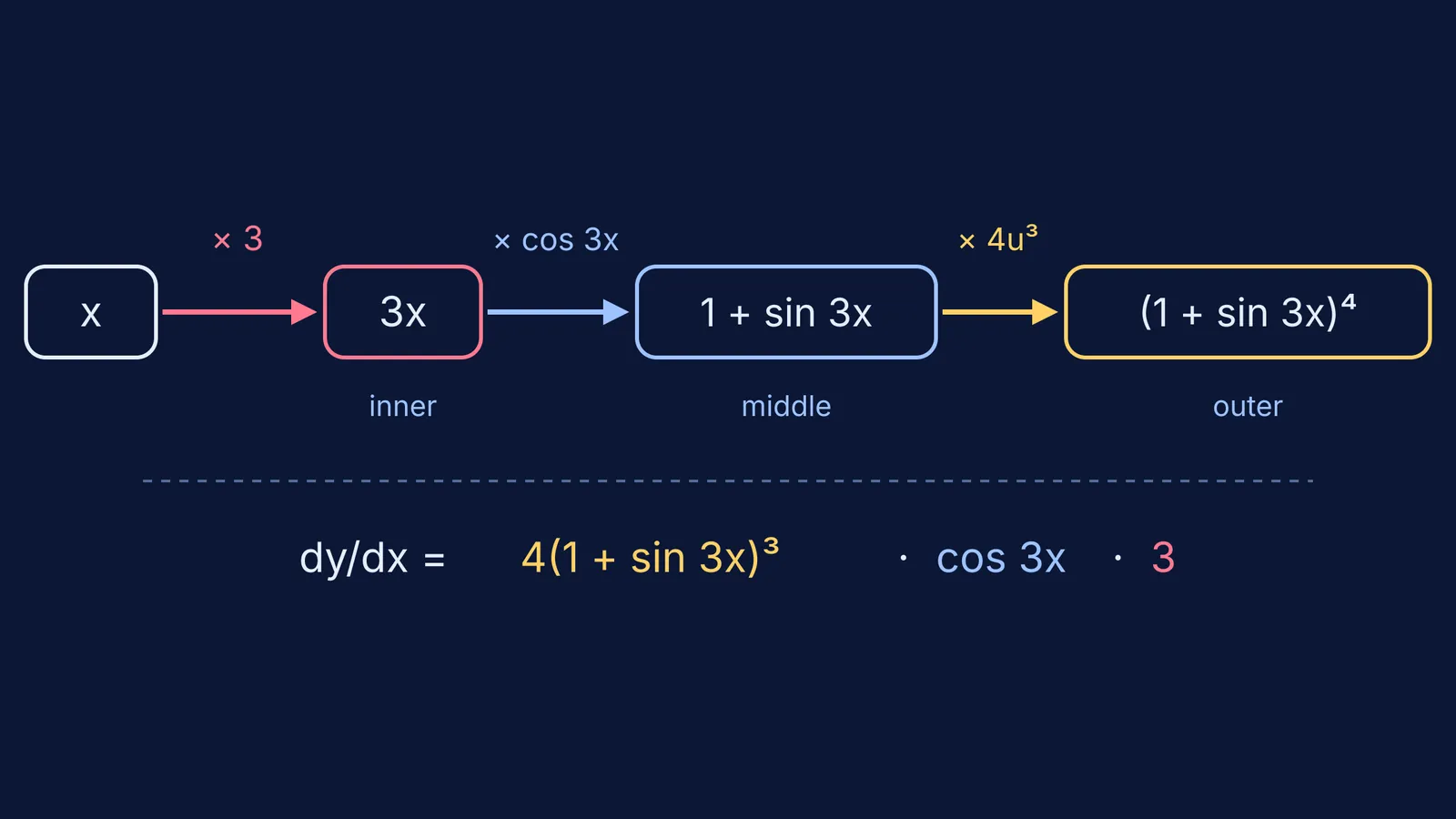
Take y = (1 + sin 3x)⁴.
Name the layers from the outside in. The outer layer is ( )⁴, the middle layer is 1 + sin( ), and the inner layer is 3x.
Differentiate each layer and leave its input alone. The outer layer gives 4(1 + sin 3x)³, the middle gives cos 3x, and the inner gives 3.
Multiply: dy/dx = 4(1 + sin 3x)³ · cos 3x · 3 = 12 cos 3x (1 + sin 3x)³.
Count: three layers, three factors.
If the layers keep tangling, the Fermi Problem Library has worked problems with a step-by-step solver that explains the reasoning rather than printing an answer.
How can you check a chain rule answer with a substitution?
Check 1: expand a simple case. NCERT does this itself in section 5.3.1. Expanding (2x + 1)³ gives 8x³ + 12x² + 6x + 1, whose derivative is 24x² + 24x + 6 = 6(2x + 1)². The chain rule gives 3(2x + 1)² · 2, which is the same thing. If you forget the inner 2, you get 3(2x + 1)², and the two methods disagree.
Check 2: estimate the slope at one point. For y = (1 + sin 3x)⁴, set your calculator to radians and take x = 0 and h = 0.01. Then y(0.01) ≈ 1.1255 and y(−0.01) ≈ 0.8853, so the slope is about (1.1255 − 0.8853) ÷ 0.02 ≈ 12.01. The formula gives 12 cos 0 (1 + sin 0)³ = 12, so it passes. If you had dropped the inner 3, your formula would say 4, which is off by a factor of three.
One caution: at x = 0, cos 3x equals 1, so this point cannot catch a missing cos 3x. Add a point where no layer equals 0 or 1. At x = 0.2, the correct formula gives about 37.94 and the version without cos 3x gives about 45.96, so the difference quotient will tell them apart.
A one-minute checklist for every chain rule question
Write the layers, outside to inside, first.
One factor per layer; keep each outer derivative's original input.
Check whether sin²x or sin(x²) is on the page.
In a product, apply the chain rule inside each term.
Check your answer at one ordinary point, or expand a small case.
The same habit carries into implicit and logarithmic differentiation, differentiating parametric functions and the calculus you need for JEE physics. If composite functions still feel shaky, the Fermi Concept Library gives every concept in mathematics its own lesson and its place in the map.
Tonight, take three textbook questions, count their layers, and check one answer at a point.


