

On this page
You are standing at a water cooler filling a conical paper cup. You notice it fills up quickly at the bottom, and then seems to take much longer as it reaches the brim. This everyday observation is a classic related rates problem in calculus.
Does water in a cone rise faster at the start or end?
Before we write down any equations, make a prediction. If water enters the cone at a constant volume per second, does the height of the water rise faster when the cone is nearly empty, or when it is almost full? A 2011 study in *Science* found that active engagement, such as predicting outcomes before seeing a solution, raises student scores on conceptual tests from 41% to 74% (Deslauriers et al., 2011).
Because the cone is narrow at the bottom, a small amount of water creates a large change in height. As the water level rises, the cone widens. The same volume of water now has to spread out over a larger horizontal area, so it adds less to the total height. Therefore, the water level rises fastest at the start and slows down as the pour continues.
How do you find the rate of height rise with calculus?
To prove this mathematically, we use related rates. We want to find the rate of change of the water's height (dh/dt) given a constant rate of change of its volume (dV/dt).
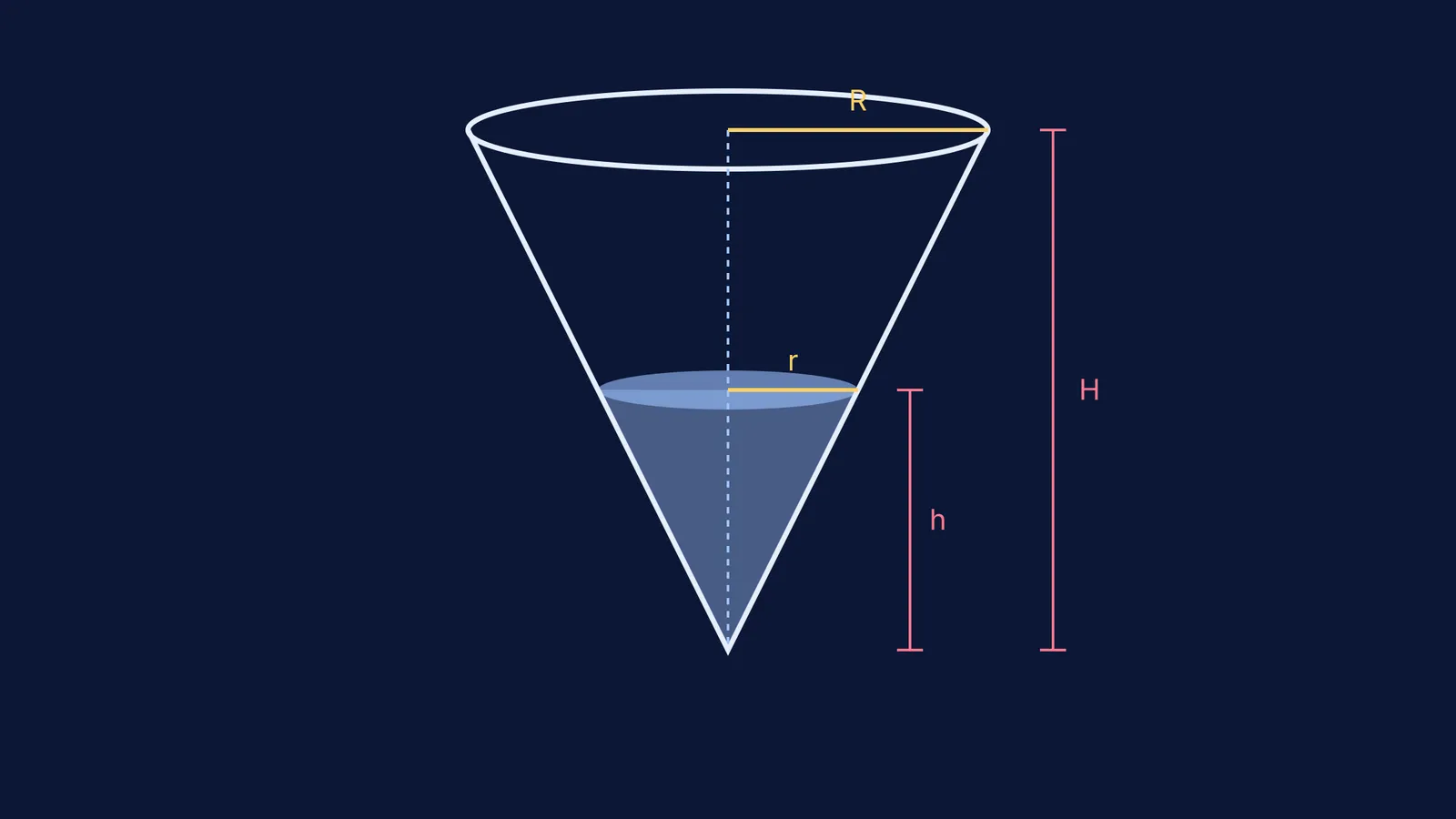
Let the cone have a total height H and a maximum radius R at the top. At any moment, the water inside forms a smaller cone with height h and radius r. The formula for the volume of this water is V = (1/3)πr²h.
We have a problem: our equation has two variables, r and h. To find dh/dt, we need to express V entirely in terms of h.
Why is the similar triangles trick necessary?
If you look at the cross-section of the cone, the water forms a small triangle nested inside the large triangle of the tank. Similar triangles have the same shape but different sizes, meaning the ratio of their corresponding sides is always identical. In this case, the large right-angled triangle representing the entire cone and the small right-angled triangle representing the water both share the same angle at the vertex. Because they are similar triangles, the ratio of the radius to the height is constant: r / h = R / H.
We can rearrange this to solve for r: r = (R / H) × h.
Now, substitute this expression for r back into the volume formula to eliminate the radius entirely:
V = (1/3)π((R / H) × h)² × h
V = (1/3)π(R² / H²) × h³
Now we have an equation that relates the volume directly to the height of the water.
How do you solve the related rates equation?
Next, we differentiate both sides of the equation with respect to time (t). Remember to use the chain rule because both V and h are changing over time.
dV/dt = (1/3)π(R² / H²) × 3h² × (dh/dt)
dV/dt = π(R² / H²) × h² × (dh/dt)
We know that dV/dt is the rate at which water is poured in, which is a constant. Let's call it C.
C = π(R² / H²) × h² × (dh/dt)
Solving for the rate of height rise, dh/dt:
dh/dt = C / (π(R² / H²) × h²)
This final equation confirms our initial prediction. The term h² is in the denominator. When the water height h is small, dividing by a small number makes dh/dt very large, meaning the water is rising quickly. As h grows, h² becomes much larger, making dh/dt smaller. The rate of height rise is inversely proportional to the square of the height.
This inverse square relationship explains your everyday observation at the water cooler. When the cup is nearly empty, the radius is tiny, so a small volume of water causes a dramatic jump in height. By the time the water reaches the wider brim, the same volume adds only a fraction of that height.
How can you practice related rates for exams?
Physics and calculus exams frequently test this exact scenario because it combines geometry, differentiation, and physical intuition into a single problem. Related rates problems often trip students up because they require translating a physical situation into geometry before doing the calculus. If you skip the geometry step—like relating r and h with similar triangles—you will end up stuck with an equation containing too many variables to solve.
If you need to review your calculus fundamentals first, see our guides on differentiating parametric functions or differentiating one expression with respect to another.
For guided practice, Fermi's AI tutor can help you work through related rates step by step. Instead of just printing an answer, the tutor builds a plan for the session and helps you set up the geometry yourself. If you struggle to picture how the variables change over time, the Fermi Simulation Lab offers interactive simulations for the ideas that are easier to see than to read.


