On this page
This is one of the classic Class 12 optimisation problems. In Chapter 6, Application of Derivatives, Exercise 6.3, Question 23 of the NCERT Class 12 Mathematics textbook asks you to "prove that the volume of the largest cone that can be inscribed in a sphere of radius R is 8/27 of the volume of the sphere."
What does a cone inscribed in a sphere look like?
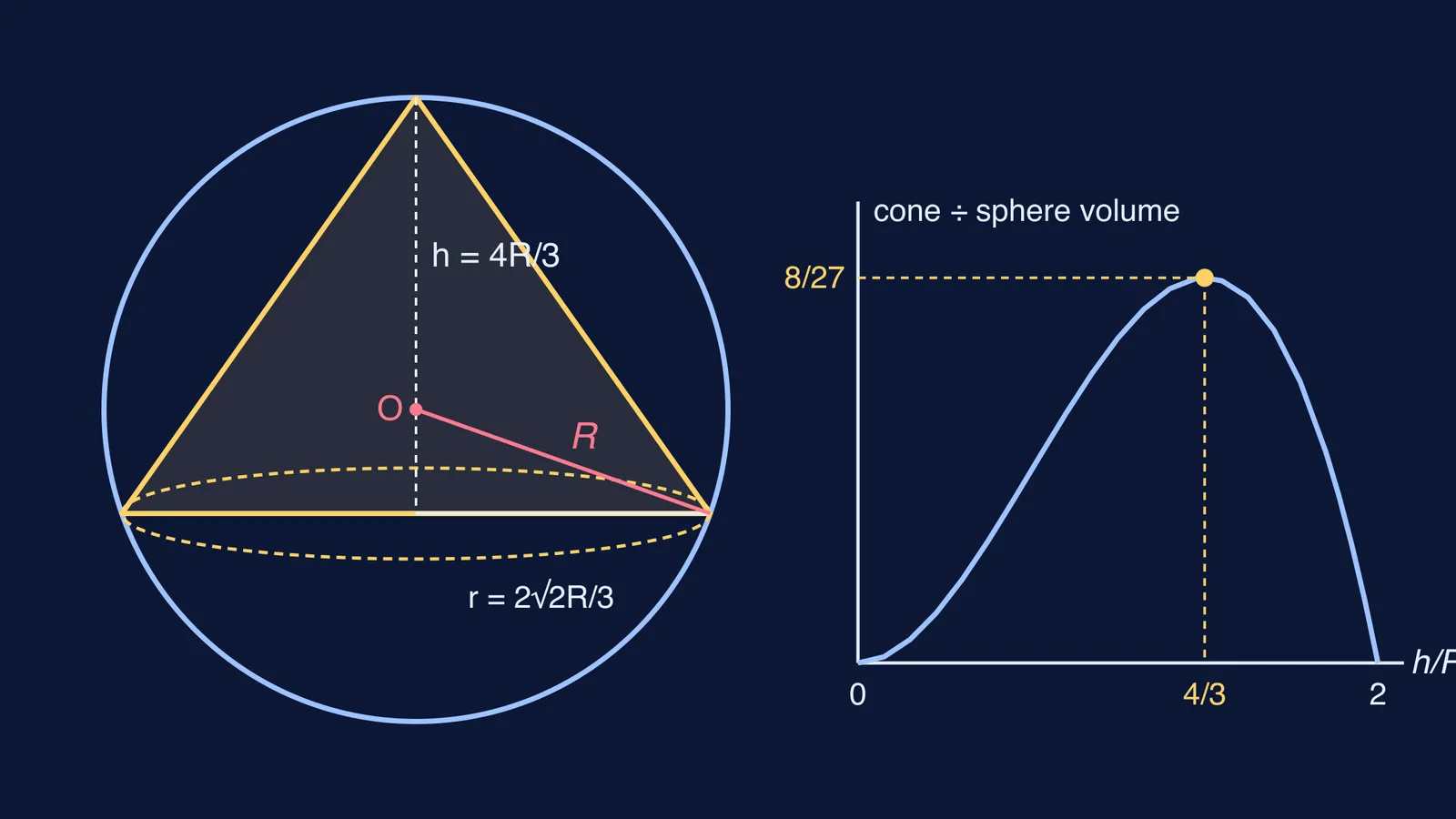
Inscribed means the cone's apex and the whole rim of its base touch the sphere. Slice through the cone's axis and you see a triangle inside a circle: the apex at the top of the circle, the base a chord lower down.
Every such cone is fixed by one number, its height h, which can run from 0 to 2R. A flat cone near the top has almost no volume. A needle-thin cone reaching the bottom has almost none either. Somewhere in between is the largest one, and calculus finds it.
How do you write the cone's volume in terms of its height?
Let the cone have height h and base radius r. The sphere's centre O sits on the axis, a distance h − R above the centre of the base. Join O to any point on the base rim: that segment is a radius of the sphere, length R. Pythagoras in that right triangle gives r² = R² − (h − R)², which simplifies to r² = 2Rh − h².
The volume of a cone is V = (1/3)πr²h, the formula the same NCERT chapter uses in Example 31, a conical water tank. Substitute r²:
V(h) = (π/3)(2Rh² − h³), for 0 < h < 2R.
That substitution is the whole trick. Two unknowns, r and h, have become one, and a function of one variable can be differentiated.
Where is the maximum, and how do you prove it?
Differentiate: dV/dh = (π/3)(4Rh − 3h²) = (π/3)h(4R − 3h).
Set it to zero: h = 0, which is no cone at all, or h = 4R/3.
Second derivative: d²V/dh² = (π/3)(4R − 6h). At h = 4R/3 it equals (π/3)(4R − 8R) = −4πR/3, which is negative, so h = 4R/3 is a maximum.
It is the largest cone overall, not just a local peak: V is zero at both ends of the interval, positive in between, and has only this one turning point.
Base radius: r² = 2R(4R/3) − 16R²/9 = 8R²/9, so r = 2√2R/3.
Volume: V = (1/3)π(8R²/9)(4R/3) = 32πR³/81.
Compare with the sphere: (4/3)πR³ = 108πR³/81, so the ratio is 32/108 = 8/27.
So the largest inscribed cone fills 8/27 of the sphere, just under 30% of it, which is the result the NCERT exercise asks you to prove.
A worked example: a sphere of radius 9 cm
Take R = 9 cm. The formula says h = 4(9)/3 = 12 cm. Then r² = 2(9)(12) − 12² = 216 − 144 = 72, so r = 6√2 ≈ 8.49 cm, and V = (1/3)π(72)(12) = 288π ≈ 904.8 cm³. The sphere's volume is (4/3)π(9³) = 972π ≈ 3053.6 cm³, and 288/972 reduces to 8/27.
Now nudge the height either way to see the peak:
h = 11 cm: r² = 198 − 121 = 77, so V = 847π/3 ≈ 282.3π cm³.
h = 12 cm: V = 288π cm³, the largest.
h = 13 cm: r² = 234 − 169 = 65, so V = 845π/3 ≈ 281.7π cm³.
Both neighbours come out smaller, as they should, and a check like this catches most algebra slips.
Can you check 4R/3 without calculus?
Yes. Write V = (π/3)h²(2R − h) = (4π/3)(h/2)(h/2)(2R − h). The three factors h/2, h/2 and 2R − h always add up to 2R. By the AM-GM inequality, positive numbers with a fixed sum have the largest product when they are equal, so h/2 = 2R − h, which gives h = 4R/3 again. It is the same fixed-sum idea as the x²y twist in two numbers with a fixed sum and the maximum product.
In a board exam that asks you to use derivatives, write the calculus proof and keep AM-GM as a quick check on your rough sheet.
What mistakes cost marks on this problem?
Differentiating V = (1/3)πr²h with r treated as a constant. Eliminate r first.
Using the slant height, or putting the sphere's centre on the cone's base. Draw the cross-section and mark R from O to the rim.
Stopping at dV/dh = 0. The question says "prove", so show the second derivative is negative.
Writing r = 2R/3 instead of 2√2R/3, or giving 8/27 without comparing to (4/3)πR³.
The same method, writing one quantity in terms of another and then differentiating, solves the largest cylinder that fits inside a cone and the largest rectangle under a parabola.
If you get stuck at the Pythagoras step, the Fermi Problem Library has worked problems with a step-by-step solver that explains the reasoning rather than printing an answer. To revise maxima and minima from the start, the Fermi Concept Library gives every concept in mathematics its own lesson.