On this page
You might expect i raised to the power i to be imaginary. It isn't. Every value of iⁱ lies on the real number line, and the main one is about 0.208. Once you write i in Euler form, the reason fits in one line, and the same line explains why there are infinitely many other values.
Why is i to the power i a real number?
Start with Euler form. In polar form, i has modulus 1 and argument π/2, so i = e^(iπ/2) (Wikipedia: Imaginary unit). If that step feels shaky, our guide to writing a complex number in polar and Euler form builds it up from the Argand plane.
Now raise both sides to the power i. The exponent i multiplies the i that is already in the exponent: i × i × π/2 = −π/2. The two factors of i meet as i² = −1, so the imaginary unit drops out of the exponent completely. What is left, e^(−π/2), is e raised to a real number, and that is always a positive real number.
The principal value of iⁱ is e^(−π/2) = 0.207879… (Wolfram MathWorld).
How do you calculate i^i step by step?
Here is the working, set out so every step can be checked. A complex power is defined as z^w = e^(w log z) (Wikipedia: Exponentiation), so every step goes through a logarithm.
Write i in Euler form: modulus 1, argument π/2, so i = e^(iπ/2).
Take the logarithm: log i = ln 1 + i(π/2) = iπ/2, because ln 1 = 0.
Multiply by the exponent: i × log i = i × iπ/2 = −π/2.
Exponentiate: iⁱ = e^(−π/2).
Evaluate: π/2 ≈ 1.5708, and e^(−1.5708) ≈ 0.2079.
Why does i^i have more than one value?
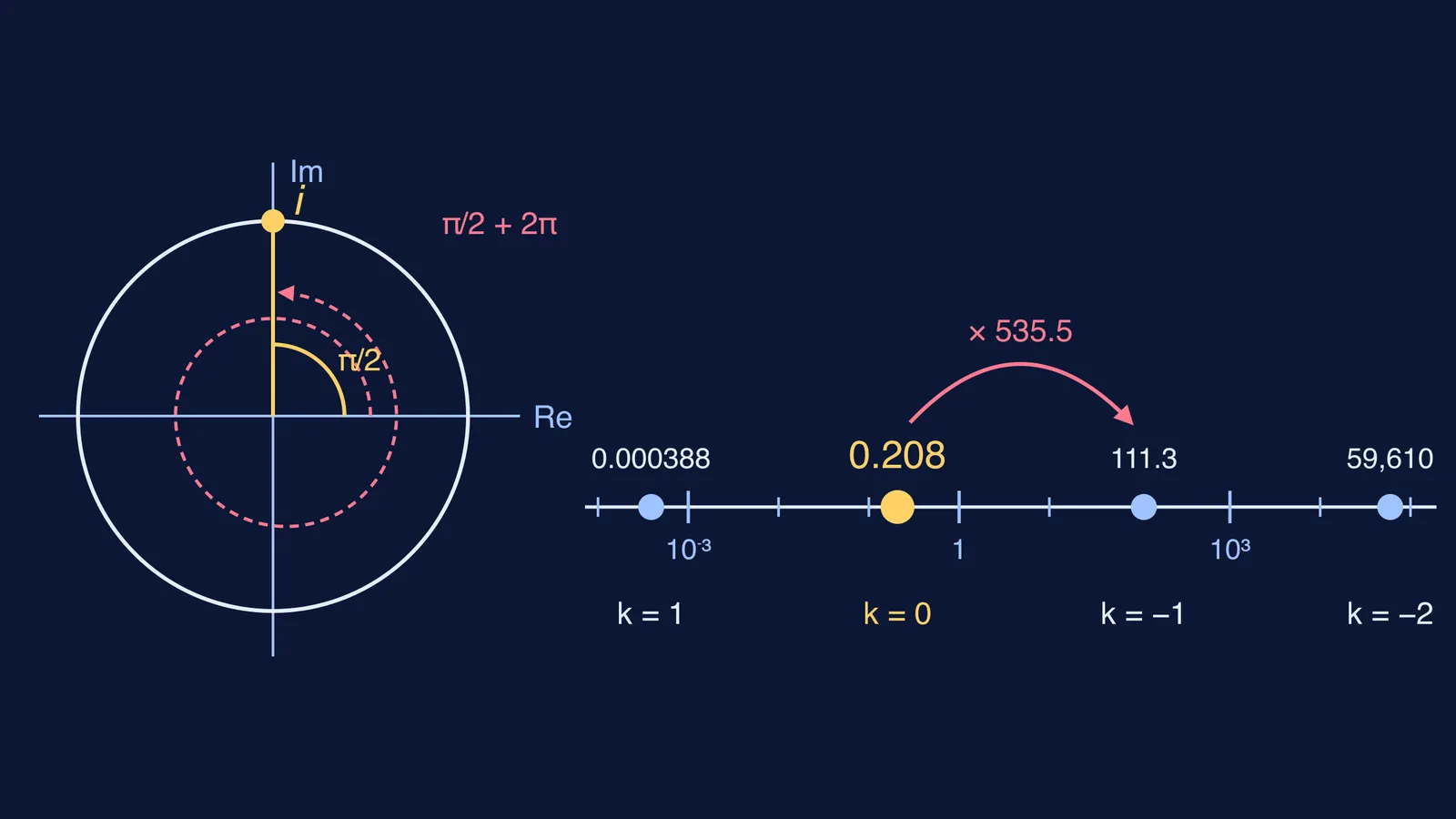
Step 1 hid a choice. The angle of i is not only π/2. Turn a full circle and you land on i again, so π/2 + 2π, π/2 − 2π and in general π/2 + 2kπ, for any integer k, all describe the same point. The argument of a complex number is defined only up to an integer multiple of 2π, so log i = i(π/2 + 2kπ) and iⁱ = e^(−π/2)e^(−2kπ) (Wikipedia: Exponentiation). The same page states it plainly: all values of iⁱ are real, and the principal one is e^(−π/2) ≈ 0.2079.
Putting a few integers into e^(−π/2 − 2kπ) gives:
k = 0: e^(−π/2) ≈ 0.2079 (the principal value)
k = −1: e^(3π/2) ≈ 111.3
k = 1: e^(−5π/2) ≈ 0.000388
k = −2: e^(7π/2) ≈ 59,610
Lowering k by 1 multiplies the value by e^(2π) ≈ 535.5, because one extra turn round the circle adds 2π to the angle. A complex power a^b has a single value only when b is an integer (Wikipedia: Complex logarithm), so an exponent like i is bound to give many values. It is the same “angles are only fixed up to 2π” bookkeeping you meet when you find the argument of a product or quotient of complex numbers.
Which value of i^i should you write as the answer?
Write the principal value unless the question asks for all values. The principal logarithm is Log z = ln|z| + i Arg z, with Arg z taken in the interval (−π, π] (Wikipedia: Complex logarithm). For i, Arg i = π/2 lies in that interval, so k = 0 and the answer is e^(−π/2) ≈ 0.208.
If a question says “find all values”, give the general form e^(−π/2 − 2kπ), where k is any integer, and say that each one is real.
How can you check that you have really understood it?
Try the same method on two more cases before you look anything up:
(−1)ⁱ: the argument of −1 is π, so Log(−1) = iπ and the principal value is e^(i·iπ) = e^(−π) ≈ 0.0432. Also real.
iⁱ again, starting from the angle −3π/2 instead of π/2: you should land on e^(3π/2) ≈ 111.3, the k = −1 value above.
If the logarithm of a complex number is the step where you get stuck, the Fermi Concept Library gives each concept in mathematics its own lesson, so you can revisit Euler form or the complex logarithm on its own. For practice, the Fermi Problem Library has worked problems with a step-by-step solver that explains the reasoning rather than printing an answer.
Next, see how Euler form makes large powers quick in De Moivre's theorem for powers like (1 + i)^n.