On this page
Most students remember three of the four causes of biodiversity loss easily, because each has a villain you can picture. The fourth, co-extinction, has no villain, which is why it slips out of long answers. Here is the NCERT definition, its two examples, and a four-question test for sorting any extinction into the right cause.
What is co-extinction in biology?
NCERT Class 12 Biology calls the four causes of biodiversity loss the "Evil Quartet" and lists co-extinction fourth. Its definition: when a species becomes extinct, the plant and animal species associated with it in an obligatory way also become extinct (NCERT Class 12 Biology, Chapter 13).
The key word is obligatory. The second species cannot live without the first. A bird that eats many kinds of fruit survives when one fruit tree disappears; a wasp that can breed inside only one kind of fig does not.
A 2004 paper in *Science* by Lian Pin Koh and colleagues defined coextinction as "the loss of a species upon the loss of another" and modelled it in coevolved systems such as fig wasps and figs, and parasites and their hosts (Koh et al., Science, 2004). They estimated that 6,300 affiliate (dependent) species are "coendangered" with host species currently listed as endangered.
What are the NCERT examples of co-extinction?
NCERT gives two (NCERT, Chapter 13):
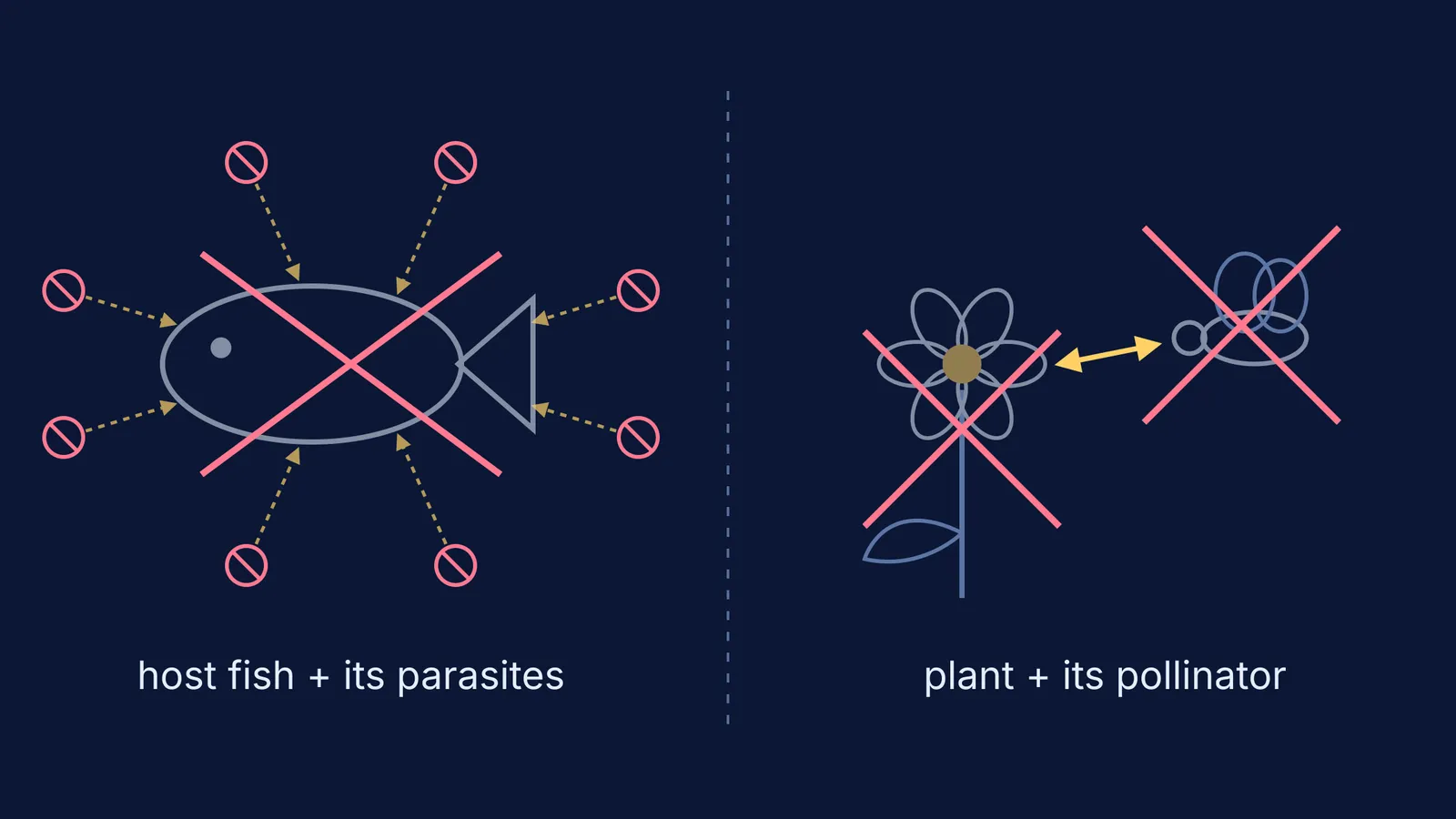
Host fish and its parasites. When a host fish species becomes extinct, its unique assemblage of parasites meets the same fate.
Plant and pollinator. In a coevolved plant-pollinator mutualism, the extinction of one invariably leads to the extinction of the other. The plant needs that pollinator to set seed; the pollinator needs that plant for food or a place to breed.
In the fish example the dependence runs one way: the parasites need the fish, but the fish does not need them. In the mutualism it runs both ways, so losing either partner loses both. For a real pair to picture, read how fig and fig wasp mutualism works.
How is co-extinction different from the other three causes?
Here are the other three causes with NCERT's own examples (NCERT, Chapter 13):
Habitat loss and fragmentation, the most important cause. Tropical rain forests once covered more than 14 per cent of the earth's land surface and now cover no more than 6 per cent.
Over-exploitation, when "need" turns to "greed". Steller's sea cow and the passenger pigeon were lost this way.
Alien species invasions. The Nile perch, introduced into Lake Victoria, led to the extinction of more than 200 species of cichlid fish.
For all four side by side, see our explainer on the evil quartet of biodiversity loss, and for Indian cases of the third cause, invasive alien species in India.
To tell them apart, ask what directly killed the species, using these four questions in order:
Was its home destroyed, polluted or broken into pieces? Habitat loss and fragmentation.
Did people hunt, catch or harvest it faster than it could breed? Over-exploitation.
Did an introduced species eat it, outcompete it or crowd it out? Alien species invasion.
Did it die out only because a species it depended on, in an obligatory way, died out first? Co-extinction.
Worked example: one lake, two causes
Try this made-up case. A lake has a fish species found nowhere else, and a tapeworm that lives only in that fish. Fishermen overfish the lake until the fish is gone. A few years later the tapeworm is gone too. What caused each extinction?
The fish: over-exploitation. People took it faster than it could breed.
The tapeworm: co-extinction. It died because its only host died.
Co-extinction is usually a second step: another cause removes the host, and co-extinction removes whatever was tied to it. When a question describes a chain, name the cause for each species separately.
How do you write co-extinction in an exam answer?
NCERT's own exercise asks: "What are the major causes of species losses in a geographical region?" (NCERT, Chapter 13). Write all four causes with one example each. For co-extinction, give the definition with the word "obligatory", then the host fish example, the shortest.
If you can recall the examples but can't say why a parasite needs its host, the gap is the concept underneath. The Fermi Concept Library has a lesson for every concept in biology, each with its place in the map, so you can see how co-extinction connects to mutualism and parasitism. To practise sorting cases like the lake, the Fermi Problem Library has worked problems with a step-by-step solver that explains the reasoning rather than printing an answer.
Next step: write the four-question test from memory, then use it on the passenger pigeon, Steller's sea cow and the Lake Victoria cichlids.