On this page
Childhood is a short poem by Markus Natten, printed on page 41 of the NCERT Hornbill textbook (Reprint 2026-27). The book's acknowledgements page thanks Oxford University Press for permission to use it. It is listed under Hornbill in the CBSE English Core curriculum for 2026-27. It asks one question: when did I stop being a child?
What is the Childhood poem about?
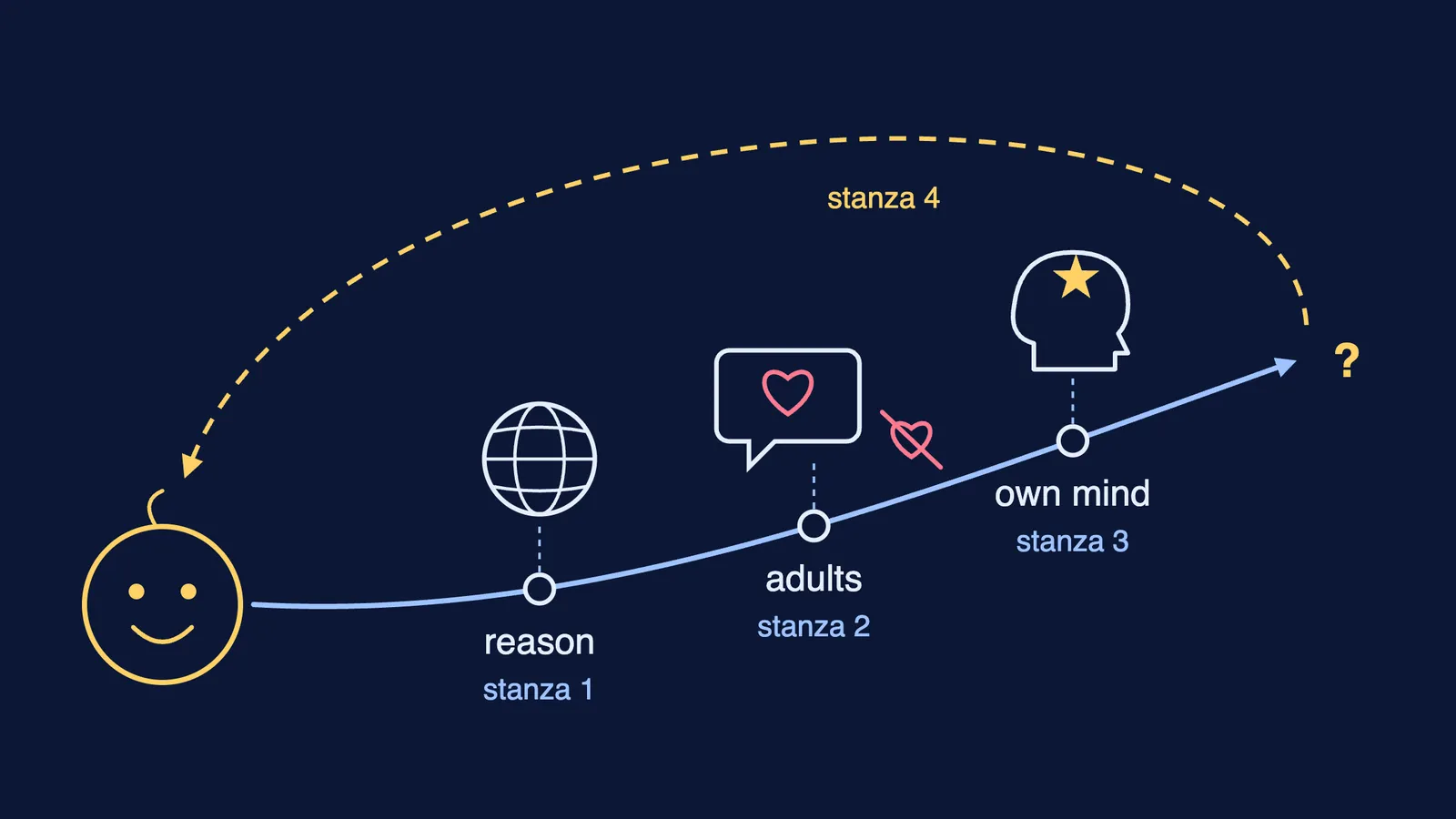
The poem has four stanzas, as printed in the NCERT text: three longer ones and a short closing stanza of four lines. Each of the first three stanzas opens by asking when childhood went and closes by wondering aloud whether that was the day. Each guess is a different kind of growing up.
What does each stanza of Childhood mean?
Stanza 1: when reason arrives. The speaker first wonders whether childhood ended when he "ceased to be eleven", that is, simply had a birthday. Then he offers a deeper answer: the moment he worked out that "Hell and Heaven" could not be found in geography, and decided they therefore could not exist. A small child believes what he is told. This child starts testing claims against evidence.
Stanza 2: when adults stop being heroes. Next he guesses it was when he noticed that adults were not what they seemed. They talked about love and "preached of love", yet did not behave lovingly. Spotting the gap between what grown-ups say and what they do is a painful step, because children tend to trust adults.
Stanza 3: when the mind becomes his own. The third guess is the most hopeful. He found that his "mind was really mine", free to use as he chose, producing thoughts that belonged to no one else. This is independence: no longer repeating parents and teachers, but forming his own views.
Stanza 4: where childhood went. The question shifts from when to where. Childhood, he says, has gone to "some forgotten place" hidden in the face of a baby. He ends by admitting this is all he knows, so the poem closes in honest uncertainty, not a neat moral.
When does childhood end, according to the poet?
He never names a single day, and that is the point. Childhood slips away in stages, through reasoning, disappointment and independence, and nobody notices the exact moment while it happens. The tone is reflective and nostalgic: he values his independence but seems to miss easy belief and trust.
If you studied it in Class 10, The Ball Poem makes a similar point through a boy's first real loss. Within Hornbill itself, The Portrait of a Lady shows growing up from the other side, as a grandson's world moves away from his grandmother's.
Which poetic devices are used in Childhood?
Refrain and rhetorical question: the opening question returns at the start of three stanzas.
Repetition with a twist: the last stanza swaps when for where, moving from time to place.
Rhyme: loose and irregular, for example eleven with Heaven, and place with face.
Alliteration: the repeated h sound in the two places of stanza 1.
Contrast and irony: adults speak of love but do not act lovingly.
Free verse feel: lines of uneven length and no fixed metre.
Before you write a device in an answer, find it in the actual lines. Our guide on checking figures of speech in NCERT poems shows how.
How do you answer Childhood questions in the exam?
The CBSE 2026-27 English Core curriculum sets one Hornbill poetry extract out of two for 3 marks. It also sets two short answers from Hornbill, one prose and one poetry, chosen from four, in 40-50 words for 3 marks each. One long answer from Hornbill prose or poetry carries 6 marks in 120-150 words.
For an extract: first say which stanza it is and which stage of growing up it shows, then look for the device in those lines.
A practice short answer (our own question): Why does the poem end with a baby's face?
Model answer (46 words): After three uncertain guesses about when his childhood ended, the speaker accepts he cannot pin it down or get it back. Childhood survives only in the innocent face of an infant. The image is gentle and nostalgic: what he lost still exists, just not in him.
A plan for a 6-mark answer on "Growing up brings both loss and gain":
Opening, about 25 words: the poem asks when childhood ends and suggests it happens in stages.
Loss, about 45 words: stanza 1 (belief gives way to reason) and stanza 2 (trust in adults breaks).
Gain, about 40 words: stanza 3, independent thought.
Close, about 30 words: stanza 4, childhood lives on only in an infant's face, so the poet feels both pride and nostalgia.
Stanza 1's habit of testing an idea against evidence is the same habit your science subjects ask of you. When you want to practise it there, the Fermi Concept Library has every concept in physics, chemistry, biology, mathematics and computing, each with its own lesson.
Next step: read the poem aloud once, then write the 6-mark plan out in 150 words.