On this page
Two capacitors are connected in series. One is rated 100 V and the other 150 V. It is tempting to add the ratings, write 250 V, and move on, but that answer loses the marks. The mistake is assuming both capacitors reach their limits at the same moment. Usually they don't, and the reason is charge.
Why can't you just add the voltage ratings?
A capacitor's voltage rating is the highest voltage it can take before its insulating layer risks breaking down. OpenStax University Physics defines dielectric strength as the critical electric field at which the molecules of an insulator become ionised, and it gives dry air a dielectric strength of 3.0 MV/m. In the same section, it shows that the potential difference that can be safely applied across an air-filled capacitor with plates 1 mm apart is limited to 3.0 kV.
The second fact you need is about series circuits. OpenStax states that all capacitors in a series combination have the same charge, and that the voltage across each one is V = Q/C. So the voltage does not split according to the ratings. It splits by capacitance, and the smaller capacitor takes the larger share. To see why the charge has to be equal, read our post on why capacitors in series have the same charge.
Together, these facts give the rule: the capacitor that reaches its rating first sets the limit for the whole chain.
How do you find the maximum safe voltage in series?
Use charge as the common measure. This three-step method works for any number of capacitors:
For each capacitor, find the largest charge it can hold: Q_max = C × V_rated.
Take the smallest of these values. Every capacitor in series carries the same charge, so this is the most the chain can carry.
Find the total voltage with V_total = Q_limit / C_series, or add up Q_limit / C for each capacitor. Use one to check the other.
Worked numerical: 4 μF rated 100 V and 2 μF rated 150 V
Step 1: find the largest charge on each capacitor.
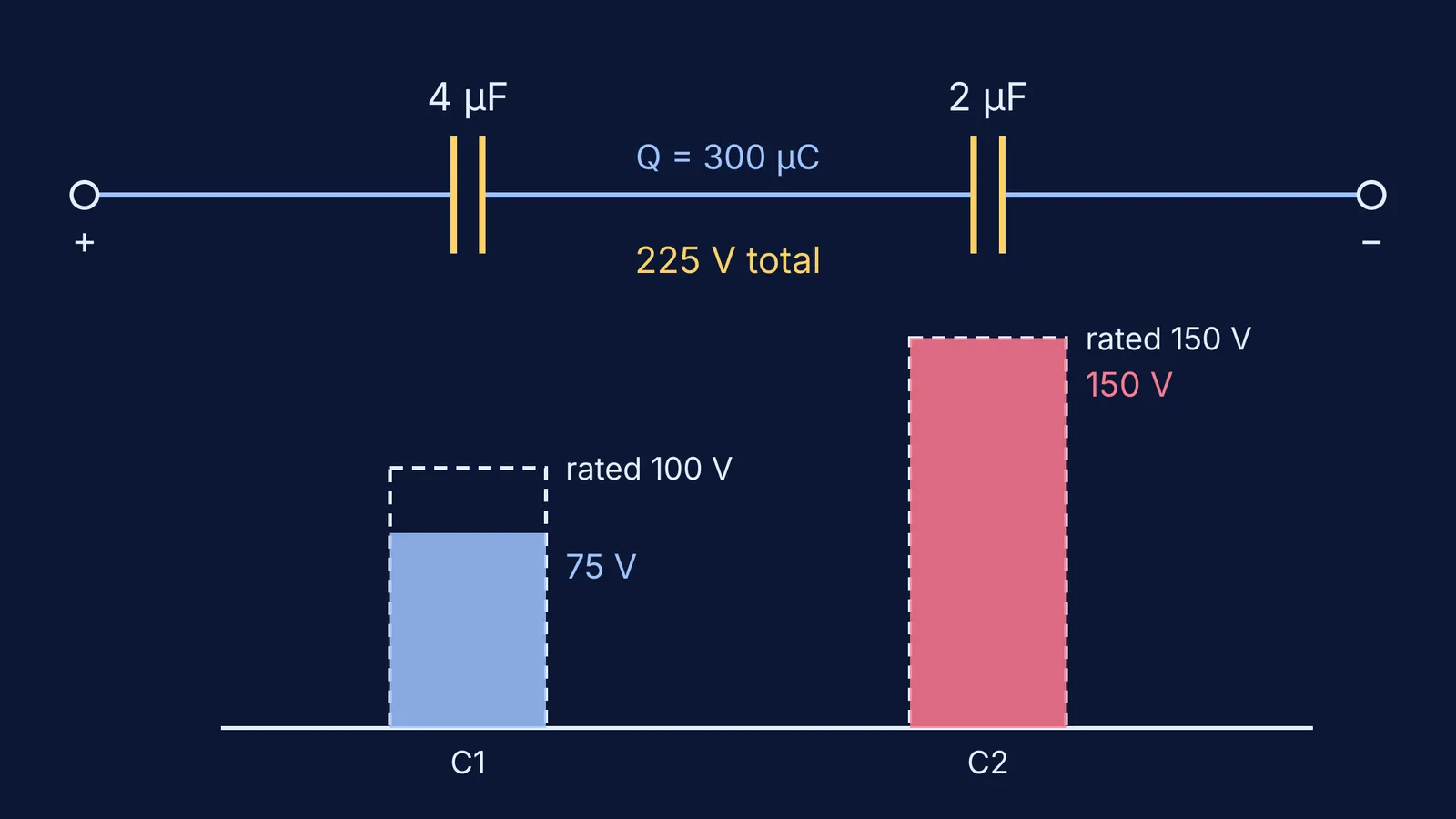
C1 = 4 μF, rated 100 V: Q_max = 4 × 100 = 400 μC.
C2 = 2 μF, rated 150 V: Q_max = 2 × 150 = 300 μC.
Step 2: find the limiting charge. The smaller value is 300 μC, so C2 sets the limit even though it has the higher rating.
Step 3: find the voltages. With 300 μC on each capacitor:
V1 = 300 / 4 = 75 V, which is within C1's 100 V rating.
V2 = 300 / 2 = 150 V, which is exactly C2's rating.
The total safe voltage is 75 + 150 = 225 V. To check, C_series = (4 × 2)/(4 + 2) = 4/3 μF, and 300 / (4/3) = 225 V.
Now test the wrong answer. At 250 V, Q = (4/3) × 250 ≈ 333 μC on each capacitor. That puts 333 / 2 ≈ 167 V across C2, which is more than its 150 V rating. C2 fails first, and then the full voltage lands on C1.
What if all the capacitors have the same rating?
Equal ratings still do not mean you can add them. Take 1 μF, 2 μF and 3 μF capacitors, each rated 100 V. Their Q_max values are 100, 200 and 300 μC, so the limit is 100 μC. The voltages are 100 V, 50 V and 33.3 V, for a total of about 183 V, not 300 V. The smallest capacitor takes the largest share of the voltage.
Does this matter outside the exam hall?
Yes. Engineers sometimes connect capacitors in series to handle a higher voltage, and manufacturers publish rules for doing it safely. The Nichicon application guidelines for aluminium electrolytic capacitors say that when capacitors are used in series, the applied voltage must stay below the rated voltage and be shared equally using a balancing resistor in parallel with each capacitor. The same guide warns that if one capacitor shorts, the other may be overvolted.
A quick checklist for your notes
Write Q_max = CV for every capacitor before you work out any voltages.
Pick the smallest Q_max. That is the series charge.
Find each V = Q/C and confirm that none is above its rating.
Add the voltages, then check the total against Q / C_series.
To test this yourself, try the capacitors in series and parallel simulation: predict the result first, then check it. For more on breakdown, see how much charge a sphere can hold before the air around it breaks down. For capacitor networks with more branches, the Fermi Problem Library has worked problems with a step-by-step solver that explains the reasoning rather than printing an answer. The Fermi Concept Library has a lesson on each idea used here, from capacitance to dielectric strength.