On this page
The Burj Khalifa in Dubai rises 828 metres and was completed in 2010, according to SOM, the firm that designed it. At that height, wind is the main design problem. Two ideas help the tower stand up to it: a braced core that is very hard to bend or twist, and a shape that stops the wind from pushing in rhythm.
What holds the Burj Khalifa up?
Seen from above, the tower is a Y: three wings around a six-sided centre. SOM describes it in one sentence: "Each wing, with its own high-performance concrete core and perimeter columns, buttresses the others via a six-sided central core, or hexagonal hub." Engineers call this a buttressed core.
In a lecture transcript published by the Skyscraper Museum, Bill Baker of SOM says the hexagonal core is there "to take the twisting", but it "could never handle the wind loads by itself, so we buttress it". When wind blows against two wings, "this third wing is like a buttress". He compares the tower to a man holding an umbrella into the wind: his front leg is the core, his back leg is the buttress, and he also uses his weight to help resist the wind.
Why is wind the real danger for a tall building?
Wind does not only push a building downwind. Peter Irwin, who led the wind engineering on the project according to Baker's talk, explains why in Physics Today. For many of the tallest skyscrapers, he writes, the forces from shed vortices are the highest they face, greater even than earthquake forces.
Vortex shedding is the alternate forming and breaking away of swirling vortices on the two sides of a body in a moving fluid; each vortex creates a suction force, so the building is rocked sideways, across the wind (Irwin, Physics Today).
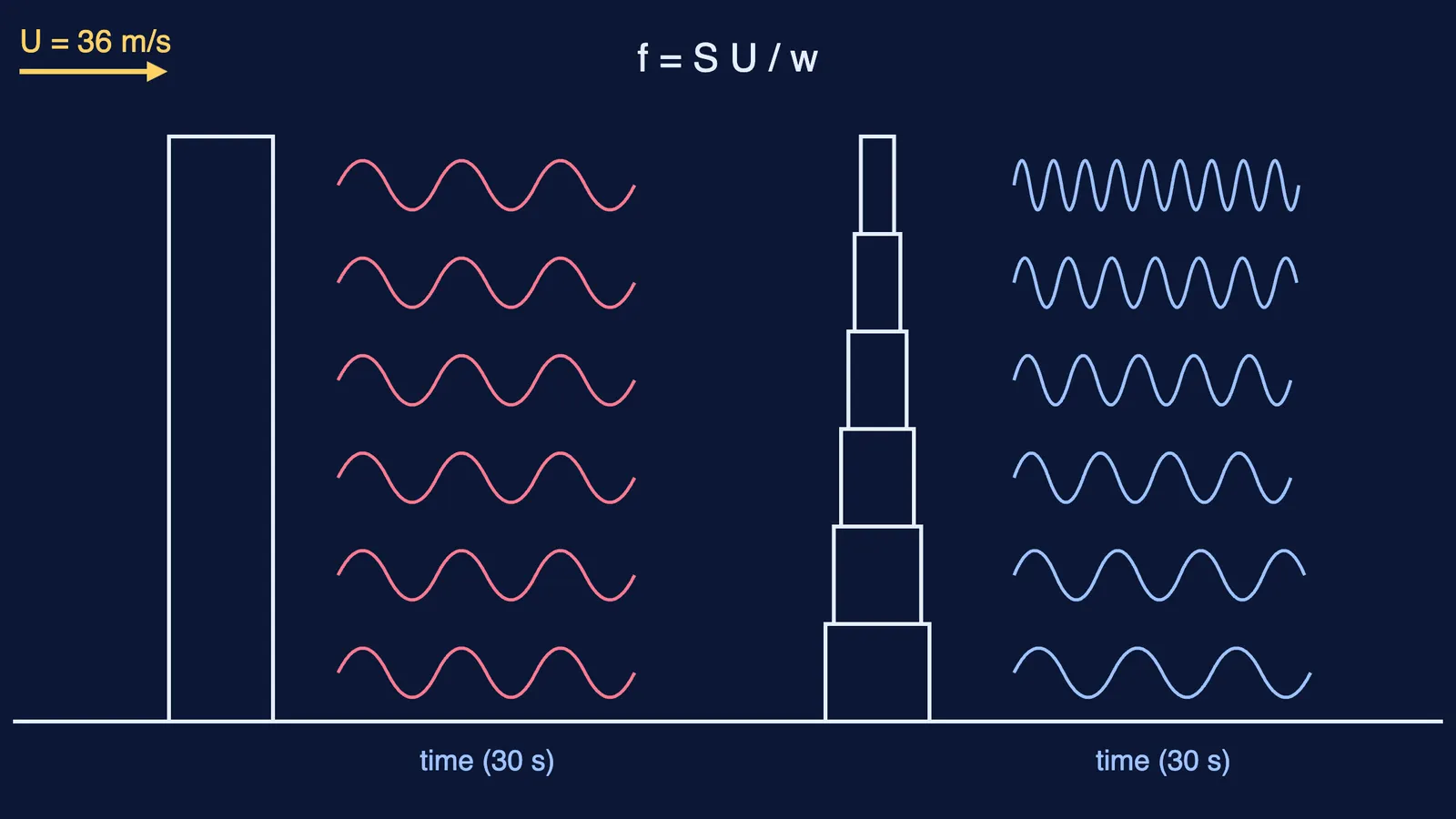
Irwin gives the rhythm of those pushes as f = SU/w, where U is the wind speed, w is the building's width facing the wind, and S is the Strouhal number, which depends on the shape of the cross-section. He uses S = 0.14 as a typical value (Physics Today).
The danger is resonance. Every building has a natural sway frequency. If the vortex pushes arrive at that same frequency, each one adds to the last, like a swing pushed in time. That is also why soldiers break step when crossing a bridge.
A worked example: when would a plain tower resonate?
Take the numbers Irwin uses in Physics Today: a straight-sided tower 50 m wide that sways naturally at 0.1 Hz, with S = 0.14.
Resonance happens when the shedding frequency equals the sway frequency: SU/w = 0.1 Hz.
Rearrange for the wind speed: U = 0.1 × w / S.
Put in the numbers: U = 0.1 × 50 / 0.14 ≈ 36 m/s, about 130 km/h.
If a steady wind holds near that speed for several minutes, Irwin notes, vortices along the whole height of a straight tower shed together and the sway builds.
Now the fix. Suppose the top part of the tower is only 25 m wide (an illustrative number, not the Burj's). At the same 36 m/s, f = 0.14 × 36 / 25 ≈ 0.2 Hz, twice the sway frequency. Top and bottom are now pushed at different rhythms, so their pushes cannot all line up.
How does the Y shape "confuse the wind"?
SOM says the Y-shaped plan "reduces wind forces" and that the advantage of the tower's stepping and shaping is "in essence, to 'confuse the wind.'" At each setback the building's width changes, and the setbacks rise in an upward spiral (SOM). When the cross-section varies with height, Irwin explains, the shedding frequency becomes a function of height and the vortices "lose their coherence" (Physics Today).
The shape came from testing. Baker recalls that the first wind-tunnel results "were really bad. It moved too much and the forces were too big." The team reshaped the tower and rotated the whole building 120 degrees to suit the prevailing wind, after which "the forces went way down" (Skyscraper Museum). RWDI, the wind engineers, put it simply: testing and shape changes "enabled a supertall structure."
What can you take from this into your physics?
Four questions crack the Burj, and they work on bridges and exam numericals too.
Which force matters most here? For a tall structure, the sideways one.
Is there a rhythm? Anything that repeats can resonate.
What sets its frequency? Write the formula and list what it depends on.
How do you break the match? Change the stiffness, change the shape, or spread the frequencies apart.
Earthquake engineers ask the same questions and reach a different answer: see how earthquake-resistant buildings use base isolation.
For ideas that are easier to see than to read, the Fermi Simulation Lab has interactive simulations. If resonance still feels shaky, Fermi's AI tutor works out what you already know and builds a plan for the session.
Like designing towers? Read how to become a structural engineer in India.