On this page
Every flyover, metro viaduct and tall apartment block you pass was checked by someone whose job is to make sure it does not bend too far, crack or fall. That person is a structural engineer. If you like physics problems with forces and beams, this is one of the most direct ways to turn them into a career.
What does a structural engineer actually do?
The US Bureau of Labor Statistics describes the work in one line: structural engineers "design and assess major projects, such as buildings, bridges, and dams, to ensure their strength and durability" (BLS Occupational Outlook Handbook).
In practice, you work out every load a structure carries (its own weight, people, wind, earthquakes), trace how it flows to the foundations, and size each beam, column and slab to be strong and stiff enough. In India that design follows the Bureau of Indian Standards codes; concrete work, for example, follows IS 456 (2000): Plain and Reinforced Concrete, Code of Practice.
Structural engineering is a specialisation of civil engineering, so the route starts with a civil degree.
How do you become a structural engineer in India?
Class 11 and 12 with PCM. Mechanics in physics and calculus in maths are the two foundations you will use most.
A B.Tech in civil engineering. The Joint Seat Allocation Authority (JoSAA) allocates seats at IITs, NITs, IIITs and other government-funded technical institutes using JEE Main and JEE Advanced. State and private colleges run their own admissions.
GATE in Civil Engineering (paper code CE). GATE 2027 is organised by IIT Madras, with exams on weekends between 6 and 21 February 2027. Its scores are used for postgraduate admission and by several public sector undertakings for recruitment, and they stay valid for three years. The official site also says plainly that qualifying does not guarantee admission, a scholarship or a job.
An M.Tech in structural engineering. At IIT Hyderabad's civil engineering department, Structural Engineering is one of five M.Tech specialisations, and for the 2-year seats funded by the Ministry of Education the page says: "Admissions will be based solely on the GATE score." Applicants need a bachelor's degree and a valid GATE score in Civil Engineering.
Years of supervised design work. You start by checking parts of a design under a senior engineer and take on more responsibility as you go. In the US, licensure also needs exams and several years of experience, according to the BLS.
Some graduates join design firms straight after a B.Tech, but an M.Tech gives you deeper training in analysis, steel and concrete design, and earthquake engineering.
Which software do structural engineers use?
Most analysis today happens in software. STAAD.Pro is described by its maker, Bentley, as structural analysis and design software for modelling steel, concrete and timber structures. ETABS, from Computers and Structures, is a package for the structural analysis and design of buildings.
The more important skill is not clicking buttons, though. It is knowing when the software's answer is wrong.
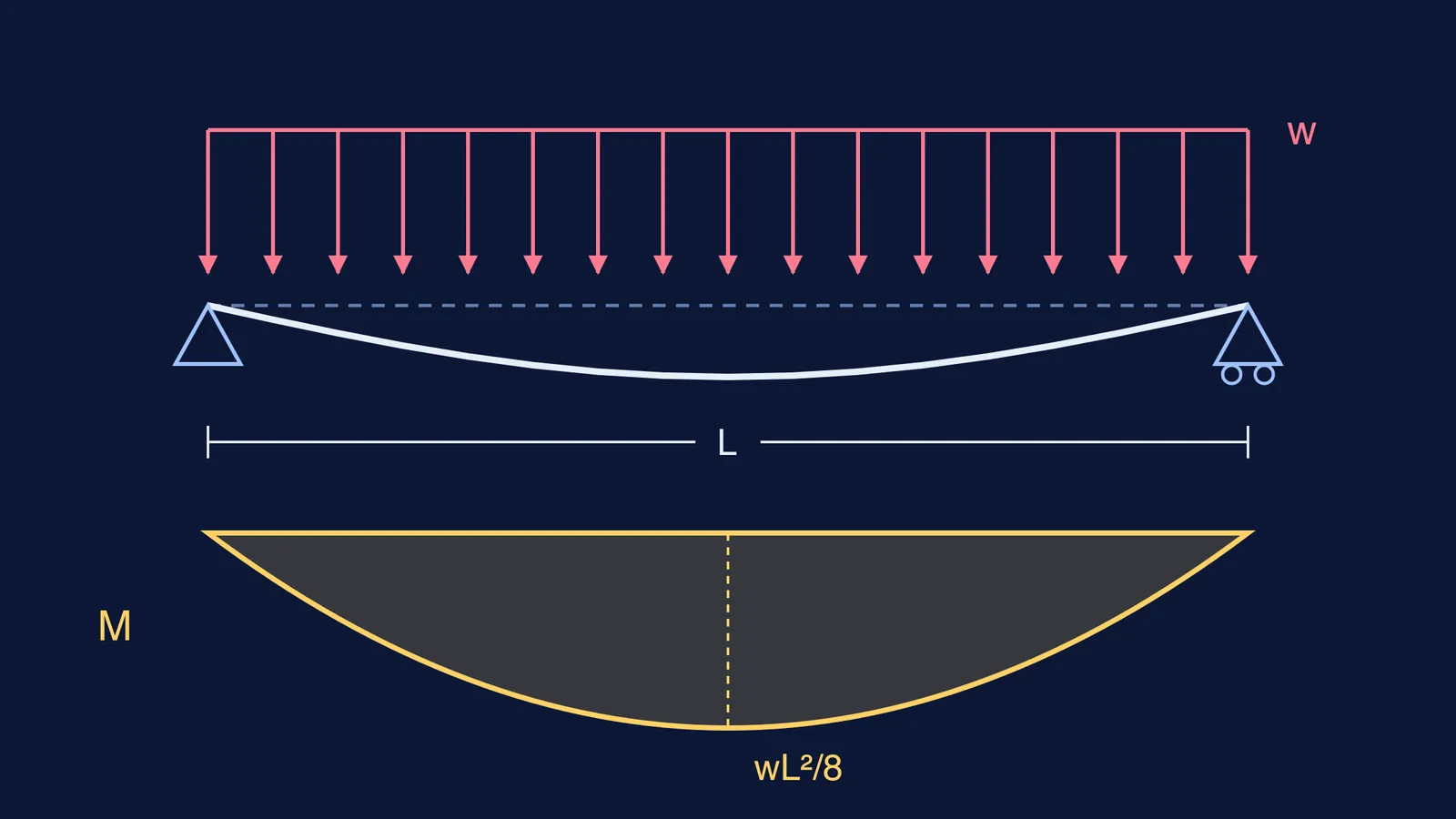
Here is the first hand check most engineers learn. A beam resting on two supports, span L, carries a uniform load w along its length (the hero diagram above). The largest bending moment sits at mid-span and equals wL²/8.
Take a 5 m beam carrying 10 kN per metre.
wL²/8 = 10 × 5 × 5 / 8 = 31.25 kN·m.
If your model reports 312.5 kN·m, ten times too big, check the load you typed and its units.
This is Class 11 statics: draw the free-body diagram, take moments about a support, find the reactions. If torques and equilibrium still feel shaky, the step-by-step solver in the Fermi Problem Library explains the reasoning behind each line rather than printing an answer.
Is structural engineering a good career?
The work is tied to construction, which a growing country keeps needing. For a sense of demand, US civil engineering employment is "projected to grow 6 percent from 2025 to 2035, faster than the average for all occupations" (BLS). Indian figures vary by city and sector, so ask seniors and college placement cells for current numbers before deciding.
The trade-off is responsibility: people will live and work inside what you design, so the job rewards careful checking more than speed.
A plan from Class 11 to your first job
Class 11-12: master free-body diagrams, torque, equilibrium and elasticity in physics, and integration in maths.
Years 1-2 of B.Tech: take engineering mechanics and strength of materials seriously; everything later builds on them.
Years 2-3: learn one analysis package on a free student licence where available, and hand-check every model you build.
Year 3: do a summer internship at a design office or on a construction site.
Year 4: decide between GATE and an M.Tech, or a job first; GATE scores stay valid for three years.
If some physics ideas are easier for you to see than to read, the Fermi Simulation Lab has interactive simulations for them. Start with one beam, one load and one hand check this week.