On this page
Benzoic acid questions come in two forms: "predict the nitration product" and "why no Friedel-Crafts?" Both have one root: the carboxyl group pulls electrons out of the ring.
What does NCERT say about benzoic acid's ring reactions?
The Class 12 NCERT chemistry textbook (Part II, Unit 8, section 8.9.4) says it in two sentences: "Aromatic carboxylic acids undergo electrophilic substitution reactions in which the carboxyl group acts as a deactivating and meta-directing group. They however, do not undergo Friedel-Crafts reaction (because the carboxyl group is deactivating and the catalyst aluminium chloride (Lewis acid) gets bonded to the carboxyl group)." The same page shows conc. HNO3 with conc. H2SO4 giving m-nitrobenzoic acid, and Br2 with FeBr3 giving m-bromobenzoic acid (NCERT Chemistry Part II, Unit 8, reprint 2026-27).
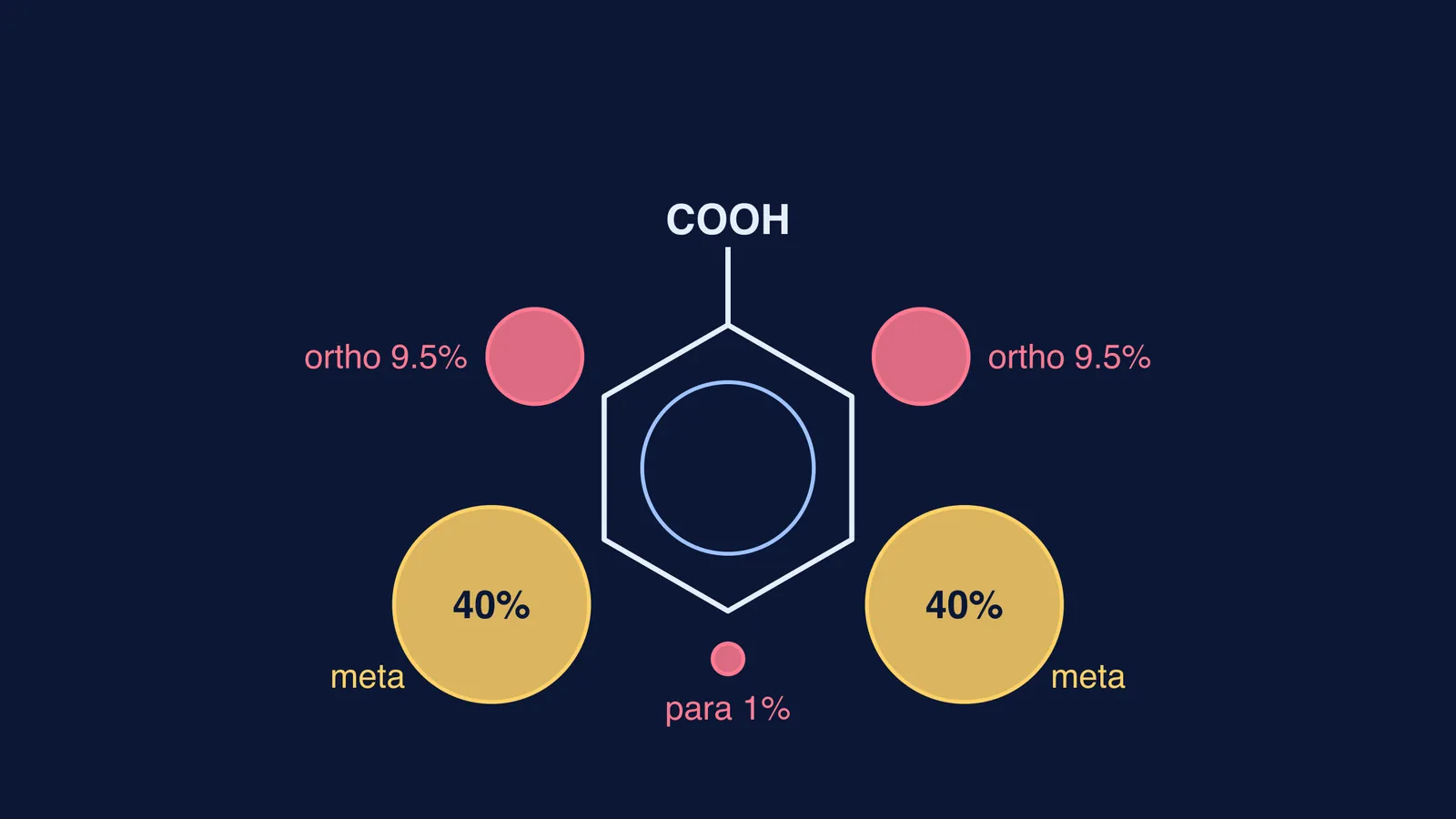
Meta is the major product, but not the only one. Nitrating benzoic acid with concentrated nitric and sulfuric acids gives about 80% 3-nitrobenzoic acid, 19% 2-nitrobenzoic acid and 1% 4-nitrobenzoic acid (Doc Brown's Chemistry, orientation in substituted benzenes).
Why does the -COOH group deactivate the ring?
In -COOH, the carbon attached to the ring is a carbonyl carbon. The oxygen pulls electron density towards itself, so that carbon carries a partial positive charge. It then pulls on the ring's pi electrons in two ways:
Inductive (-I): the electron-poor carbonyl carbon draws sigma electron density out of the ring carbon it is bonded to.
Resonance (-R): the ring's pi electrons can spread onto the C=O oxygen, which leaves a positive charge at the ortho and para carbons.
Nitration needs the ring to give electrons to NO2+. A ring that has lost electron density does this more slowly, so the group is called deactivating. To see where -COOH sits next to -NO2, -OH and the halogens, read our guide to ranking activating and deactivating groups in benzene.
Why does benzoic acid give the meta product?
A full answer explains the intermediate, not just the phrase "meta-directing". When NO2+ adds to the ring, it forms an arenium ion (sigma complex): a carbocation whose positive charge is spread over three ring carbons.
Worked example: three attacks, three intermediates
Number the ring: C1 carries -COOH.
Attack at C2 (ortho): the positive charge spreads over C1, C3 and C5. One resonance form puts + on C1, right next to the electron-poor carbonyl carbon. Two neighbouring positive centres repel each other, so that form is badly destabilised.
Attack at C4 (para): the charge spreads over C3, C5 and C1. Once again, one form puts + on C1. Same problem.
Attack at C3 (meta): the charge spreads over C2, C4 and C6. It never reaches C1, so no form puts two positive centres side by side.
Conclusion: the meta intermediate is the least destabilised. It forms fastest of the three, so meta wins.
Why doesn't benzoic acid undergo Friedel-Crafts reaction?
A full answer gives two reasons.
The ring is too deactivated. Friedel-Crafts alkylation and acylation tend to fail on rings with strongly deactivating groups such as nitro, CF3 and sulfonyl (Master Organic Chemistry, Friedel-Crafts limitations). The carbocation or acylium ion is usually a weaker electrophile than NO2+, so a ring that has lost electron density barely reacts with it.
AlCl3 is used up by the -COOH group. AlCl3 is a Lewis acid with an empty orbital. The lone pairs on the carbonyl oxygen are a Lewis base sitting on the same molecule, so the AlCl3 bonds there instead of activating the alkyl or acyl halide. NCERT says this directly: the catalyst "gets bonded to the carboxyl group" (NCERT Unit 8). That complex puts even more positive character next to the ring, so the ring is deactivated further.
For the same pattern in other molecules, see why Friedel-Crafts fails with nitrobenzene and aniline.
How do you use this in a conversion question?
Before you write a reagent, check:
Is the group on the ring an activator or a deactivator at this step?
Does it direct ortho/para or meta?
Does the next step need AlCl3? With -COOH, -NO2, -CHO or -NH2 on the ring, Friedel-Crafts is out.
Would swapping the order of steps put the new group where the question wants it?
The last point is how toluene becomes m-nitrobenzoic acid: oxidise -CH3 to -COOH first, so the meta director is in place when you nitrate. Our toluene to m-nitrobenzoic acid walkthrough shows both orders and why only one of them works.
If you get the substituent right but keep choosing the wrong order of steps, work through a few conversion problems in the Fermi Problem Library, where a step-by-step solver explains the reasoning rather than printing an answer. If the arenium ion picture itself still feels shaky, the Fermi Concept Library gives each chemistry concept its own lesson and its place in the map.