

On this page
Converting toluene to m-nitrobenzoic acid takes two steps, and the order matters more than the reagents. Both steps are standard Class 12 reactions. The marks go to the student who knows which step comes first, and can say why.
This post gives you the route, the data behind the order, and a written answer you can copy into your notes.
How do you convert toluene to m-nitrobenzoic acid?
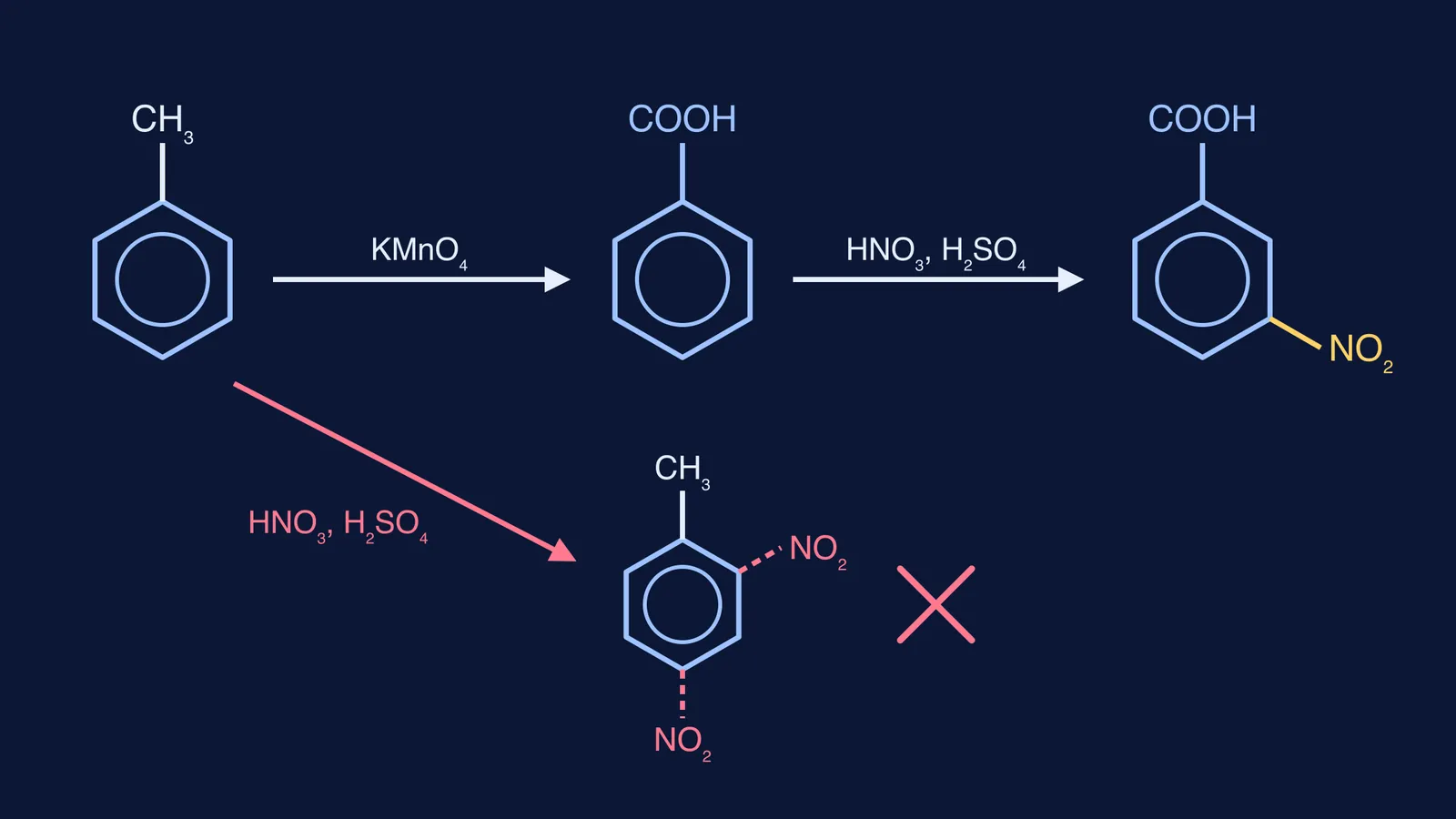
Oxidise the side chain. Heat toluene with KMnO₄. The methyl group becomes a carboxyl group, giving benzoic acid (with alkaline KMnO₄ you get the benzoate first, and acidifying it gives benzoic acid).
Nitrate the ring. Treat benzoic acid with a mixture of concentrated HNO₃ and H₂SO₄. The nitro group goes in meta to COOH, giving m-nitrobenzoic acid (3-nitrobenzoic acid).
OpenStax Organic Chemistry explains that alkyl side chains on a benzene ring are oxidised to –CO₂H groups. The reaction needs a hydrogen on the benzylic carbon, which is why tert-butylbenzene does not react. Toluene's methyl group has three benzylic hydrogens, so it oxidises.
For step 2, the same textbook says aromatic rings are nitrated with a mixture of concentrated nitric and sulfuric acids, and the electrophile is the nitronium ion, NO₂⁺. If you are unsure why the sulphuric acid is there, our post on the role of sulphuric acid in nitration walks through it.
Why can't you nitrate toluene first?
The methyl group and the carboxyl group point the incoming nitro group to different places. OpenStax lists –CH₃ as an ortho- and para-directing activator and –CO₂H as a meta-directing deactivator.
The same page gives measured isomer percentages for nitration:
Toluene nitrates 63% ortho, 3% meta and 34% para.
Benzoic acid nitrates 22% ortho, 76% meta and 2% para.
So if you nitrate toluene first, almost all of your product is o- or p-nitrotoluene. Oxidising those gives o- or p-nitrobenzoic acid, not the meta compound you were asked for. Only 3% of the nitrotoluene is meta, which is not a usable route.
Nitrate after oxidising and the meta product is the major one. The COOH group withdraws electrons from the ring, and it pulls hardest on the ortho and para positions, so the meta position is the one that gets attacked. For a refresher on how to tell the two kinds of group apart, see how to predict ortho, para or meta products.
How do you decide the order in any benzene conversion?
Ask three questions before you write a single reagent:
Where are the two groups relative to each other? Meta, or ortho/para?
Which of the two groups would direct to that position? Here, COOH directs meta; CH₃ does not.
Can I install that directing group first, from what I have? Yes: toluene's methyl group can be oxidised to COOH.
Now test the method on the para isomer. To make p-nitrobenzoic acid from toluene, you reverse the order: nitrate first, while the ortho/para-directing methyl group is still there, take the para isomer, then oxidise the methyl group with KMnO₄. Same two reactions, opposite order, different product. Our guide to the order of steps in synthesising disubstituted benzenes works through more pairs like this.
How should you write this answer in a board or JEE exam?
A clean answer to "Convert toluene to m-nitrobenzoic acid" looks like this:
Toluene, with KMnO₄ (heat), then H₃O⁺, gives benzoic acid.
Benzoic acid, with conc. HNO₃ and conc. H₂SO₄, gives m-nitrobenzoic acid.
Reason: –COOH is an electron-withdrawing, meta-directing group, so nitration occurs at the meta position. Nitrating toluene first would give mainly o- and p-nitrotoluene, because –CH₃ is ortho/para-directing.
Three common mistakes cost marks:
Writing the steps in the wrong order, or skipping the reason.
Forgetting the acidification step after alkaline KMnO₄.
Drawing the nitro group at position 2 or 4 by habit. Count around the ring from COOH: meta is position 3.
Where can you practise more conversions like this?
Order-of-steps questions reward practice on many pairs, not memorising one. The Fermi Problem Library has worked problems with a step-by-step solver that explains the reasoning rather than printing an answer, so you can check why a step comes first, not just what it is. If directing effects themselves are the gap, the Fermi Concept Library gives each concept in chemistry its own lesson.
Next time you see a conversion, ask the three questions before you reach for a reagent.


