On this page
Ranking questions on substituted benzenes come up in Class 12 organic chemistry, JEE Main and NEET-UG. You only need one idea to answer them: a group that pushes electron density into the ring speeds up attack by an electrophile, and a group that pulls density out slows it down.
What is the order of activating and deactivating groups?
From most activating to most deactivating:
-O⁻ (phenoxide): extremely activating
-NH₂: strongly activating
-OH: strongly activating
-OCH₃: strongly activating
-NHCOCH₃: moderately activating
-CH₃: weakly activating
-H: the benchmark (benzene itself)
-F, -Cl, -Br, -I: weakly deactivating
-CHO and -COOH: moderately deactivating
-CN: strongly deactivating
-NO₂: strongly deactivating
The strength bands (extreme, strong, moderate, weak) follow the classification of electrophilic aromatic directing groups, which puts -O⁻ alone in the extreme band, -NHCOR as moderate, alkyl groups as weak, and halogens as weak deactivators that still direct ortho and para. A university course page gives the same sequence for activators: -NH₂ > -OH, -OR > -NHCOR > -CH₃.
The numbers show how wide the range is. According to the OpenStax organic chemistry text/16%3A_Chemistry_of_Benzene_-_Electrophilic_Aromatic_Substitution/16.04%3A_Substituent_Effects_in_Electrophilic_Substitutions), in nitration an -OH group makes the ring about 1,000 times more reactive than benzene, while an -NO₂ group makes it more than 10 million times less reactive. Methylbenzene (toluene) is nitrated about 25 times faster than benzene/Arenes/Reactivity_of_Arenes/Nitration_of_Benzene_and_Methylbenzene), which is why the methyl group counts as only a weak activator.
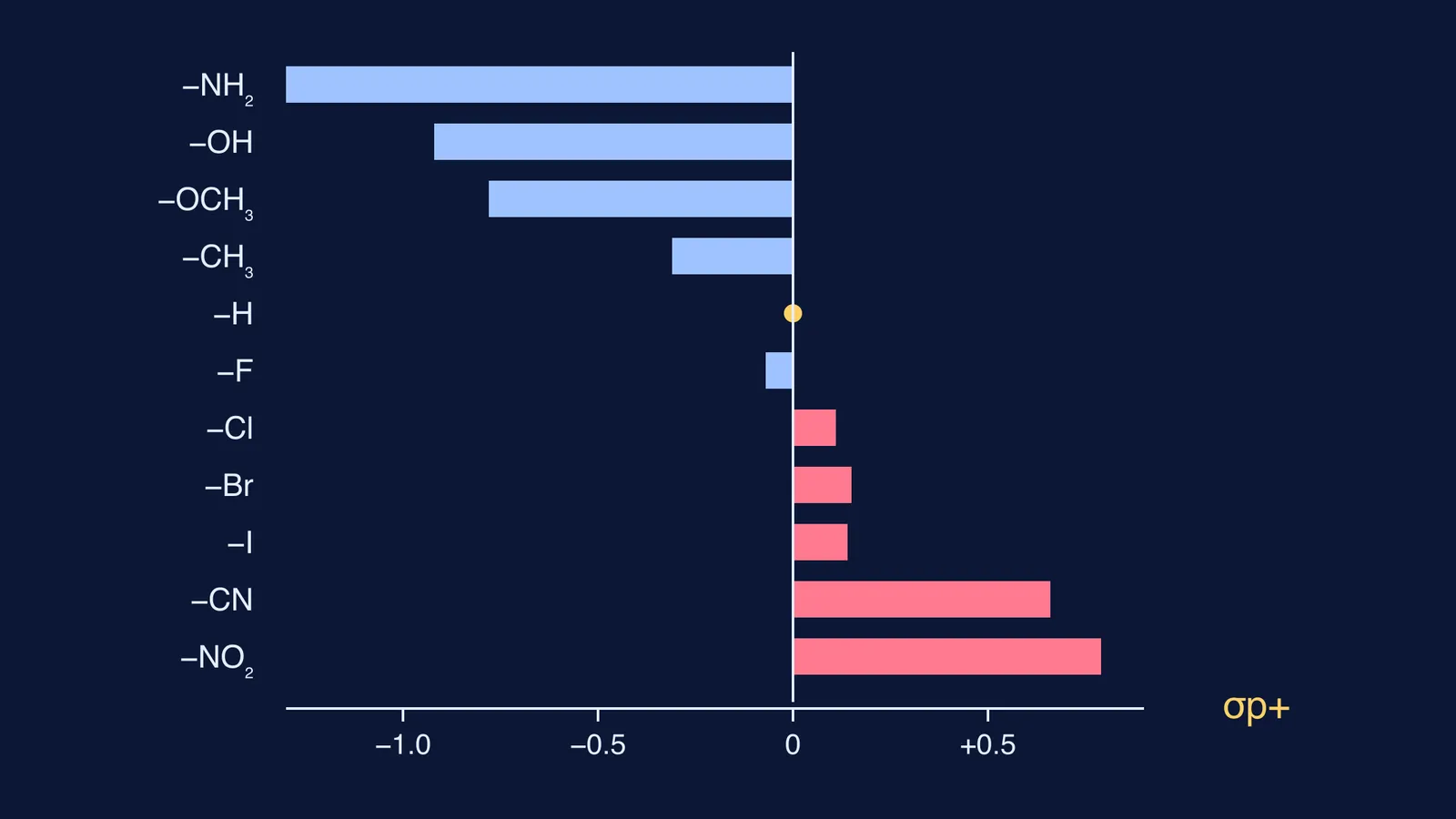
For close pairs, use Hammett σp+ constants, which measure how strongly a group donates or withdraws charge at the para position. A table based on Hansch, Leo and Taft's 1991 review gives about -1.3 for -NH₂, about -0.92 for -OH (both shown in brackets in the table) and -0.78 for -OCH₃, so the order is -NH₂ > -OH > -OCH₃. The same table gives +0.66 for -CN and +0.79 for -NO₂, which is why -NO₂ comes last.
Why does each group sit where it does?
Ask three questions about the atom attached to the ring.
Does it carry a charge? A negative charge (-O⁻) pushes hardest, so it goes first. A positive one (-NH₃⁺) pulls hard, so it goes near the end.
Does it have a lone pair? If so, it donates by resonance, so it is an activator (-NH₂, -OH, -OCH₃). In -NHCOCH₃ the nitrogen's lone pair is partly drawn into the C=O group, so it donates less and the group is only moderately activating. Halogens are the exception: their inductive pull outweighs their resonance donation, so they deactivate but still direct ortho and para. See why chlorine is deactivating but ortho-para directing.
Is it double- or triple-bonded to a more electronegative atom? C=O, C≡N and N=O pull electron density out of the ring by resonance. These groups deactivate and direct meta.
If the answer to all three is no, as with -CH₃, the group is a weak activator through hyperconjugation and the inductive effect.
How do you solve ranking MCQs on benzene derivatives?
Try these before reading the answers.
Q1. Arrange in decreasing order of reactivity towards electrophilic substitution: chlorobenzene, toluene, acetanilide, phenol.
Answer: phenol > acetanilide > toluene > chlorobenzene. -OH is strong, -NHCOCH₃ moderate, -CH₃ weak, and -Cl is on the slow side of benzene.
Q2. Arrange in decreasing order of reactivity towards nitration: benzaldehyde, benzene, nitrobenzene, chlorobenzene.
Answer: benzene > chlorobenzene > benzaldehyde > nitrobenzene. All three groups deactivate, so benzene leads: -Cl is weak, -CHO moderate, -NO₂ strong.
Q3 (the trap). Is aniline more reactive than phenol in a nitrating mixture of concentrated HNO₃ and H₂SO₄?
Answer: no. In strong acid, -NH₂ is protonated to -NH₃⁺, which is a strong, meta-directing deactivator. The ranking holds for the neutral group, so check the conditions first. This is one reason aniline is first converted to acetanilide, as explained in why aniline is acetylated before nitration.
If you keep getting rankings wrong, find the step where it goes wrong: the charge, the lone pair or the conditions. The Fermi Problem Library has worked problems with a step-by-step solver that explains the reasoning rather than printing an answer. To revise the inductive and resonance effects, use the Fermi Concept Library.
Next, learn where each group sends the incoming electrophile, covered in our guide to directing groups in electrophilic substitution.