On this page
Most unit cell questions come down to one number: Z, the number of atoms (or formula units) that really belong to one cell. Count every sphere you see in the diagram and you will get it wrong, because most of those spheres are shared with neighbouring cells. Once you know the four sharing fractions, Z for any cubic cell is a two-line sum, even when different atoms sit in different places.
How much of a corner, edge, face or body-centre atom belongs to one unit cell?
Picture the cell as one cube in a stack of identical cubes. The share an atom gives your cell is 1 divided by the number of cubes that meet at its position.
Corner (1/8): an atom at a corner is contained by eight unit cells, so only one-eighth of it is inside any one cell, as OpenStax Chemistry 2e explains.
Edge centre (1/4): four cubes share an edge, and ChemEd X notes that one fourth of an ion at the middle of each edge lies in the cell.
Face centre (1/2): a face atom is part of two cells and contributes 1/2 to each, according to ChemEd X.
Body centre (1): the atom sits wholly inside one cube.
A cube has 8 corners, 12 edges, 6 faces and 1 body centre. With those four counts and the four shares, every cubic Z is multiplying and adding.
How many atoms are there per unit cell in sc, bcc and fcc?
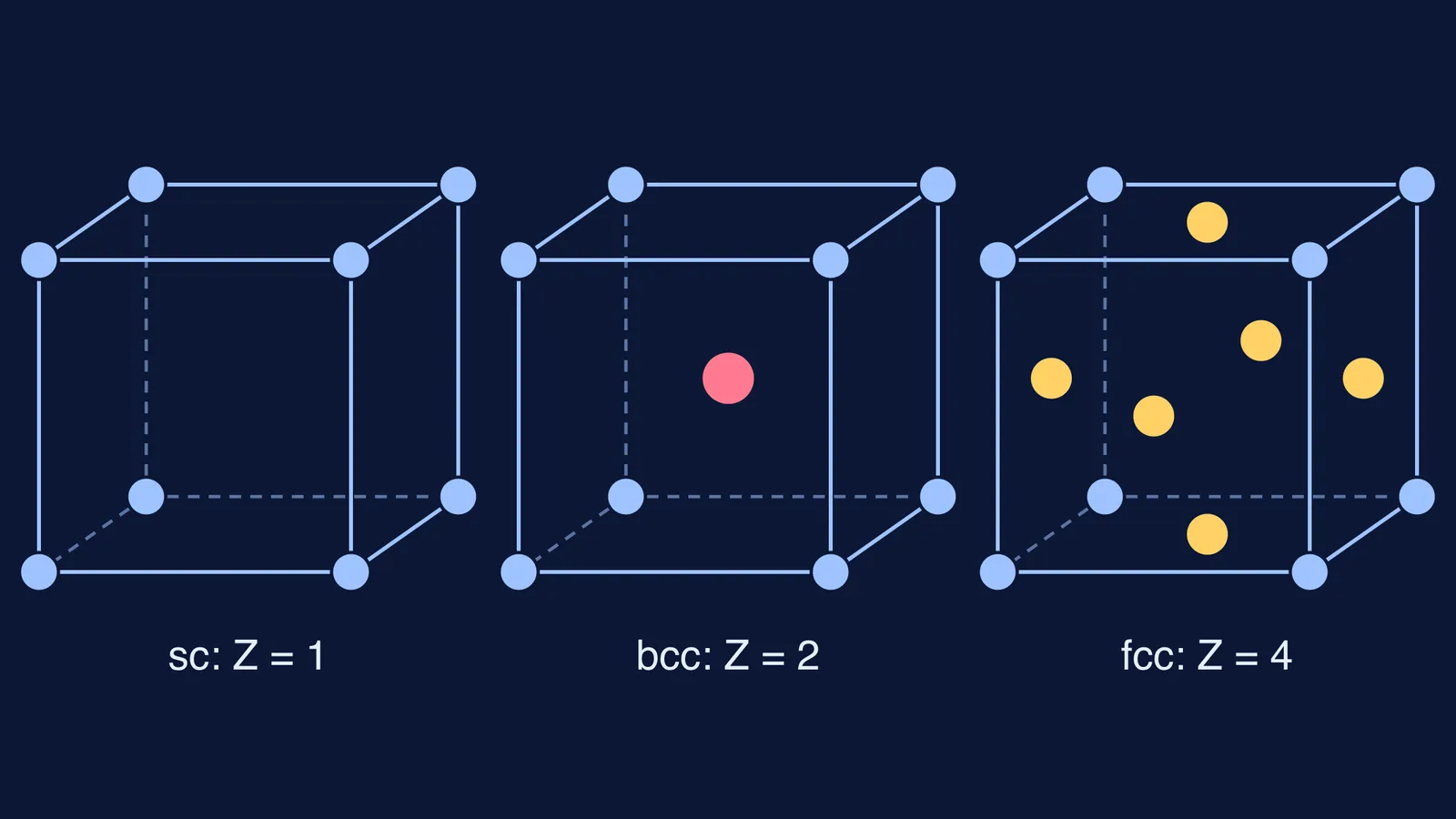
The three sums below are the ones OpenStax Chemistry 2e works through for metals.
Simple cubic (sc): atoms only at the corners. Z = 8 × 1/8 = 1.
Body-centred cubic (bcc): corners plus one atom in the middle. Z = 8 × 1/8 + 1 × 1 = 2.
Face-centred cubic (fcc, also called cubic close-packed): corners plus one atom on each face. Z = 8 × 1/8 + 6 × 1/2 = 1 + 3 = 4.
The same section gives coordination numbers of 6, 8 and 12 for sc, bcc and fcc. Z is the first input when you move on to packing efficiency of fcc, bcc and simple cubic.
How do you find Z when a lattice has more than one kind of atom?
Count each kind of atom separately, using its own positions, then write the ratio. Two real structures show the method.
Worked example 1 is perovskite, CaTiO3. In the cubic perovskite cell described in Peter Hadley's solid-state problems at TU Graz, calcium sits at the corners, titanium at the body centre and oxygen at the six face centres.
Ca: 8 corners × 1/8 = 1
Ti: 1 body centre × 1 = 1
O: 6 faces × 1/2 = 3
Ca : Ti : O = 1 : 1 : 3, so the formula is CaTiO3 with one formula unit per cell (Z = 1). The same page gives the Bravais lattice as simple cubic, with all five atoms (3 O, 1 Ti, 1 Ca) in the basis.
Worked example 2 is sodium chloride, a common example of edge sharing. If you place the chloride ions at the corners and face centres, the sodium ions sit at the 12 edge midpoints and the body centre.
Cl-: 8 × 1/8 + 6 × 1/2 = 4
Na+: 12 × 1/4 + 1 × 1 = 3 + 1 = 4
ChemEd X reaches the same 4 cations per cell, and OpenStax confirms four sodium and four chloride ions. So Z = 4 formula units of NaCl, which is 8 ions in all.
Now try a common exam twist. Suppose A atoms sit at the corners, B atoms at the face centres, and one corner atom is missing. A = 7 × 1/8 = 7/8 and B = 6 × 1/2 = 3. Multiply by 8 to clear the fraction: the formula is A7B24. When atoms are removed, multiply the share by the number left. When atoms fill gaps between spheres instead, use the method for finding a formula from tetrahedral and octahedral voids.
If your shares are right but the formula keeps coming out wrong, practise in the Fermi Problem Library, where the step-by-step solver explains the reasoning rather than printing an answer.
What mistakes cost marks when counting atoms per unit cell?
Run this checklist before you write your final answer:
Did you use 12 for edges and 6 for faces? They are easy to swap.
Did you count each kind of atom on its own before taking the ratio?
Is Z asking for atoms or formula units? NaCl has Z = 4 but 8 ions.
If atoms were removed or swapped, did you use the new count at that position?
Does the final formula balance the charges (Ca2+, Ti4+ and three O2- do)?
For where these cubes come from, read how Auguste Bravais found the 14 crystal lattices. If unit cells still feel shaky, the Fermi Concept Library gives each chemistry concept its own lesson.