On this page
A question like "write the coefficient of x in 7xy − 3x + 5xy − 4" is easy once you know what each word points to. This guide names every part of an expression using NCERT's own Class 7 material, then gives you a routine that works on any expression.
What is a term in an algebraic expression?
NCERT's Class 7 exemplar unit on algebraic expressions puts it in two lines: expressions are made up of terms, and a term is the product of factors.
To find the terms, split the expression at every + and − sign that is not inside a bracket. The current textbook, Ganita Prakash chapter 4, Expressions using Letter-Numbers, shows the habit: it rewrites 23 − 10 × 2 as 23 + −10 × 2, so the minus sign stays attached to the term after it.
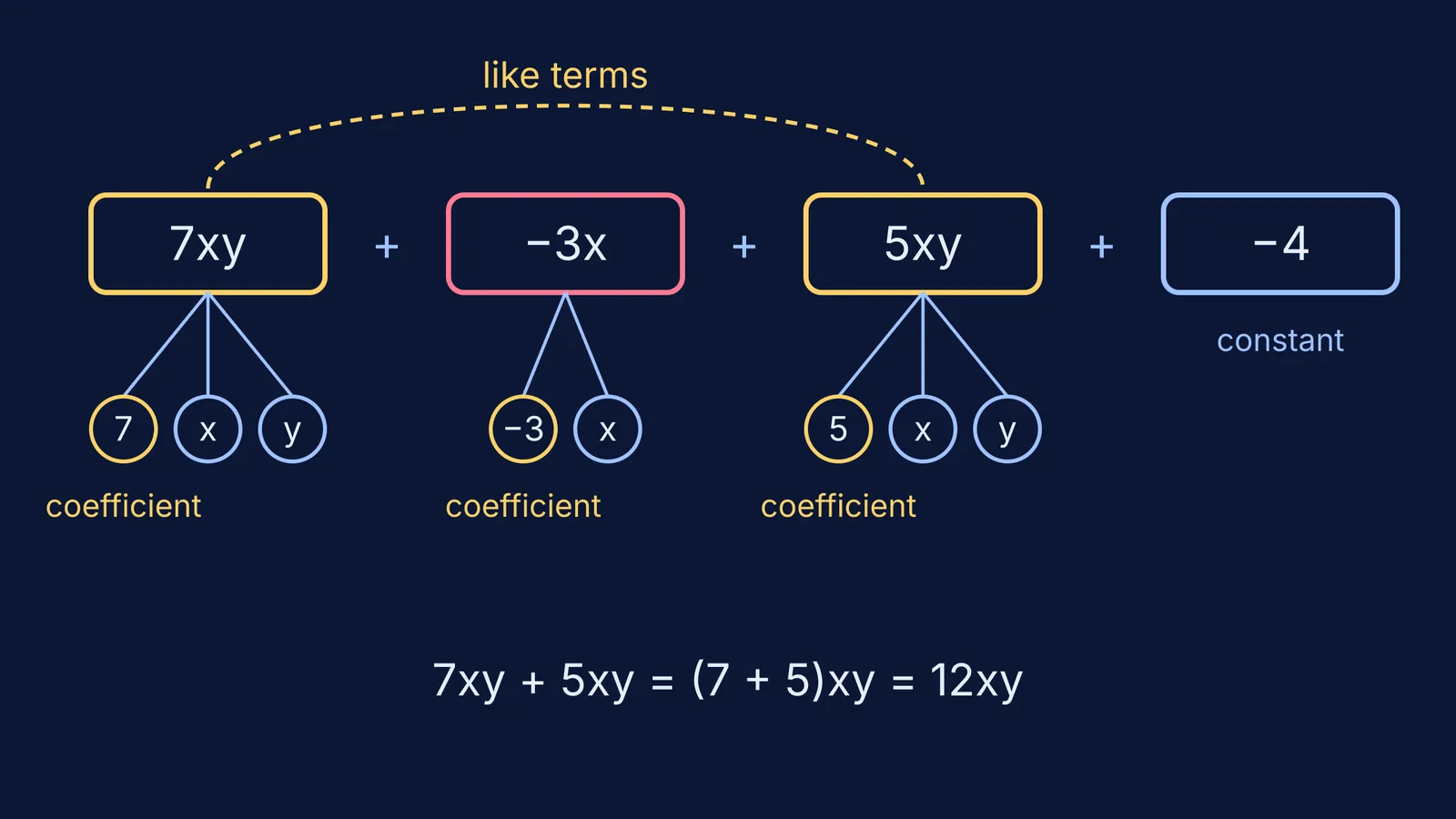
Do the same with 7xy − 3x + 5xy − 4 and you get 7xy + (−3x) + 5xy + (−4). That is four terms: 7xy, −3x, 5xy and −4. The last one has no letter in it, and the exemplar calls a number not joined to a variable a constant.
What are the factors of a term?
Each term is a multiplication with the × signs left out. The exemplar notes that factors may be numerical as well as algebraic (literal).
7xy = 7 × x × y
−3x = −3 × x
5xy = 5 × x × y
Watch for hidden factors. The exemplar gives the factors of −xy² as −1 × x × y × y: a lone minus sign is a factor of −1, and y² means y written twice.
What is the difference between numerical and literal coefficients?
The exemplar defines the coefficient as the numerical factor in a term. In 7xy the numerical coefficient is 7; in −3x it is −3, sign included.
Many books call the letter part the literal coefficient: in 6xyz, the numerical coefficient is 6 and the literal coefficient is xyz, as this explainer on numerical and literal coefficients puts it.
The exemplar also gives a wider meaning: "Sometimes, any factor in a term is called the coefficient of the remaining part of the term." So in 7xy, the coefficient of y is 7x. One of its examples asks for the coefficient of xy in 3x²zy + 7xyz − 2z²x. Its answer is 7z, the factor left over when you take xy out of the term 7xyz.
How do you tell like terms from unlike terms?
Ganita Prakash says terms that involve the same letter-numbers, such as 5c, c and 10c, are like terms, while 18c and 11d are unlike terms because they have different letter-numbers.
The test: cover the numerical coefficient and compare what is left. Letters and powers must match exactly.
7xy and 5xy: like, because both leave xy
7xy and −3x: unlike, because xy is not x
2x² and 2x: unlike, because x × x is not x, even though the numbers match
4xz and 9zx: like, because the order of letters does not matter; NCERT's Class 8 chapter on algebraic expressions notes that xz is the same as zx
Only like terms combine. The exemplar's rule: the sum of two like terms is a like term whose coefficient is the sum of their coefficients. So 7xy + 5xy = (7 + 5)xy = 12xy, and the whole expression simplifies to 12xy − 3x − 4. The −3x and −4 stay as they are.
How do you identify terms and coefficients step by step?
Rewrite every − as + − so each sign sits with its term.
Box each term and count the boxes.
Write each term as a product of factors, including any hidden 1 or −1.
Circle the numerical coefficient and underline the letter part.
Group terms whose underlined parts match exactly, then add their circled numbers.
Try it on p² − 2p + 5p² + p. The terms are p², −2p, 5p² and p, with coefficients 1, −2, 5 and 1. The like pairs are p² with 5p², and −2p with p. Adding coefficients gives 6p² − p.
Parents can help with one prompt: ask your child to read each term aloud as a multiplication, "minus two times p", before naming its coefficient.
Where does this lead next?
These words carry straight into polynomials and factorising. Next, try our test for which expressions count as polynomials, then how to factorise by taking a common factor, or a practice routine for like and unlike terms with an AI tutor.
If a homework question won't come apart, the Fermi Problem Library has worked problems with a step-by-step solver that explains the reasoning rather than printing an answer, so you can see where each coefficient comes from. To revisit the idea itself, the Fermi Concept Library gives every mathematics concept its own lesson.