On this page
Shirley Toulson's A Photograph is a short poem with a long reach. In three stanzas a child looks at an old beach snapshot of her mother and moves through three moments in time: the day the photo was taken, the years when her mother laughed at it, and now, years after her mother's death. Here is each stanza in plain words, the devices to name, and how to write exam answers.
The poem sits in the NCERT Hornbill textbook for Class 11, straight after Khushwant Singh's prose chapter. NCERT's teacher note says it is placed there because the two share a theme, so it helps to read it next to our guide to The Portrait of a Lady, which is also about remembering someone who has gone.
What is A Photograph poem about, stanza by stanza?
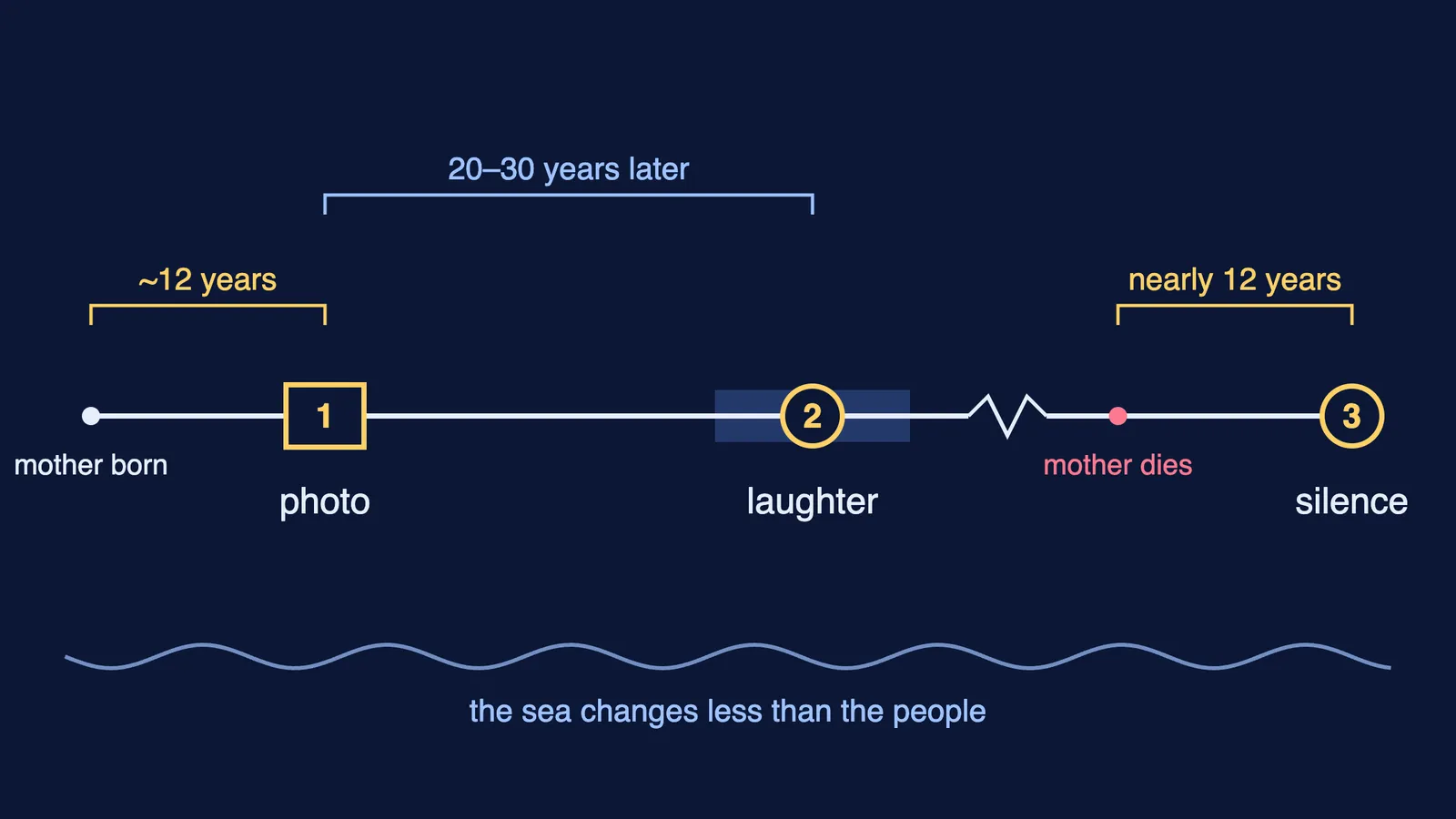
Stanza 1: the photo. The speaker holds an old photograph, which she calls the "cardboard", a plain word that reminds us a precious memory is only a piece of paper. In it her mother, about twelve, is out wading in the sea with her two younger cousins, one holding each of her hands. All three pause and smile for an uncle who is taking the picture. The speaker notes that this pretty young face belongs to a time before she herself was born. The sea seems to have changed less than the people, while the girls' "terribly transient feet" were only passing through.
Stanza 2: the laughter. Two or three decades on, the mother would look at the same snapshot and laugh, naming her cousins and teasing the clothes they had been made to wear to the beach. The speaker sees a neat pattern: that beach day became her mother's past, and her mother's laughter is now the speaker's past. Both memories are "wry", amused and sad together, and carry the "laboured ease of loss": people try to speak lightly about what they miss, and it takes effort.
Stanza 3: the silence. Now the mother has been dead for nearly as long as the girl in the photo had been alive, so a little under twelve years. The speaker says there is nothing to add about this. The last line uses silence as both noun and verb: death leaves her with no words at all.
What are the themes of A Photograph?
Time and change. People age and die; the sea seems to change far less. The contrast makes human life look brief.
Memory and loss. A photograph keeps a moment, but cannot bring back the person. Each generation remembers the one before.
Grief without words. The poem ends not in tears but in silence, which is often how real loss feels.
Kamala Das writes about the fear of losing a parent in My Mother at Sixty-six (Class 12).
Which poetic devices are used in A Photograph?
Alliteration: the repeated t sound in the line about the girls' feet.
Contrast: the lasting sea set against the passing girls.
Oxymoron: "laboured ease" joins effort and ease, two opposites.
Personification and repetition: in the last line, silence itself does the silencing.
Free verse: no fixed rhyme or metre, so it reads like quiet speech. The stanzas have nine, six and four lines.
How do you answer A Photograph questions in the exam?
The CBSE English Core syllabus for 2026-27 lists A Photograph among the Hornbill poems. The Class 11 paper has a Hornbill poetry extract worth 3 marks, two short answers of 40-50 words (one prose, one poetry) at 3 marks each, and a 6-mark long answer of 120-150 words on Hornbill prose or poetry.
Practise with these questions in your own words:
Why does the speaker call the photograph "cardboard"?
How does the sea differ from the people in the poem?
What do the three stanzas show about the passing of time?
Why does the poem end in silence?
Worked example: a 40-50 word answer
Question 2, in three moves: point, evidence, meaning.
"The sea in the photograph seems to have changed less over the years, but the girls who paddled in it grew up, and the speaker's mother has since died. By calling their feet 'transient', the poet shows how brief human life is beside nature."
That is 44 words, with one short quotation and no retelling.
A 15-minute revision plan
Minutes 1-5: say the three layers aloud: photo, laughter, silence.
Minutes 6-10: write the five devices with one line on what each shows.
Minutes 11-15: answer one practice question in 40-50 words, then check it for point, evidence and meaning.
For loss seen through a child's eyes, compare this poem with our explanation of The Ball Poem.
When English is done and you turn to physics or maths, Fermi's AI tutor can work out what you already know and build a plan for the session, so you sit down to a clear next step.
Tonight, read the poem once more and draw the three layers as a timeline in your notebook.