On this page
If you have finished Class 12 science and want to earn within a year or two, a skill-based certificate or diploma can get you there. The catch: "job-oriented" is printed on a lot of brochures, and not every course behind those words is recognised. Here is how to tell the difference before you pay.
Formal skill training is still uncommon in India. In the government's PLFS Annual Report 2025 press note, 5.0% of people aged 15-29 reported having received or receiving formal vocational or technical training. Among people aged 15-59 who had received such training, 83.3% of men and 51.4% of women were in the workforce, according to the same press note.
What counts as a recognised short course after 12th science?
In India, skill qualifications are graded on the National Skills Qualifications Framework (NSQF), a ladder of levels based on what you know and can do. The National Qualifications Register calls itself "the official national public record of all qualifications aligned to NSQF levels", and you can search it by course title, sector, job role or level. The regulator behind it, the National Council for Vocational Education and Training (NCVET), recognises awarding and assessment bodies and approves qualifications developed by Sector Skill Councils.
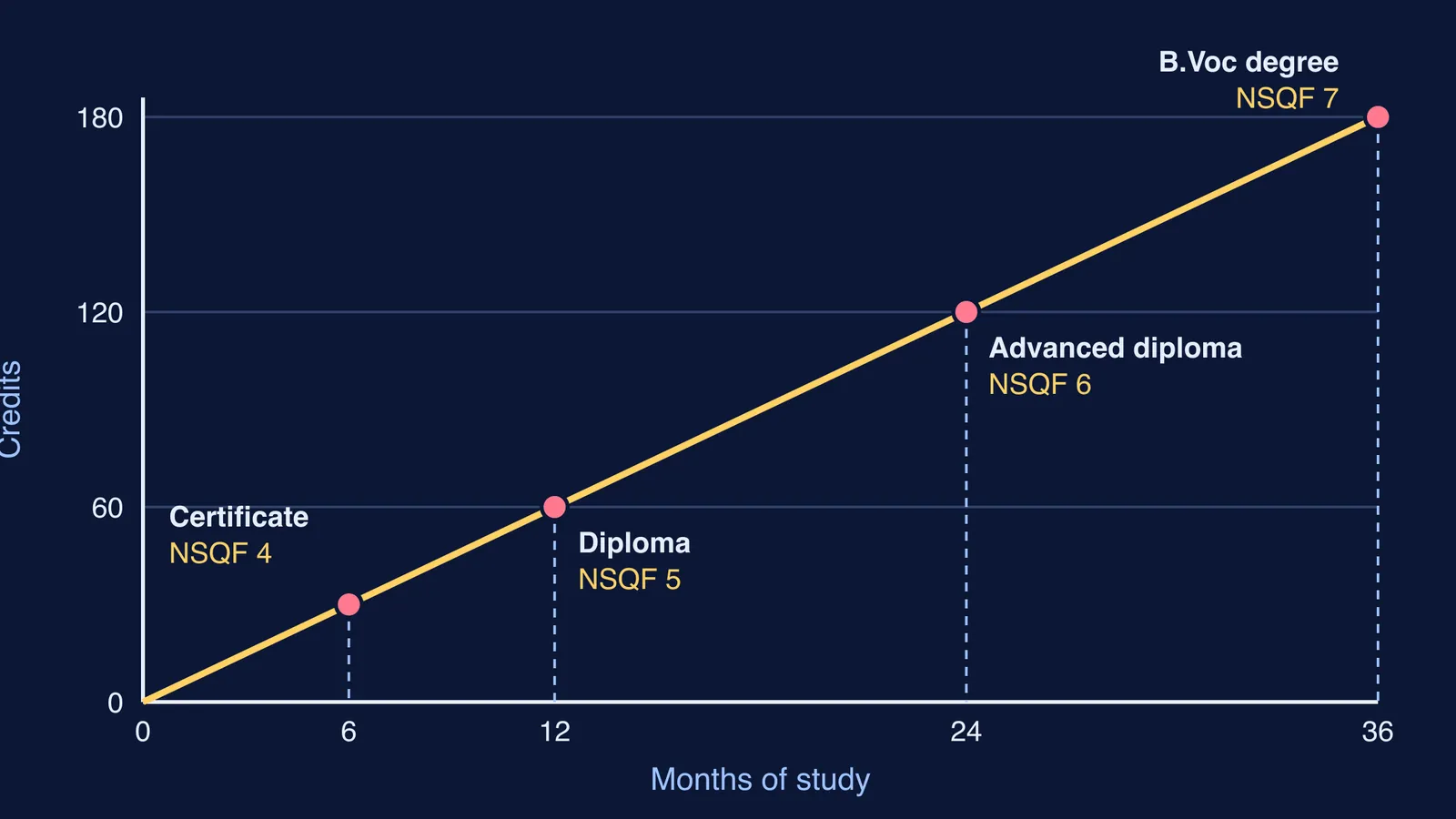
The best-known college route is the Bachelor of Vocation. Under the UGC guidelines for the B.Voc programme, you can leave with a certificate (NSQF Level 4) after one semester, a diploma (Level 5) after two semesters, an advanced diploma (Level 6) after four, or the B.Voc degree (Level 7) after six. Skill components make up 60% of the credits, and banked credits let you leave for work and come back. We have a fuller explainer on how the B.Voc degree works.
Which short job-oriented courses can a science student choose?
Three broad families are open to you after PCM or PCB:
NSQF-aligned certificate courses, usually tied to one job role and awarded through a Sector Skill Council. Our guide to national skill certifications and what they prove goes deeper.
B.Voc and community college diplomas at recognised colleges, where you can stop after one or two years with a qualification in hand.
Allied health and technical diplomas, such as lab technology or engineering. Many of these fields have their own approving council; our post on which regulatory council approves which course lists them.
How do you check whether a course is recognised?
Run this six-step check before you pay any fee:
Write down the exact qualification name and the NSQF level the institute claims.
Search that name on the National Qualifications Register. If it is not there, ask the institute which registered qualification it maps to.
Find the awarding body that signs the final certificate: a Sector Skill Council, a university or a state board, not just the training centre.
For a B.Voc or college diploma, confirm the university is genuine. The UGC's list of fake universities named 32 institutions as of February 2026.
For health or engineering diplomas, check approval with the relevant council for the current academic year.
Ask for placement records in writing, then speak to one former student yourself.
Who do short vocational courses suit?
They suit you if you like hands-on work, need to earn soon, or want to test a field before committing three or four years. Because the B.Voc ladder lets you exit and return, a one-year diploma can be a plan B that keeps doors open.
They suit you less if your target job legally needs a full professional degree, or if you are picking a course mainly to avoid a harder decision.
What does a careful choice look like in practice?
Take Meera, an imagined student who finished Class 12 with PCM. She needs to earn within a year and enjoys fixing gadgets. She compares an electronics course at a local training centre with the one-year diploma exit of a nearby college's B.Voc. The centre's course is not on the National Qualifications Register, and its certificate carries only the centre's name. The college course sits under a UGC-recognised university and states an NSQF level for each exit. She chooses the college, plans to work after the diploma, and can return for the degree later.
If a course leans on physics or maths you feel shaky about, such as circuits in an electronics diploma, the Fermi Concept Library has a lesson for every concept in physics, chemistry, biology, mathematics and computing, so you can close gaps before classes start.
What should you ask the institute before paying?
Take these questions to the admissions desk, with a parent taking notes:
"Which NSQF qualification does this course lead to, and what is its exact name on the National Qualifications Register?"
"Who awards the final certificate, and who conducts the assessment?"
"Can I see last year's placement list with employer names?"
"If I leave after one year, what qualification do I walk away with?"
Then compare your two shortlisted courses with the same six checks, and decide with the facts on paper.