On this page
A skill certificate is only as useful as the trust behind it. India has a national system that makes vocational certificates comparable and checkable. Knowing how it works helps you tell a useful certificate from one that just fills a folder.
Who recognises skill certificates in India?
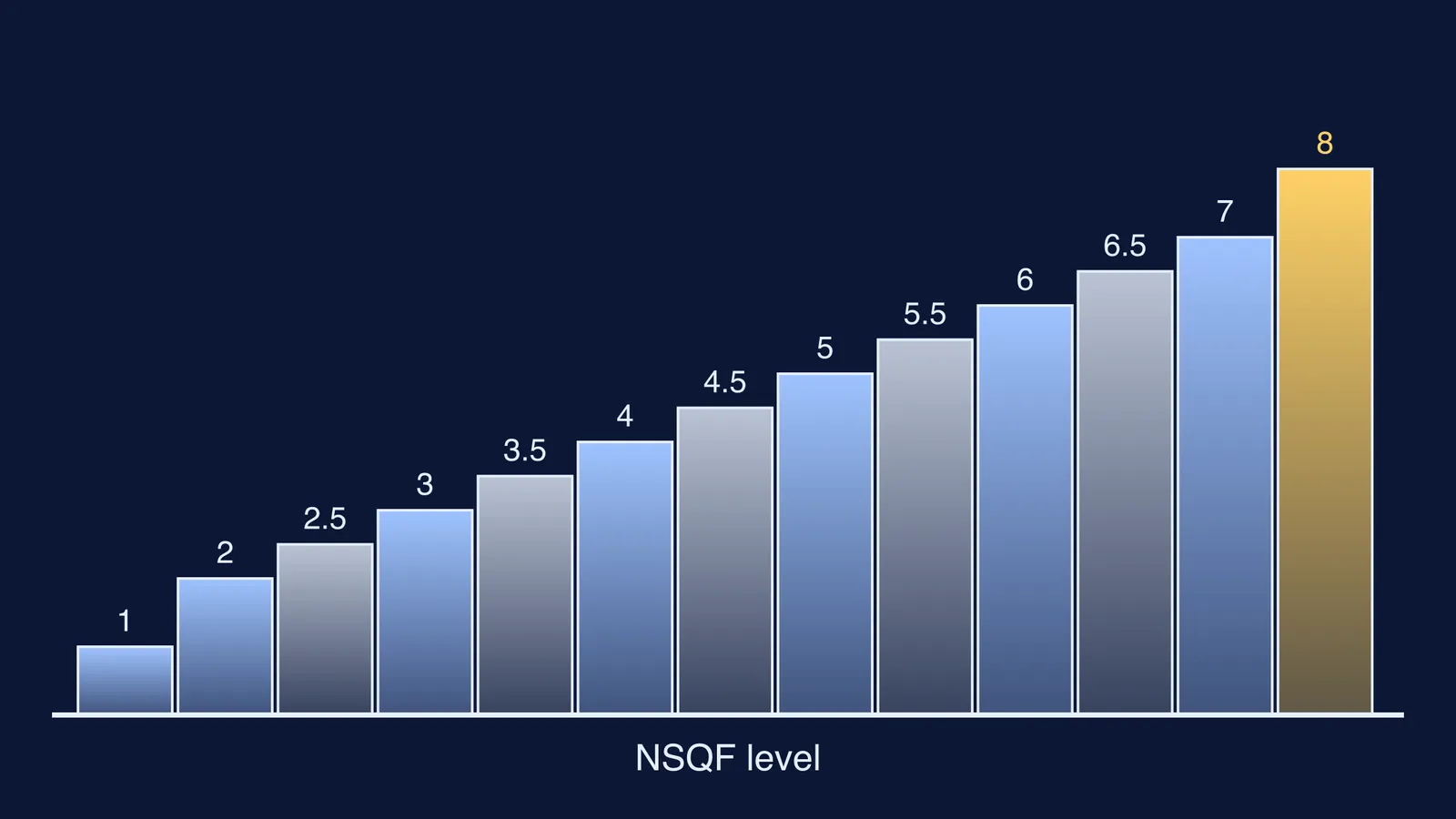
The first is a framework for levels. The National Skills Qualifications Framework (NSQF) was launched in December 2013 and rationalised and notified in June 2023, and it arranges qualifications from Level 1 to Level 8 by the knowledge, skill and responsibility each one demands, according to a Ministry of Skill Development release on PIB. The 2023 version also adds half-levels such as 2.5 and 4.5 between the whole numbers, as National Skills Network explains.
The second is a regulator. The National Council for Vocational Education and Training (NCVET) was notified on 5 December 2018 as India's overarching skills regulator, and its jobs include recognising awarding bodies and assessment agencies and approving qualifications, says the ministry's Year End Review 2025. The same review reports that by 28 December 2025 NCVET had recognised 161 awarding bodies and 68 assessment agencies, including 36 Sector Skill Councils.
Why does this matter? A certificate from an NCVET-recognised awarding body sits on a national scale. One from outside this system may still teach you something, but an employer has nothing to check it against.
Which sectors do national skill certificates cover?
Almost every kind of hands-on work. The National Qualifications Register is the official public record of all NSQF-aligned qualifications, and you can search it by sector, job role and level. Its sector list runs from apparel and aerospace to construction, electronics, healthcare and wood and carpentry.
The scale is large. The Year End Review 2025 says 27.08 lakh candidates had been trained under PMKVY 4.0 across 38 sectors by 7 December 2025, and that India had more than 14,682 ITIs. The same review counts more than 49.18 lakh apprentices engaged under the National Apprenticeship Promotion Scheme since 2016. It also notes that apprenticeship credits are now visible on DigiLocker, so learners can use them towards further study or employment.
Are government skill certificates useful for jobs?
Sometimes, and the honest answer depends on the job. Training does not guarantee work. In a written reply to the Rajya Sabha in April 2025, skills minister Jayant Chaudhary said the first three phases of PMKVY had a placement record of 43 per cent, with 24.37 lakh people placed, as Careers360 reported. He added that placements were tracked in those first three versions, while PMKVY 4.0 focuses on helping trainees choose their own career path. So treat a certificate as evidence of a skill, not as a job offer.
Use this four-question test before you add one to an application:
Does the job advert name the trade or job role, such as electrician or retail associate? A certificate in that exact role speaks directly to it.
Is the qualification on the National Qualifications Register, with an NSQF level and a named awarding body?
Did the course include a practical assessment or on-the-job training? Employers care what you can do, not how many hours you sat in a room.
Can the employer verify it in a minute, through DigiLocker or the awarding body?
Four yeses: lead with it. Two or three: list it under skills. One or none: leave it off and put the time into a project you can show.
A certificate is likely to count for less in degree-led hiring, such as campus placements for engineering graduates, where your degree, projects and interviews usually carry more weight.
How do you show a skill certificate on a CV?
Write it so a recruiter can check it without asking you. A good line names four things: the qualification title, the NSQF level, the awarding body and the year. For example: "Qualification title, NSQF Level 4, awarded by the Sector Skill Council for that trade, 2026. Verifiable on DigiLocker." Add the last part only if your certificate is actually there.
In an interview, link it to the work in two sentences: "The course had a practical assessment where I wired and tested a distribution board. I can walk you through how I checked it was safe before switching it on." A specific task turns a certificate into a reason to hire you.
Many technical trades lean on Class 10 science, such as current, voltage and resistance for electrical work. If those ideas feel shaky, the Fermi Concept Library has a lesson on every concept in physics, chemistry, biology, mathematics and computing, so you can fix the gap before the course moves on.
Where should you go next?
Choosing a route after Class 10? Read our comparison of ITI and polytechnic after Class 10. Already hold a diploma or degree? See apprenticeships for engineering graduates. For private course certificates, read what employers check in online course certificates.