On this page
Every year, thousands of engineering students finish their final semester with solid theoretical understanding but little real-world industrial exposure. While classroom laboratories demonstrate core phenomena, they rarely prepare graduates for the high-throughput production lines, enterprise software stacks, and compliance standards of commercial engineering. For degree and diploma holders seeking a structured entry into the workforce, statutory apprenticeship schemes provide an established, government-regulated bridge.
Administered under the Apprentices Act, 1961, by the Ministry of Education's Regional Boards of Apprenticeship Training (BOAT) and Board of Practical Training (BOPT), the National Apprenticeship Training Scheme (NATS) places technically qualified youth directly into industry. Rather than functioning as temporary campus interns or casual hires, enrolled candidates are registered trainees entitled to statutory stipends, structured mentorship, and national certification.
How does an engineering apprenticeship work in India?
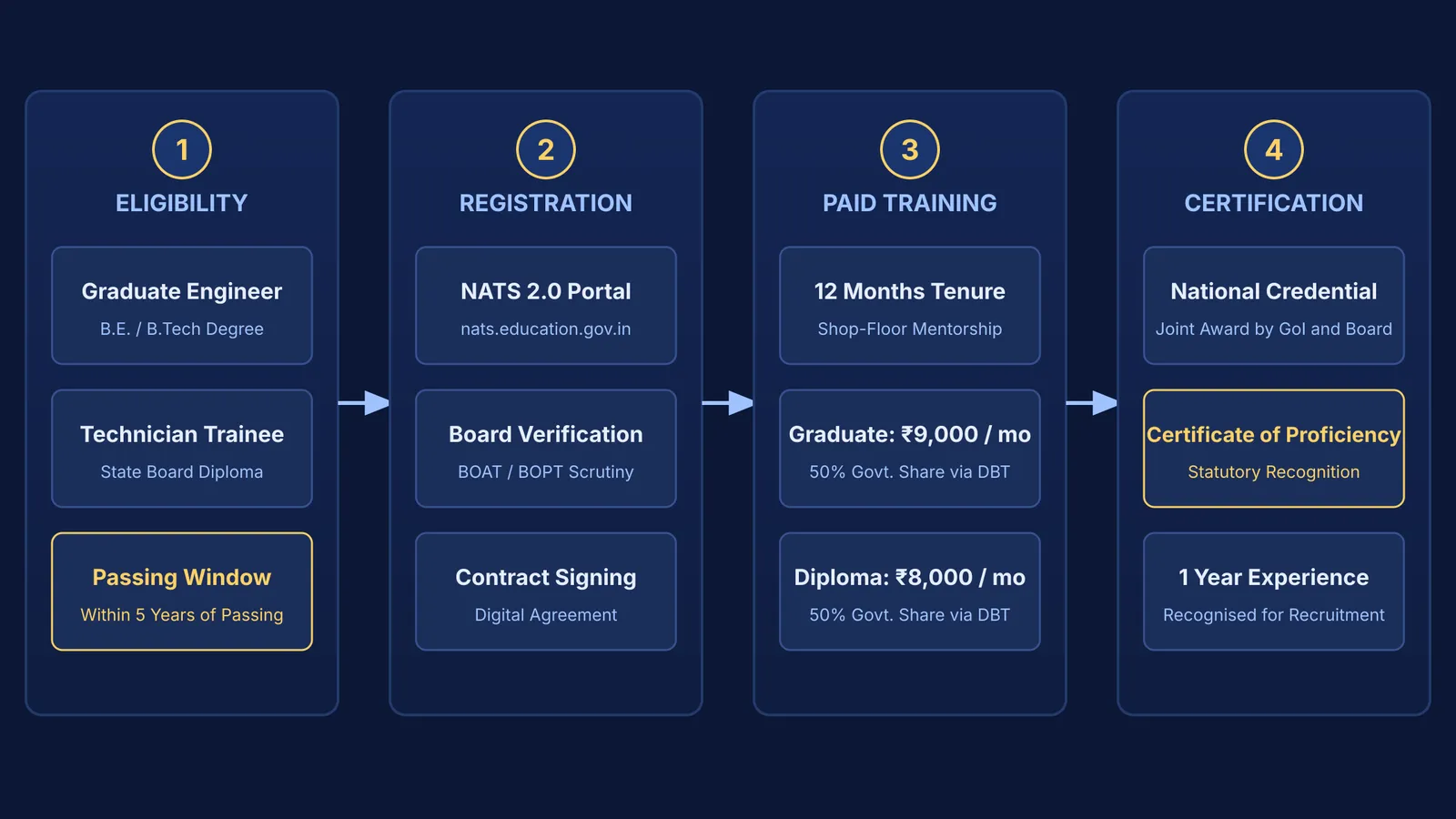
At its core, an engineering apprenticeship under NATS is a statutory, 12-month contract of on-the-job practical training between an accredited establishment and a fresh graduate. Unlike informal internships, the training curriculum is formally registered with one of four regional boards—located in Mumbai, Chennai, Kanpur, and Kolkata—ensuring that host companies follow prescribed syllabi rather than assigning routine administrative chores.
Under Indian labour law, apprentices are classified as statutory trainees rather than conventional employees. This legal distinction means trainees do not receive statutory retirement benefits such as provident funds or gratuity, but it also exempts them from commercial employment bonds. Instead, companies provide dedicated shop-floor mentors, technical safety training, and hands-on machinery access. While degree candidates who plan to enter academia often pursue research internships for undergraduates in India, those aiming for technical industry roles benefit directly from formal shop-floor apprenticeships.
Who is eligible, and what stipend do you receive?
Eligibility under the National Apprenticeship Training Scheme divides technical applicants into two formal statutory categories:
Graduate Apprentices: Candidates holding a degree in engineering or technology (such as B.E., B.Tech, or equivalent qualifications) from a recognized university.
Technician Apprentices: Candidates holding a state-board diploma in engineering or technology.
Under statutory guidelines outlined on the MyScheme NATS portal, you must be an Indian citizen and must apply within the graduation window (traditionally within 3 years, with recent portal rules extending up to 5 years from course completion). Crucially, you must not have previously completed an apprenticeship or accumulated 1 year or more of formal work experience. Because competitive apprenticeship openings in top public sector undertakings evaluate degree or diploma aggregate scores during shortlisting, our guide on how to improve your CGPA in college outlines structured semester planning.
Apprentices receive a mandatory monthly stipend throughout their 12-month tenure. Under the framework outlined on the MyScheme NATS portal, the central government prescribes statutory minimum stipends—historically pegged at ₹9,000 per month for graduate engineers and ₹8,000 per month for diploma technicians, with 50% reimbursed by the central government. Many large public sector undertakings (PSUs) and multinational enterprises voluntarily pay significantly higher stipends, often ranging between ₹12,000 and ₹25,000 per month depending on sector and plant location.
Transitioning from academic coursework to an industrial floor often exposes gaps between textbook derivations and practical engineering systems. If you need to revisit core principles across physics, mathematics, or computing before attending technical placement interviews, the Fermi Concept Library arranges each foundational concept into structured lessons within a broader subject map.
How do you apply through the NATS 2.0 portal?
On July 30, 2024, the Ministry of Education upgraded the national framework by launching the NATS 2.0 portal, disbursing over ₹100 crore in stipends on launch day. The platform centralized candidate verification, establishment matching, contract signing, and stipend disbursals into a single digital workflow.
To secure a placement, candidates follow a structured four-step procedure:
Student enrollment: Register on the official portal (`nats.education.gov.in`) with your Aadhaar number, degree or diploma certificate, and active bank account details.
Regional board verification: Your regional BOAT or BOPT office reviews and verifies your academic credentials, issuing a unique student enrollment number.
Establishment search: Browse open vacancies posted by participating public and private establishments, filtering by engineering discipline, state, and stipend rate.
Contract execution: When selected through written screening or interviews, the employer issues an apprenticeship contract on the portal, which you sign digitally to initiate the 12-month tenure.
For tackling equipment calculations, circuit analyses, or applied thermodynamics problems encountered during training, the Fermi Problem Library provides worked problems with a step-by-step solver that explains the underlying reasoning rather than merely printing a numerical answer.
Does an apprenticeship lead to a permanent job?
A common misconception among students and parents is that completing an apprenticeship guarantees absorption as a regular employee. Under Section 22 of the Apprentices Act, 1961, employers are mandated to formulate their own internal recruitment policy for apprentices, but they are under no statutory obligation to offer permanent employment unless an explicit retention clause is written into the training contract.
However, the real value lies in the government credential. Upon successfully completing the 1-year training period, you receive a Certificate of Proficiency issued jointly by the Government of India and the respective regional board. Under central and state recruitment norms, this certificate is formally recognized as 1 year of valid technical work experience. Just as students navigate unfamiliar routines during their first semester at engineering college, transitioning into an industrial plant requires shifting from passive exam preparation to active, day-to-day technical execution—giving apprentices an undeniable competitive edge in subsequent job searches.