On this page
The rise of digital learning has made it easier than ever to add qualifications to your resume. However, many students are unsure if spending time and money on these credentials will actually lead to job offers. Are online course certificates worth it?
The short answer is yes, but employers do not value the piece of paper itself as much as the skills it represents. Understanding how hiring managers view these certificates will help you choose the right ones, structure your learning effectively, and present your qualifications to potential employers in a compelling way.
Do employers care about online certificates?
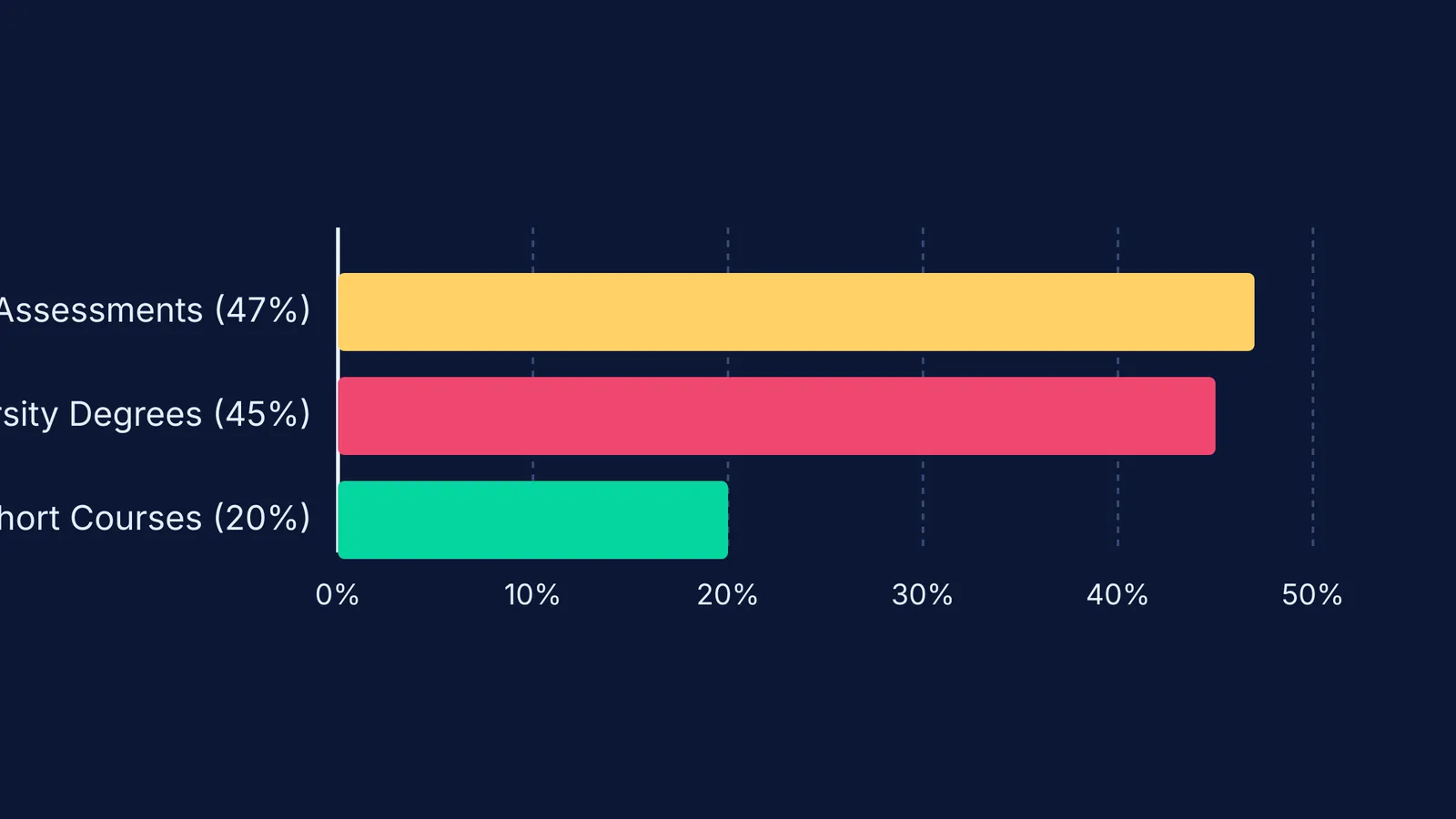
The hiring landscape is shifting towards a "skills-first" approach, where what you can do matters more than where you learned to do it. According to The Future of Jobs Report 2023, nearly 47% of companies now use skill assessments to select candidates, overtaking the 45% that prioritise a university degree. Furthermore, 20% of companies explicitly rank short courses and online certificates among their top three criteria for evaluating talent.
This means that while a certificate might get your application noticed, it is your ability to demonstrate the underlying skill that ultimately secures the job. Earning a certificate also builds internal self-assurance, which translates into better interview performance; according to a Coursera report on micro-credentials, 85% of students with these qualifications reported greater confidence in their skills.
What skills are employers looking for?
While technical skills like data analysis and coding are highly sought after, employers are increasingly valuing cognitive flexibility. The World Economic Forum identifies analytical and creative thinking as the most critical skills for the future, highlighting the need for employees who can adapt to new challenges.
This means the most valuable online courses are those that force you to solve complex problems rather than just memorising facts. It is not enough to simply watch videos; you must actively engage with the material to develop the analytical skills that modern jobs demand. If you are preparing for skill assessments, having a structured study plan, such as Using an AI tutor in the week before an exam: a day-by-day plan, can help you translate passive learning into active problem-solving.
Why finishing courses with projects is essential
A certificate shows that you have been exposed to a topic, but a project proves that you can apply it to solve real-world problems. Employers often check your portfolio—such as a GitHub repository for coding, a design portfolio for user experience, or a detailed case study for business analytics—before they look at the name on your certificate.
When you take an online course, do not just answer the multiple-choice quizzes. Build something. If you are learning data analysis, download a public dataset and write a comprehensive report. If you are learning web development, build a functional website and host it online. Doing so transforms your theoretical knowledge into a tangible asset.
Bridging the gap in STEM subjects
For students learning difficult scientific or mathematical concepts, online video lectures can sometimes leave you with unanswered questions, making it hard to complete those crucial hands-on projects.
This is where active learning tools are essential. If you are studying university-level science or mathematics, Fermi's AI tutor can work out what you already know and build a plan for the session, so you sit down to a clear next step. When you encounter a topic that is difficult to picture, the Fermi Simulation Lab provides interactive simulations for ideas that are easier to see than to read.
When deciding how to get help with these complex subjects, you might weigh different options, such as choosing an AI tutor or private tutor? What each does well and how to combine.
A plan to make your certificates count
To maximise the return on the time you invest in online learning, follow this practical checklist for every new course you start:
Look for courses that require a capstone project or a final assignment that you must build yourself.
Pair a high-demand technical skill, such as programming or data analysis, with courses that develop human-centric skills like leadership or communication.
Save all your assignments and organise them into a public portfolio that you can link to in job applications.
When preparing for an interview, rehearse a short explanation of the most challenging problem you solved during the course.
Online certificates are a powerful way to signal your commitment to lifelong learning, but they are only the first step. By focusing on the skills you acquire and the projects you build, you can show employers exactly what you are capable of achieving.