

On this page
When you join a professional course in India, the university awarding your certificate is only half of the legal framework. While universities confer academic degrees, specialised statutory bodies—known as professional councils—set curricula, inspect infrastructure, and grant statutory approval for you to practise.
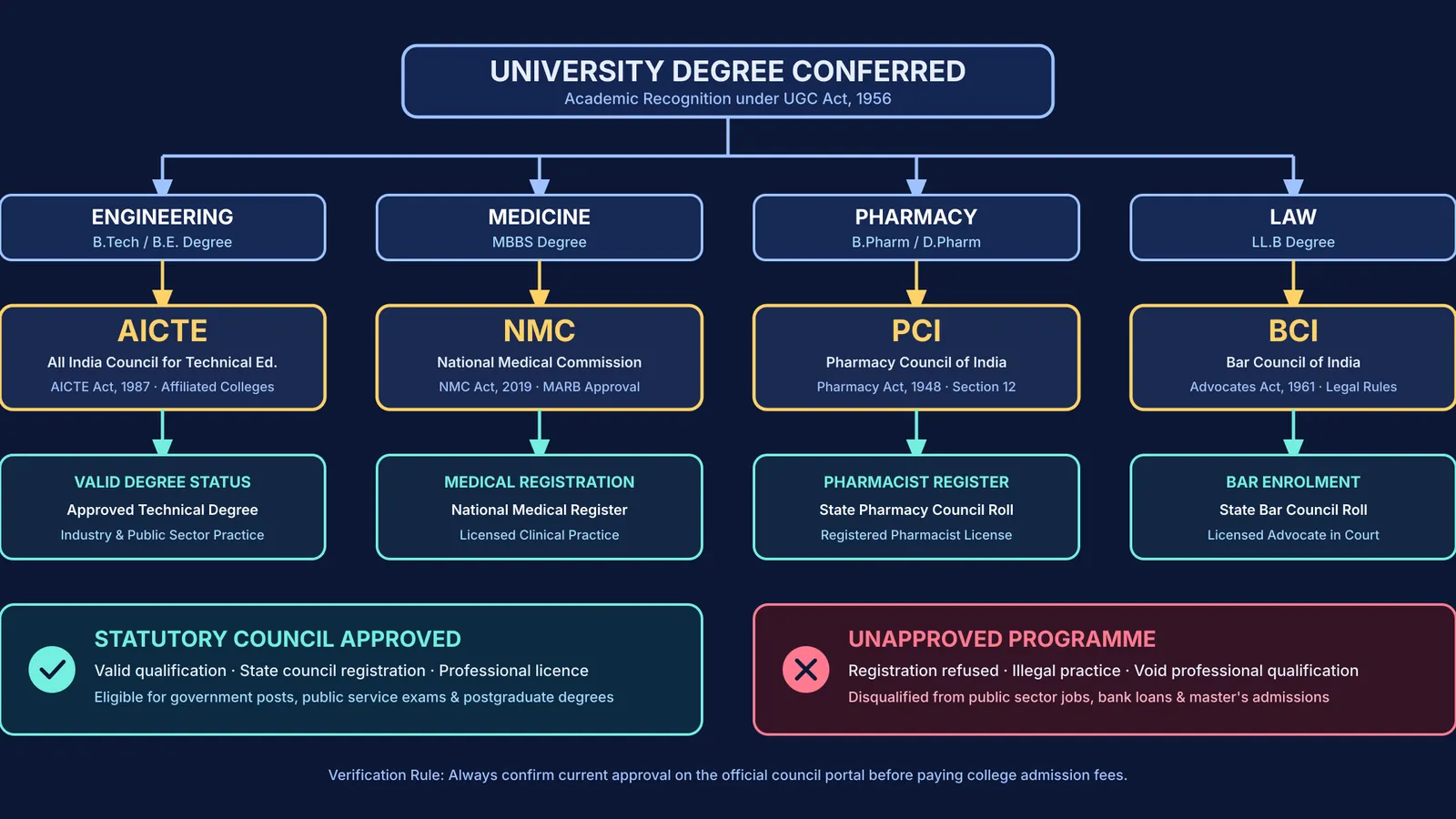
Different disciplines answer to distinct statutory authorities established by Parliament:
Engineering and Technology: The All India Council for Technical Education (AICTE), constituted under the AICTE Act, 1987, approves technical programmes across affiliated colleges.
Medicine: The National Medical Commission (NMC), established by the National Medical Commission Act, 2019 to replace the Medical Council of India, oversees medical degrees (MBBS) through its Medical Assessment and Rating Board.
Pharmacy: The Pharmacy Council of India (PCI), established under the Pharmacy Act, 1948, regulates diploma and degree pharmacy education.
Law: The Bar Council of India (BCI), under the Advocates Act, 1961, regulates legal education and sets standards for LL.B degrees.
Architecture: The Council of Architecture (CoA), under the Architects Act, 1972, regulates five-year B.Arch programmes.
Why is university UGC recognition not enough for professional degrees?
A common misunderstanding is that if an institution has recognition from the University Grants Commission (UGC) under the UGC Act, 1956, its degrees automatically allow professional practice. UGC recognition authorises a university to award degrees, but it does not confer a professional licence.
The Supreme Court of India clarified this boundary in landmark decisions. In *Bharathidasan University v. AICTE (2001)*, the Court held that universities created by statute do not require prior AICTE approval to start engineering departments, because the AICTE Act excludes universities from its definition of technical institutions. However, all affiliated colleges must secure AICTE approval.
In medicine and pharmacy, statutory council approval is mandatory for all institutions. In *PCI v. Dr. S.K. Toshniwal Educational Trusts (2020)*, the Supreme Court ruled that the Pharmacy Act is a special statute giving PCI exclusive authority over pharmacy courses, superseding AICTE. Under Section 12 of the Pharmacy Act, graduates cannot register as pharmacists without PCI course approval. Similarly, the NMC Act, 2019 requires every medical college, including those in deemed universities, to secure prior NMC permission before admitting students.
What happens to students who graduate from an unapproved programme?
Studying in a programme that lacks council approval carries serious legal and professional risks:
Registration refusal: Graduating from an unapproved MBBS or B.Pharm programme prevents you from joining the National Medical Register maintained by the National Medical Commission or the state registers of the Pharmacy Council of India, making professional practice illegal.
Ineligibility for government posts: Public service commissions and government undertakings reject applicants whose degrees come from unapproved programmes during document verification.
Loan and scholarship denials: Education loans under Indian Banks' Association guidelines require council-approved courses, and unapproved colleges disqualify students from central and state scholarships.
Blocked higher education: Universities and foreign evaluation bodies reject unapproved degrees when assessing candidates for master's programmes.
When working through foundational coursework in university-level engineering or basic sciences, the Fermi Problem Library provides worked problems with a step-by-step solver that explains the reasoning rather than printing an answer.
How can you verify your college and course before paying admission fees?
Before paying fees, use this five-point verification checklist to safeguard your degree:
Search the official council portal: Check the AICTE Approved Institutes dashboard, the NMC College and Course Search directory, or the PCI Approved list directly rather than relying on college marketing.
Confirm the exact branch name: An institution may have approval for traditional branches while running newer specialisations without council sanction.
Verify the approved intake: Councils sanction a specific seat count. Excess students admitted beyond the approved quota cannot be registered.
Follow central counselling seat lists: Centralised counselling systems provide verified seat matrices. Engineering applicants can review JoSAA counselling basics, and medical candidates can check NEET UG counselling basics.
Inspect the Extension of Approval letter: Ask the college for its current Extension of Approval letter from the council to ensure coverage for your entry year.
Starting your course at a verified institution ensures a smooth transition into your first semester at college. For students preparing for university-level coursework, the Fermi Concept Library covers every concept in physics, chemistry, biology, mathematics and computing, each with its own lesson and its place in the map.


