On this page
VITEEE is the entrance test for B.Tech at the VIT campuses, and the 2027 paper is shorter than the one students sat in 2026. Your rank decides when you enter counselling, and that decides which fee categories are still open when you choose.
What is the VITEEE 2027 exam pattern?
According to the official VITEEE 2027 page, the test is a computer-based exam of 100 multiple-choice questions in 2 hours. Mathematics (or Biology) has 40 questions, Physics 25, Chemistry 25, Aptitude 5 and English 5.
Each section has its own clock on the same page: 50 minutes for Mathematics or Biology, 30 minutes each for Physics and Chemistry, and 10 minutes for English and Aptitude.
VITEEE 2027 gives +4 marks for a correct answer and -1 for a wrong one, so the maximum is 400 marks (VITEEE 2027). This is a change: the 2026 paper had 125 questions in 2 hours 30 minutes, as VIT's own blog described in January 2026. Retime older papers before you use them.
The official page lists the exam window as 27 April to 2 May 2027 (tentative) and says you can appear only once. The section clocks give you a pace to practise: about 75 seconds per Maths question, 72 seconds per Physics or Chemistry question, and 60 seconds per English or Aptitude question.
How does your VITEEE rank decide your fee category?
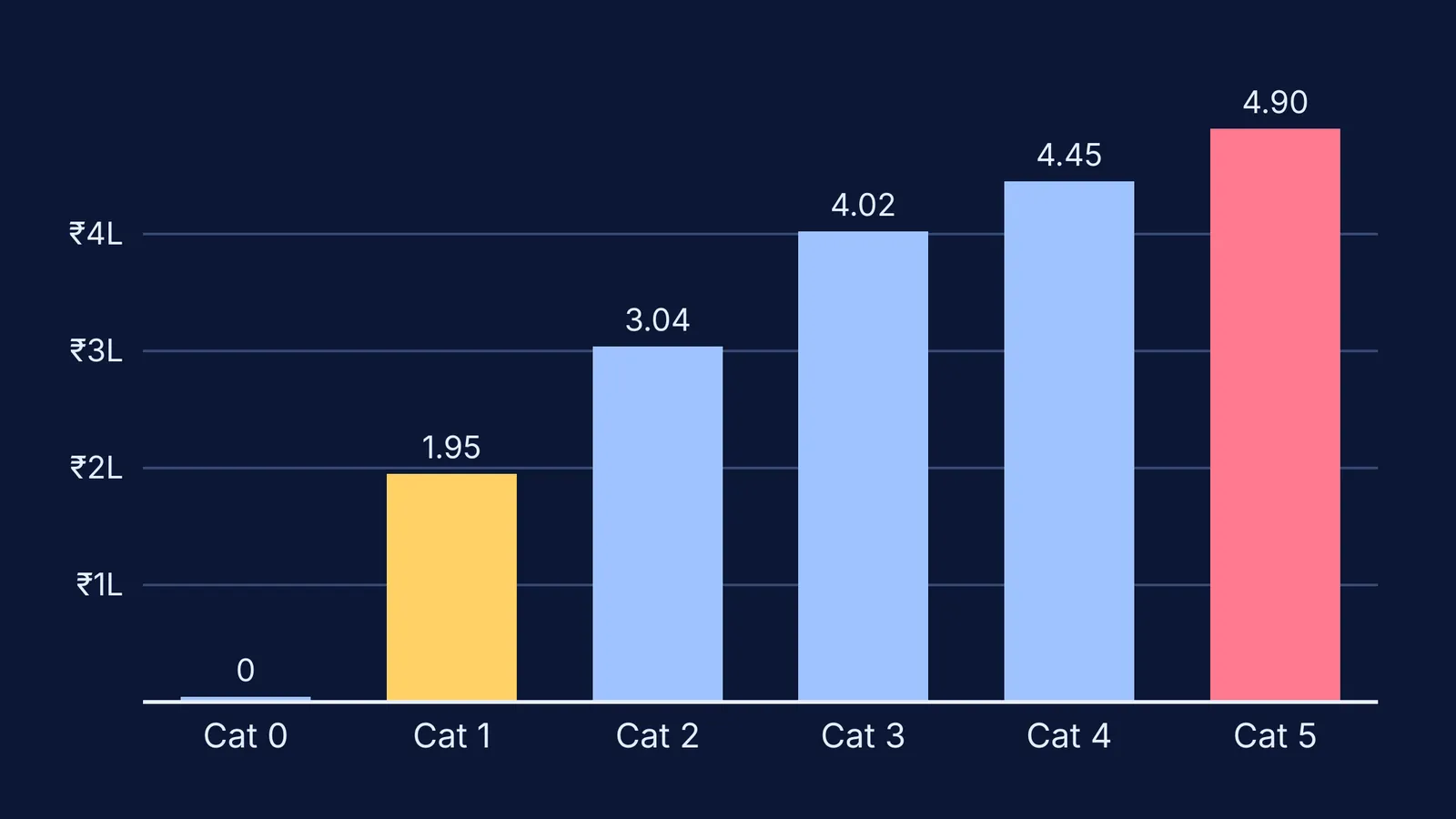
VIT charges the same programme at different tuition levels called fee categories. For B.Tech Computer Science and Engineering at Vellore (Group B), the official 2026-27 fee structure lists annual tuition of ₹1,95,000 in Category 1, ₹3,04,000 in Category 2, ₹4,02,000 in Category 3, ₹4,45,000 in Category 4 and ₹4,90,000 in Category 5, the no-scholarship level. Category 0 is listed at zero.
Your scorecard does not print a category. Counselling runs in phases by rank, and at your turn you choose a campus, programme and fee category from what is still available; the VITEEE page says allotment depends on your rank and seat availability, and that cut-off ranks differ from year to year.
In 2026, Phase 1 covered ranks 1 to 20,000, Phase 2 ranks 20,001 to 45,000, Phase 3 ranks 45,001 to 70,000, Phase 4 ranks 70,001 to 1,00,000 and Phase 5 everything above, as Careers360 reported. In a later phase, expect fewer lower-fee seats left in popular branches.
A worked example: take CSE at Vellore at the 2026-27 rates above. Category 1 costs ₹1,95,000 a year and Category 5 costs ₹4,90,000, a gap of ₹2,95,000 a year. Over four years that is ₹11,80,000 in tuition alone, before hostel and other fees, and assuming the rates do not change.
So agree on two things at home before counselling: the highest category you will accept, and whether a different branch or campus in a lower category beats your first-choice branch in a higher one. Our worksheet on high-fee private engineering colleges helps you put those numbers side by side.
How do you prepare for VITEEE alongside JEE Main in six weeks?
Keep JEE Main as your main plan (our week-by-week plan for the last three months before JEE Main covers that) and give VITEEE 30 to 45 minutes on weekdays plus one weekend slot. First, download the subject-wise syllabus PDFs under Admission Guidelines on the VITEEE site and tick off chapters already on your JEE list. If you are not sure where to begin, Fermi's AI tutor can work out what you already know and build a plan for the session.
Week 1: Take one full paper in the 2027 format with the section clocks. Note your score in each section.
Week 2: Pace drills, three times: 20 Maths questions in 25 minutes, then 15 Physics or Chemistry questions in 18 minutes.
Week 3: Study the chapters only VITEEE asks for, and do a 10-minute English and Aptitude set every day.
Week 4: Two full timed papers. Sort each wrong answer as wrong method, careless slip or never learnt. For wrong-method errors, the Fermi Problem Library has a step-by-step solver that explains the reasoning rather than printing an answer.
Week 5: One full paper. Practise your skip rule: with -1 for a wrong answer, leave a question you cannot narrow down, and keep moving.
Week 6: One paper early in the week, then only your error log and sleep. Download the admit card, which VIT lists for 25 to 30 April 2027.
What should you have ready for VITEEE counselling?
The fee ceiling your family agreed on, written down.
A ranked list of campus, branch and category combinations, from first choice to the last one you would still join.
Your phase dates, checked on vit.ac.in, not on a forwarded message.
Your plan for other counsellings that run at the same time; our guide to managing several counselling rounds without losing fees helps here.
The VITEEE page states that application and counselling fees are non-refundable, so register for a phase only when you mean to take part.