
On this page
A private engineering seat can be a good decision or a decade of EMIs. Three numbers usually tell you which: what the four years cost in total, what the loan costs by the day it is paid off, and what the college's own graduates actually earned. Here's how to check each.
What does a private engineering seat really cost?
Tuition is only the first line. Write down the full four-year figure for each college:
Tuition for all eight semesters, including announced increases
Hostel and mess, or rent and food if there is no hostel
One-time charges: admission, caution deposit, exam and registration fees
A laptop, books, lab coats and project costs
Travel home, and a monthly allowance for your child
Get the whole-course fee schedule in writing before paying a seat-holding amount. If a college or agent won't put numbers on paper, treat that as an answer. Our guide on how to evaluate a private university's claims has more questions to ask.
How much will an education loan cost by the time you repay?
Price the loan, not just the fee, and first check whether you qualify for an interest subsidy.
Under PM-USP CSIS, students with family income up to ₹4.5 lakh a year on technical or professional courses at approved institutions get full interest subvention during the moratorium on loans up to ₹10 lakh, according to the Cabinet's PM Vidyalaxmi release (PIB, 6 November 2024). The same release says PM Vidyalaxmi gives a 3% interest subvention during the moratorium on loans up to ₹10 lakh for students from families earning up to ₹8 lakh who are not eligible for any other government scholarship or interest subvention scheme. It applies only at colleges in the NIRF top 100 (overall, category or domain), state government colleges ranked 101 to 200, and all central government institutions. It is capped at one lakh students a year, with preference for government institutions, so don't count on it at a private college.
Here is a worked example with illustrative rates, not a bank quote; swap in the figures from your sanction letter.
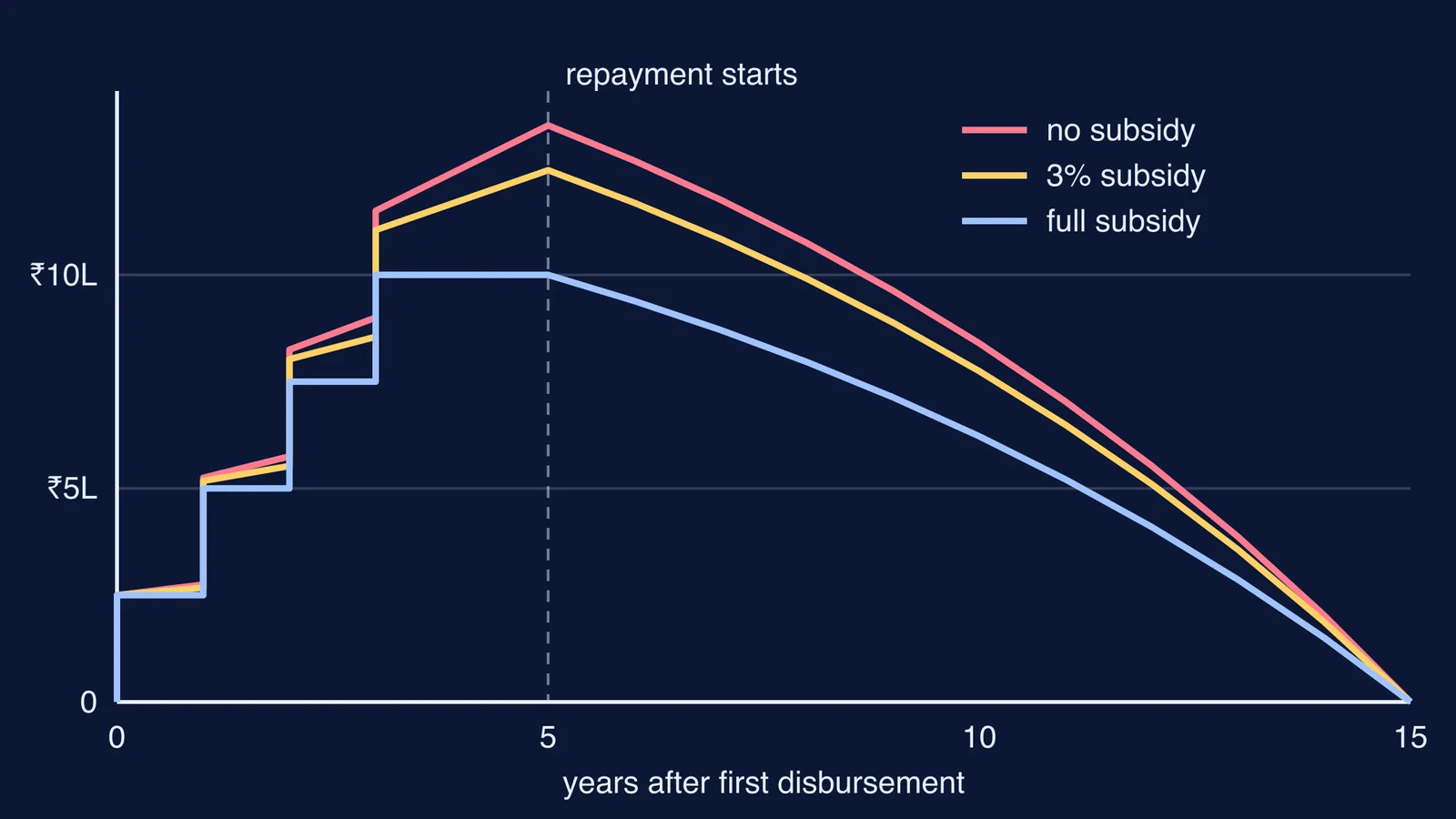
Assume you borrow ₹10 lakh, paid out as ₹2.5 lakh at the start of each of the four years. Assume 10% simple interest builds up until repayment begins one year after the course ends, followed by a 10-year EMI at 10%.
No subsidy: ₹3.5 lakh of interest builds up, so you start repaying ₹13.5 lakh. The EMI is about ₹17,840 a month, and you repay about ₹21.4 lakh in total.
With a 3% interest subsidy during the moratorium: ₹2.45 lakh builds up. The EMI is about ₹16,450, and the total is about ₹19.7 lakh.
With full interest subsidy during the moratorium: you start at ₹10 lakh. The EMI is about ₹13,215, and the total is about ₹15.9 lakh.
To talk this through with your teenager, see how to explain an education loan to a teen.
How do you check a college's placement claims?
Ignore the "highest package" banner and look at what the college reported to the government. NIRF's engineering methodology scores colleges on the percentage of graduates placed or selected for higher studies, and on the median salary of graduates over the previous three years, using data the institution provides (NIRF 2025 engineering framework). For ranked colleges, each institute's submitted data file is linked from the NIRF engineering rankings page.
IIT Madras is a public institute, but its file shows the format. In IIT Madras's NIRF 2025 data file, the four-year UG batch that finished in 2023-24 lists 714 students graduating on time, 549 placed and 153 selected for higher studies. The median salary of placed graduates is listed as ₹17.5 lakh. Do the same three sums for any college you're considering:
Placed ÷ graduating on time: how much of the batch actually got jobs
Graduating on time ÷ admitted four years earlier: how many finished on schedule
Median salary of placed graduates: this excludes anyone not placed
If an unranked college won't share figures in this format, you can't verify its claims.
What are the alternatives to a high-fee seat?
Run every real option through the worksheet:
A lower-fee government or state college through later counselling rounds (see choosing between an NIT and a state college)
A different branch at a better-value college
A private college that qualifies for PM Vidyalaxmi, if you'll need a collateral-free loan
A drop year with a clear plan, if the scores suggest a much better seat is within reach
If you take the drop-year route, Fermi's AI tutor works out what you already know and builds a plan for each session, so each day starts with a clear next step.
Fill in the worksheet for your top two options this week, before any seat-holding deadline.