

On this page
Between May and August every year, admission brochures, social media campaigns, and education fairs flood families with dazzling promises. Phrases like "guaranteed placement track record," "highest international offer of ₹54 LPA," and "world-class campus" dominate glossy leaflets. Yet behind modern infrastructure, private universities in India operate under strict statutory frameworks overseen by the University Grants Commission and enacted by Parliament, state assemblies, and the Supreme Court of India. Enrolling in an institution based purely on marketing brochures rather than verified regulatory filings can leave students with unrecognized degrees, invalid professional qualifications, or non-refundable fees swallowed by unauthorized study centres.
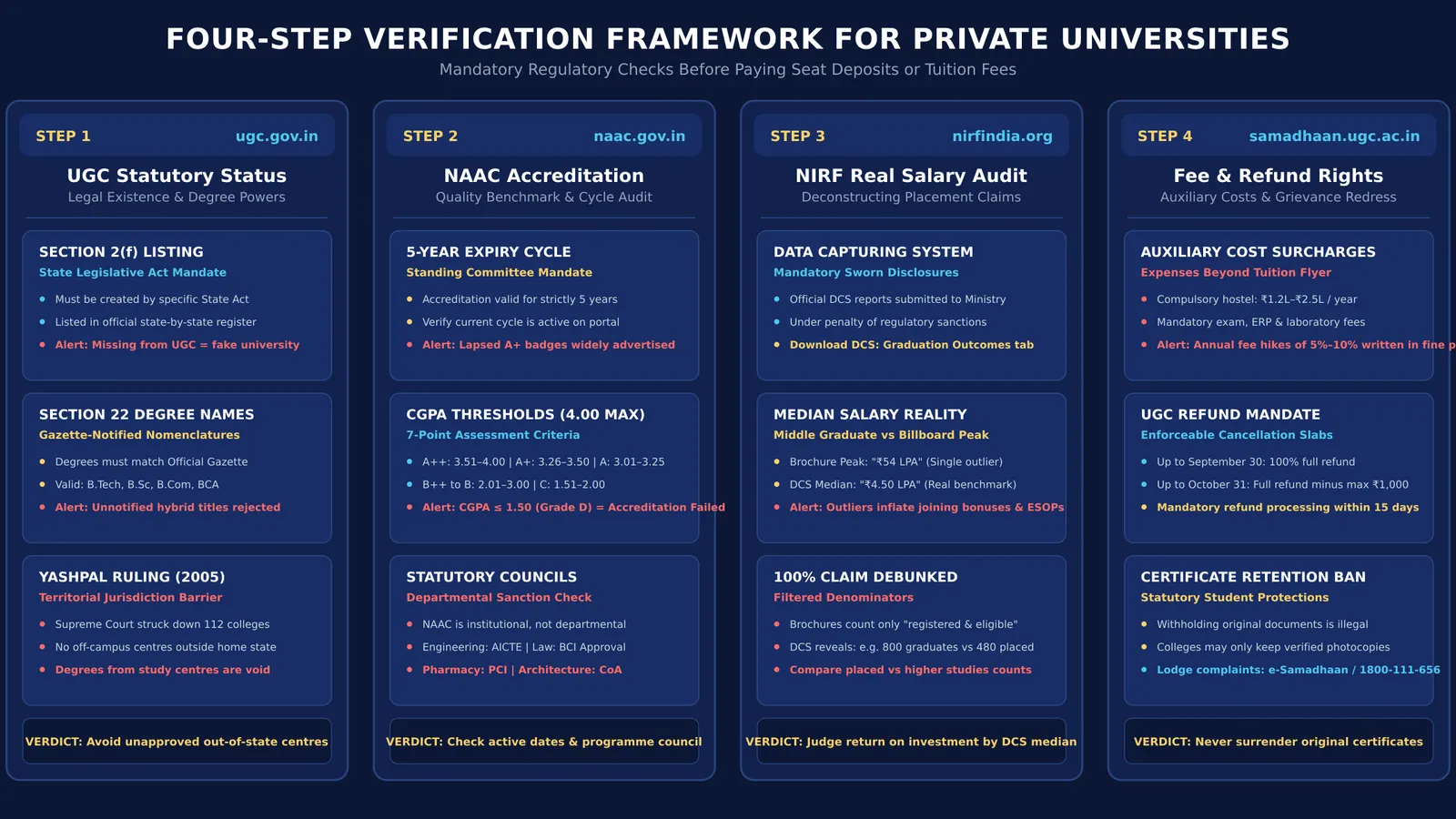
Before paying any seat acceptance fee or advance tuition deposit, parents and students should systematically audit an institution across four independent regulatory portals.
How do you verify UGC recognition and degree validity?
The foundational baseline for any higher education institution in India is the University Grants Commission Act, 1956. Under Section 2(f) of the Act, a university must be incorporated under a Central Act, a Provincial Act, or a State Legislature Act. You can immediately confirm whether a university legally exists by searching the official University Grants Commission consolidated directory of universities. If the institution is absent from this statutory state-by-state register, it is not empowered to grant degrees, regardless of what its website or campus marketing claims.
Listing under Section 2(f) verifies the university's legal existence, but you must also examine Section 22 of the UGC Act, which governs the specification of degrees. Universities can only confer degrees whose exact nomenclatures—such as B.Tech, B.Sc, B.Com, or BCA—have been officially notified in the Gazette of India by the University Grants Commission. Private universities frequently market novel titles such as "B.Tech in Artificial Intelligence Management" or hybrid industry diplomas dressed up as undergraduate degrees. If the exact degree title is not notified under Section 22, public sector employers, national entrance examinations, and foreign universities can reject the credential outright.
A recurring regulatory trap is the unauthorized off-campus centre. In the landmark case *Prof. Yashpal & Anr. v. State of Chhattisgarh & Ors.* (2005), the Supreme Court struck down statutory provisions that had created 112 private universities without basic physical infrastructure, establishing that state private universities cannot operate study centres, examination franchises, or regional campuses outside their home state. Even within their home state, universities require 5 years of operation and prior approval from the University Grants Commission before opening any off-campus branch. In addition, professional degrees require approval from specialized statutory councils: engineering programmes should follow AICTE norms, law degrees require Bar Council of India (BCI) clearance, pharmacy degrees need Pharmacy Council of India (PCI) approval, and architecture programmes require Council of Architecture (CoA) sanction.
What do NAAC grades and NBA accreditations actually mean?
Private universities frequently display prominent gold badges reading "NAAC A+ Accredited" across billboards and newspaper advertisements. The National Assessment and Accreditation Council evaluates higher education institutions across seven criteria on a 4.00-point Cumulative Grade Point Average (CGPA) scale, which you can verify on the NAAC Accreditation Portal. Under this system, grades span from A++ (CGPA 3.51 to 4.00) down to C (CGPA 1.51 to 2.00), while institutions scoring 1.50 or below receive a D grade and fail accreditation.
However, parents must watch for two common marketing deceptions. First, NAAC accreditation is institutional, not departmental. An institution with an overall A grade might have achieved that rating based on an established arts or business faculty, while its newly launched biotechnology or computer science department lacks qualified professors and accredited lab facilities. Second, NAAC accreditation is valid for strictly 5 years from the date of the executive committee's decision. Many institutions continue advertising an A+ badge awarded a decade ago that lapsed without renewal. Always search the institution on the NAAC Accreditation Portal to confirm that the accreditation cycle is active. For a broader framework on institutional benchmarks, explore our guide on how to read NIRF data sensibly.
How can you spot misleading placement statistics?
University placement brochures are engineered to highlight exceptional outliers while concealing general cohort realities, which differs sharply from verified reporting on the NIRF Portal. A front-page banner boasting a "Highest Package: ₹54 LPA" usually reflects a single student who secured an off-campus international offer, or a domestic corporate compensation structure inflated by non-guaranteed joining incentives, retention bonuses, and four-year employee stock vesting schedules.
To learn what an ordinary graduate actually earns, ignore promotional flyers and download the institution's official Data Capturing System (DCS) submission from the NIRF Portal. Under the Graduation Outcomes parameter, participating institutions must submit verified placement records under penalty of regulatory sanctions. These DCS disclosures provide three essential figures:
The total graduating cohort size compared to the number of students actually placed through campus recruitment.
The median salary of placed graduates, which reflects the middle earning figure and cannot be distorted by a single high-earning outlier.
The proportion of graduates who enrolled in higher studies rather than taking campus placements.
When a university advertises a "100% placement record," its official NIRF Portal filing often reveals that the institution filtered its denominator, counting only "registered and eligible" students while excluding those with backlogs or missed internal cutoffs. If an engineering cohort graduates 800 students but places 480 at a median salary of ₹4.50 lakh per year, that ₹4.50 lakh represents the realistic economic expectation, not the ₹54 lakh outlier on the billboard. For additional ways to cross-examine recruitment claims, see our breakdown of spotting college placement red flags.
What hidden costs should you look for in the fee structure?
Under fee disclosure regulations notified by the University Grants Commission, higher education institutions are legally required to publish their full, itemized fee schedules prior to admissions. In practice, however, the annual tuition figure highlighted on an admission flyer rarely represents the complete cost of attendance. When calculating the four-year financial commitment, families must request a signed, line-item fee breakdown that includes auxiliary charges.
Many private campuses require first-year undergraduates to live in on-campus hostels, adding ₹1.2 lakh to ₹2.5 lakh annually to base tuition. Other recurring charges include mandatory semester examination fees, computer laboratory fees, enterprise resource planning (ERP) portal charges, caution deposits, and annual fee escalation clauses allowing the university to raise base tuition by 5% to 10% each year. We examine how these peripheral charges add up in our overview of the hidden costs of college admission.
Equally crucial are the institution's fee refund rules. Under the statutory fee refund mandate published on the UGC Samadhaan Portal, all higher education institutions must provide a 100% refund for admissions cancelled up to September 30, and may deduct no more than a ₹1,000 processing fee for withdrawals up to October 31. Universities are explicitly prohibited from holding original secondary or higher secondary mark sheets to coerce students into staying. If an institution delays or refuses your refund past the mandated 15 working days, you can lodge an enforceable complaint on the UGC Samadhaan Portal or call the national student helpline at 1800-111-656.
A four-step verification checklist before paying your deposit
Before transferring any seat booking deposit, follow this systematic four-step due-diligence workflow:
Confirm statutory university recognition: Search the institution on ugc.gov.in to confirm its Section 2(f) establishment Act, and verify that the exact degree title appears in UGC Section 22 notifications.
Validate accreditation and council approvals: Check naac.gov.in to ensure the institutional grade has not expired, and confirm that professional programmes hold formal approval from the relevant council (BCI, PCI, CoA, or AICTE).
Audit official placement filings: Download the DCS report at nirfindia.org to check the total graduating batch against placed counts and evaluate the median annual salary.
Review the complete fee schedule: Secure a written four-year cost sheet including hostel, mess, and exam surcharges, and confirm that the university's written refund clause adheres to UGC refund timelines on the UGC Samadhaan Portal.
Once your college choice is verified and secure, preparing for university-level academic coursework requires transitioning from rote problem memorization to deep conceptual understanding. When stepping into rigorous higher mathematics and sciences, Fermi's AI tutor can work out what you already know and build a plan for the session, while the Fermi Concept Library helps students master foundational principles before semester lectures begin.


