

On this page
The thrill of clearing an entrance exam is often followed by a sudden financial shock. For many families, the "advertised fee" in a private college brochure represents only the tuition component. The gap between the sticker price and the actual cost to sit in the classroom can severely strain a household's budget in the very first month.
What are the common hidden fees?
The unexpected expenses usually begin before classes start. Once you clear an entrance exam, individual private colleges often charge ₹1,000 to ₹3,000 per application form Cracku. Over multiple college applications, this adds up quickly.
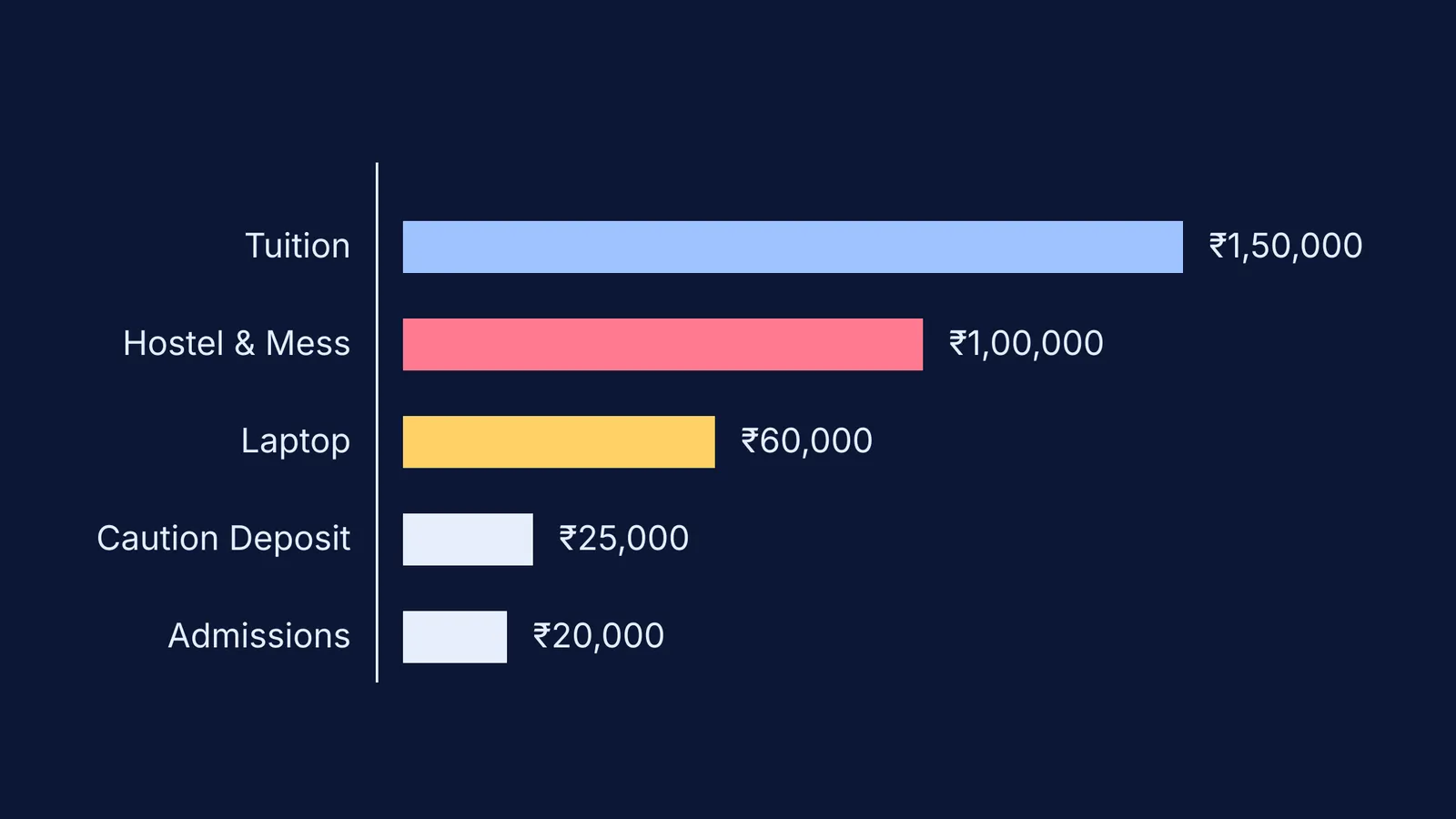
Upon admission, mandatory one-time charges take effect. These include admission and registration fees and development or campus fees. A significant additional expense for technical fields is technology. A laptop suitable for engineering or design costs ₹40,000 to ₹1,20,000, depending on the need for 3D modelling and heavy simulations Croma.
How much is the hostel caution money?
If a student is moving cities for coaching or college, accommodation is the largest expense after tuition. While the annual rent and mess charges are somewhat predictable, the upfront security deposit—known as caution money—is not.
To prevent exorbitant hidden charges, regulatory bodies are stepping in. The Maharashtra Fee Regulatory Authority (FRA) recently capped caution money at ₹25,000 for engineering and management courses, and at ₹50,000 for health science courses Times of India.
However, for deemed universities outside these state caps, candidates often pay a refundable security deposit of up to ₹2,00,000 just to participate in medical counselling registration conducted by the Medical Counselling Committee (MCC). This deposit is refundable if no seat is allotted or if the student joins the allotted college. But if a student is allotted a seat in later rounds and fails to join, or if admission is cancelled due to missing documents, the entire deposit is forfeited Medical Dialogues.
What are the costs before admission?
The financial strain often begins years before admission. The 2025 MoSPI Comprehensive Modular Survey on Education found that 27% of all school students take private coaching. For higher secondary students, these coaching costs jump to an average of ₹9,950 in urban areas. With the average household expenditure for an urban private unaided school already at ₹31,782 per year, many families have little room for sudden university fees. The survey also noted that 95% of students rely on family members to cover expenses, while only 1.2% depend primarily on government scholarships, meaning parents bear almost the entire burden PIB.
When preparing for admissions, practicing effectively is key. If you are stuck on a past paper, the Fermi Problem Library has worked problems with a step-by-step solver that explains the reasoning rather than printing an answer. And when you need to understand the underlying theory, Fermi's AI tutor works out what you already know and builds a plan for the session, so you sit down to a clear next step.
How can you plan for the first month?
To avoid surprises when studying in a hostel or at a private institution, treat the first semester as a financial spike. Families should budget an extra ₹90,000 to ₹1.9 lakh beyond the first semester's tuition for the initial setup Securis.
While an initial budget of ₹90,000 often covers basic hostel and mess fees, the actual total includes essentials required for modern education. These encompass high-speed internet, software subscriptions, lab kits, mandatory bridge courses, and occasional travel home Securis.
Here is a readiness checklist to use before paying an admission fee:
Ask for the "Total Cost of Course" in writing, including all development, library, and examination fees.
Confirm whether hostel accommodation is mandatory for the first year.
Check the history of annual fee increments. A standard 5% to 10% annual increase on tuition can inflate the final-year cost significantly.
Verify the refund policy timeline for the caution money and any penalties for withdrawing admission before the cutoff date.
Being aware of these hidden extras allows families to plan their finances accurately, ensuring that the focus remains on the student's education rather than the unexpected bills.


