

On this page
Why does the overall NIRF rank mislead undergraduate applicants?
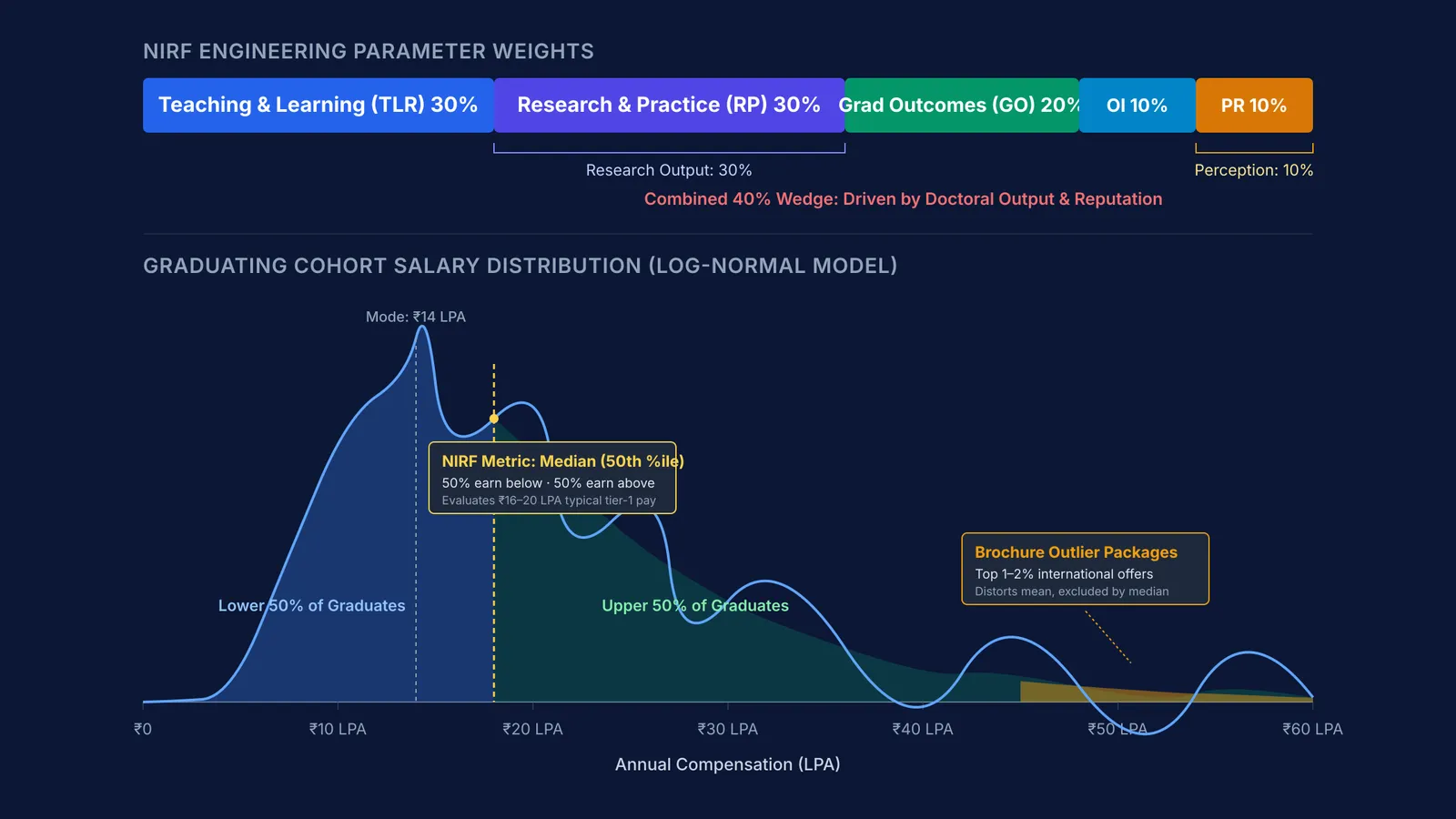
Each year, the Ministry of Education releases higher education rankings via the Press Information Bureau, evaluating 6,517 institutions in 2024. For students and parents, the composite leaderboard looks like a simple scorecard. Yet under the official framework on the NIRF portal, scores depend on five parameters:
Teaching, Learning and Resources (30%)
Research and Professional Practice (30%)
Graduation Outcomes (20%)
Outreach and Inclusivity (10%)
Perception (10%)
Research and Perception form a combined 40% wedge. Research tracks publications, citations, and patents—vital for doctoral scholars, but irrelevant to first-year undergraduate laboratory teaching. Perception relies on peer surveys, giving older campuses an unearned structural advantage over newer institutes focused on undergraduate engineering education.
How to find and read the NIRF DCS report?
To compare colleges sensibly, look past the public rank and download the Data Capturing System (DCS) report from the NIRF portal:
Open the Engineering ranking table.
Click the PDF icon next to the college name, marked "Data Submitted by Institute".
Scroll to "Placement & Higher Studies" for the 4-year undergraduate programme.
Every participating college is required to host this document publicly. It details intake, on-time graduation, placed students, and median salaries over three consecutive cohorts.
Which numbers matter most in the NIRF report?
According to the official DCS tables on the NIRF Engineering Rankings, audited reports replace marketing claims across three key metrics:
True placement percentage:
College brochures claim "100% placement" by excluding unplaced students who had backlogs or did not clear eligibility hurdles. In the DCS report, divide students placed by students graduating in minimum stipulated time. If 600 students graduate on time and 420 take jobs, the true placement rate is 70%.
Median salary:
Billboards highlight the highest international package, which often reflects a single outlier offer loaded with multi-year stock vesting. Under the NIRF 2024 Engineering framework, 25 marks in Graduation Outcomes evaluate the median salary—the exact midpoint where half earned more and half earned less.
The 2024 DCS reports show why this distinction matters for 4-year undergraduate programmes:
IIT Madras ranked number 1 overall, placing 496 of 639 graduating students at a median salary of ₹16.63 lakh.
IIT Delhi ranked number 2, placing 676 of 835 graduating students at a median salary of ₹20.00 lakh.
IIT Bombay ranked number 3, placing 644 of 798 graduating students at a median salary of ₹19.63 lakh.
IIT Madras led the overall table due to research output and perception, yet graduates at IIT Delhi and IIT Bombay secured higher median pay.
Three-year trajectory:
Track whether median compensation and placed numbers grew across the three reported cohorts, or whether expanding batch sizes diluted campus job outcomes.
What are the blind spots and limitations of NIRF data?
DCS reports still carry blind spots that applicants should keep in mind:
No branch-specific breakdown: NIRF aggregates Computer Science with Civil, Chemical, and Metallurgy into one figure. High software packages conceal weak hiring in core branches.
Time lag: The 2024 report reflects students who graduated in 2022-23, lagging behind current economic conditions.
Self-reported numbers: While research citations are scraped externally, placement and salary data are self-reported by institutions on the NIRF portal.
Campus quality: NIRF cannot measure hostel living standards, academic stress, or student wellbeing.
How should students and parents evaluate colleges?
When shortlisting colleges during counselling, use this four-step checklist:
Download the DCS reports from the NIRF portal for your shortlisted institutes.
Calculate the true placement rate by dividing placed students by total graduating students minus those entering higher studies.
Compare the median salary against four years of tuition and living expenses to gauge financial return.
Speak to recent alumni to verify branch-specific hiring and laboratory quality.
When arranging choices for seat allocation, check realistic cutoffs in our JoSAA counselling basics and confirm the 75 percent board eligibility rule. Planning ahead also clarifies what changes during your first semester at college.
If you encounter concept gaps in foundational science or mathematics during your college preparation, the Fermi Concept Library covers every concept in physics, chemistry, biology, mathematics and computing, each with its own lesson and its place in the map. For technical coursework requiring worked problem derivations, the Fermi Problem Library provides worked problems with a step-by-step solver that explains the reasoning rather than printing an answer.


