On this page
Two hours feels like plenty of time until it is gone. Most of it leaks away into rereading familiar notes, checking the phone and deciding what to do next. A fixed structure, where every block has one job, cuts down on all three.
What should you do in a two-hour study session?
Use this as your default and adjust the minutes to the chapter in front of you.
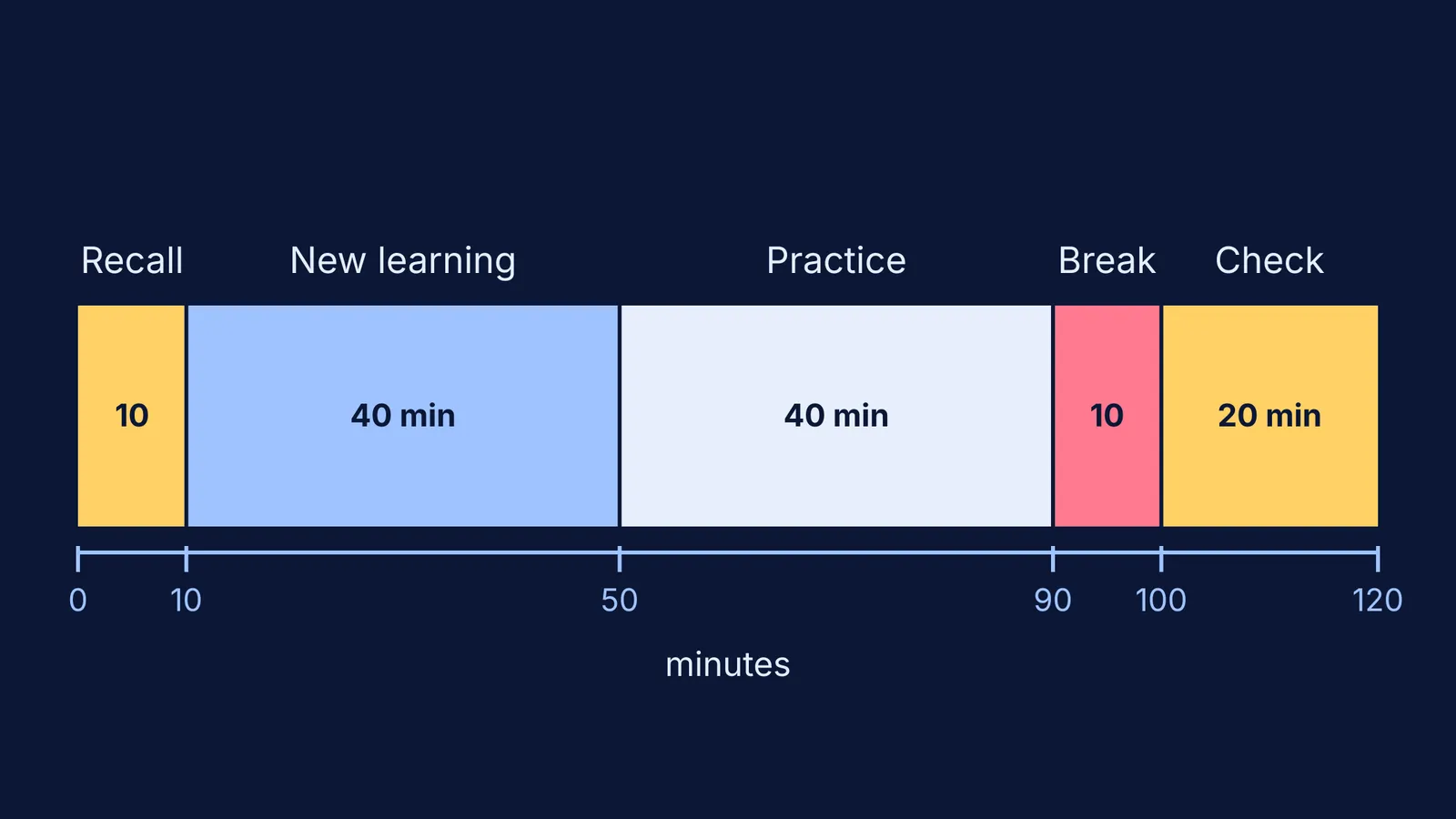
Warm-up recall (0 to 10 minutes). Close your books. Write down everything you remember from your last session on this subject, then open your notes and mark the gaps.
New learning (10 to 50 minutes). Study one new section. After each subsection, stop and explain it to yourself in your own words before moving on.
Practice (50 to 90 minutes). Solve problems with the worked examples closed. Mix in two or three questions from older chapters.
Short break (90 to 100 minutes). Stand up, walk, drink water, look out of a window. Leave the phone in another room so the break stays a break.
Closing check (100 to 120 minutes). A short test from memory on today's material, then a three-line plan for next time.
The order matters. Recall first shows what has faded since last time. The break sits before the closing check so the check draws on memory, not on what was just in front of your eyes.
Why start with recall instead of rereading?
In a review of 10 common study techniques, psychologists led by John Dunlosky rated practice testing and distributed practice as the two of high utility (Psychological Science in the Public Interest, 2013). The same review rated rereading and highlighting as low utility, even though most students report using them.
Testing yourself also feels less effective than it is. In experiments by Henry Roediger and Jeffrey Karpicke, students who restudied a passage did better on a test five minutes later, but students who had taken recall tests remembered substantially more when tested two days or one week later (Psychological Science, 2006). Restudying also made students more confident, one reason rereading can feel productive.
In this plan the warm-up and closing check are practice tests, and returning next session spaces the practice. For a quick way to run the warm-up, try the blurting revision method, and for the same habit on school days, see how to recall before each class.
How long should a study break be?
Even brief breaks can help you stay on task. In a University of Illinois experiment, 84 participants did a repetitive 50-minute computer task, and only the group whose task was briefly interrupted twice showed no drop in performance over time (University of Illinois news release). The study was published in Cognition in 2011 (Ariga and Lleras).
Be realistic about what a break can do. A 2022 meta-analysis of 22 study samples found that short breaks gave small boosts to energy and reduced fatigue, but no significant improvement in overall performance (PLOS ONE, 2022). The authors note that recovering from highly demanding tasks may need breaks longer than 10 minutes. So treat 10 minutes as the minimum after hard problems, and spend it moving, not scrolling.
What does the closing check look like?
Spend the last 20 minutes on three things:
Five questions on today's material, answered from memory and then marked against your notes.
One question from an older chapter, so earlier topics keep coming back.
Three lines in your notebook: what I got, what I missed, what I start with next time.
That third line becomes your next warm-up. If you sit down and do not know where to begin, Fermi's AI tutor can work out what you already know and build a plan for the session.
A worked example: two hours on friction in Class 11 physics
Say you covered Newton's laws last time.
0 to 10: On a blank page, write the three laws and draw the free-body diagram of a block on an incline. Your notes show you wrote the normal force as mg instead of mg cos θ. Circle it.
10 to 50: Read the friction section: static and kinetic friction, the coefficient of friction, the angle of repose. After each idea, write a two-sentence explanation without looking.
50 to 90: Solve eight friction problems, then two Newton's laws problems from last week, the idea behind an interleaved practice plan. When a method goes wrong, the Fermi Problem Library has worked problems with a step-by-step solver that explains the reasoning rather than printing an answer.
90 to 100: Walk, refill your water bottle, stretch.
100 to 120: From memory, write the condition for static friction and derive tan θ = μs for the angle of repose. Mark it. Next session starts with the incline problem you got wrong.
Try the plan for a week on your hardest subject, and keep books closed for the warm-up and the closing check: open them and you are rereading, not recalling.