

On this page
You close the textbook, take a blank page and write down everything you remember about a topic. Then you open your notes and fill in what you missed in a different colour. That is blurting. It feels harder than rereading, and it shows exactly what you don't know yet.
What is the blurting method?
Blurting is a revision method in which you recall a topic from memory onto a blank page before checking it against your notes. It has three steps:
Recall. Notes closed, write every fact, formula, diagram and link you can remember, in any order.
Check. Open your notes and, in a second colour, correct mistakes and add what you left out.
Return. A day or more later, blurt the same topic again, starting with what the second colour showed you.
Researchers call the first step free recall, a form of retrieval practice. The name is informal, but the idea behind it has been studied for decades.
Why does blurting work better than rereading?
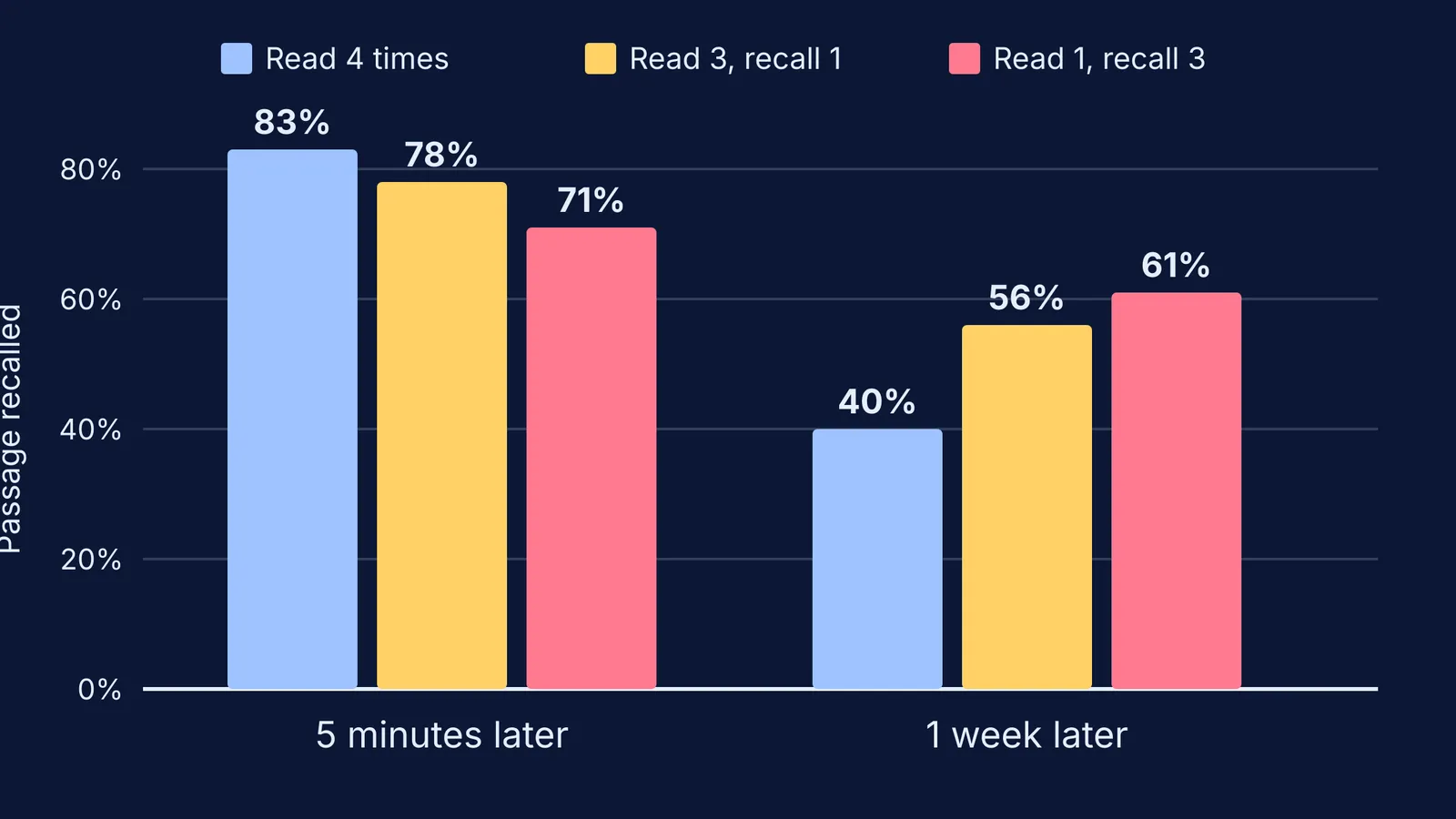
In a 2006 study in Psychological Science, Roediger and Karpicke had university students learn short science passages either by rereading them or by reading once and then writing down all they could remember, without feedback.
A week later, students who had recalled a passage three times remembered 61% of it, while students who had read it four times remembered 40% (full paper, Experiment 2). The rereaders had seen the passage far more often: 14.2 read-throughs on average against 3.4.
There was a catch. On a test five minutes after studying, rereading won, 83% against 71%, and the rereaders felt more confident they would remember the passage a week later. They were wrong. Rereading feels like learning because the page looks familiar; our posts on why rereading feels like learning and why students misjudge their own learning explain that trap.
In a 2011 study in Science, Karpicke and Blunt found that retrieval practice produced more learning from science texts than building concept maps, including on questions that required inferences. A 2013 review of 10 study techniques by Dunlosky and colleagues rated practice testing as high utility, and rereading and highlighting as low utility.
How do you blurt a topic, step by step?
Here is a 20-minute routine, using CBSE Class 10 Electricity as the example. Each recall test in the 2006 study lasted 10 minutes.
Pick a small topic (2 minutes). The whole chapter is too big. Resistance, and resistors in series and parallel, is about right.
Blurt in blue (8 minutes). Notes closed. A typical page: V = IR; resistance depends on length, area and material; R = ρL/A; series R = R1 + R2 + R3; parallel 1/R = 1/R1 + 1/R2 + 1/R3; heating H = I²Rt.
Check in green (8 minutes). Open the NCERT chapter and your notes, tick what is right and add what is missing. Here the green might add: resistivity is measured in ohm metres; current is the same through resistors in series, voltage is the same across resistors in parallel; why home appliances are wired in parallel.
Write a gap list (2 minutes). Turn each green item into a short question: Unit of ρ? What stays the same in series, and in parallel? Why parallel wiring at home?
Next time, blurt before you look at anything. When yesterday's green comes out in blue, the gap is closing.
What should you do with the gaps?
Sort them before the next session:
Forgotten facts (a unit, a definition): another blurt tomorrow is usually enough.
Wrong facts (you wrote that parallel resistances simply add): fix these first. In a 2005 study by Pashler and colleagues, giving the correct answer after a wrong response raised retention a week later by 494%, while feedback after correct answers made little difference. It used word pairs, not physics, but it suggests the check is the step not to skip.
Never understood (you can write R = ρL/A but cannot say why a longer wire resists more): another blurt will not fix this. Relearn the idea first.
For that kind of gap, the Fermi Concept Library has every concept in physics, chemistry, biology, mathematics and computing, each with its own lesson and its place in the map, so you can see what the idea builds on.
How often should you blurt a topic?
Blurt a topic the day you study it, again the next day, then after a few days and again after a week or two. Our 4-week spaced revision schedule gives a timetable you can slot blurting into.
Expect the first blurt to look thin. Half a page with gaps means the method is working, not failing. Parents can help by asking to see the green: the corrections are the evidence of real revision.
If a long syllabus leaves you unsure which topic to blurt first, Fermi's AI tutor can work out what you already know and build a plan for the session, so you start with a clear next step.
Tonight, pick one topic you studied this week, close the book and fill a blank page.


