On this page
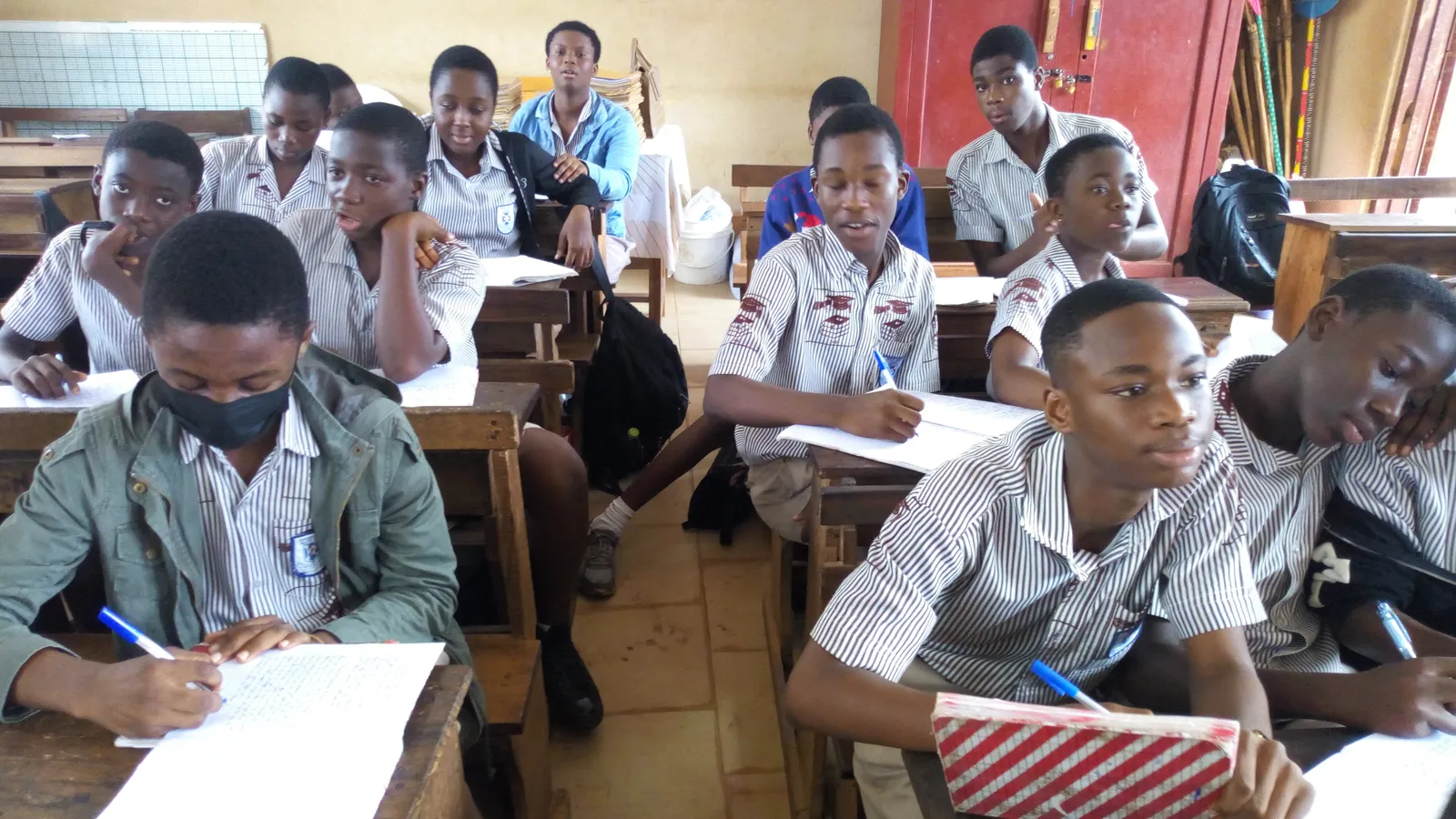
The board fills twice, you copy all of it, and your notebook ends up as a messier copy of the textbook. The fix is not writing faster. It is deciding, line by line, what earns a place. Here is a three-question filter, worked through on a Class 11 physics lecture.
Why does copying everything feel safe but not help?
Copying feels productive because the page fills up, but rereading a page is one of the weaker ways to study. A 2013 review of 10 study techniques by John Dunlosky and colleagues rated rereading, highlighting and summarisation as low utility, and practice testing and spaced (distributed) practice as high utility (Psychological Science in the Public Interest). Notes earn their space when you will test yourself from them.
How do you decide what to write in notes when everything seems important?
Ask three questions about each thing the teacher says, in this order.
Would I forget it by next week? If it is obvious to you, or you already know it, skip it. If you would lose it, it is a candidate.
Is it already in NCERT or my module? If yes, write its address (chapter, section, equation or example number), not its text.
Has it cost me marks, or could it? If yes, write it in full, in your own words, with the wrong version beside the right one.
Forgetting is quicker than it feels in class. In a 2015 replication of Hermann Ebbinghaus's forgetting experiment, Jaap Murre and Joeri Dros had one person learn lists and relearn them later; the time saved by the first learning fell from about 47% after 20 minutes to about 32% after one day and about 4% after 31 days (PLOS ONE). Those were nonsense syllables, not physics, but the warning holds: "I'll remember that" is often wrong by the weekend.
The third question matters most. Janet Metcalfe's 2017 review concluded that making errors and then getting corrective feedback helps learning, and that feedback which analyses the reasoning behind the mistake is crucial (Annual Review of Psychology). A note that records why you went wrong is that analysis, written down where you will see it again.
What does the filter look like on a real physics lecture?
Take a lecture on Motion in a Straight Line, Chapter 2 of NCERT Class 11 Physics (NCERT textbook PDF). Here is what a teacher might cover, and where each item lands.
Deriving v = v0 + at and x = v0t + ½at² from the area under a v-t graph. NCERT does this in Section 2.4 with Fig. 2.5. Pointer only: "Derivation: NCERT 2.4".
The same equations by calculus. NCERT Example 2.2. Pointer only.
A ball thrown up at 20 m/s from a 25 m building. This is NCERT Example 2.3. Pointer, plus a note to try it later with the book closed.
"At the top, v is zero but a is still −g." The NCERT example keeps a = −g throughout, but it is easy to read past. If you have ever set a = 0 at the top, this passes question 3. Write it in full: "Wrong: a = 0 at the highest point. Right: a = −10 m/s² the whole flight; v is zero for one instant. Why I slipped: I mixed up 'not moving' with 'not accelerating'."
"In v² = v0² + 2ax, x is displacement, not distance travelled." NCERT says the equations relate displacement, but if a turning-back question has ever given you a wrong answer, write the trap and one line of reasoning.
The teacher's own shortcut or memory trick that is not in the book. You would forget it, and NCERT will not remind you. Write it.
The result: a handful of lines and pointers instead of copied derivations.
When a mistake keeps coming back and you cannot see why, the Fermi Problem Library has worked problems with a step-by-step solver that explains the reasoning rather than printing an answer, which gives you the words for your "why I slipped" line.
What should you do with your notes after class?
The filter decides what goes in. What you do next decides whether it sticks.
The same evening, turn each kept line into a question. "What is the acceleration at the top of a vertical throw?" goes on the left, the answer on the right, so you can cover one side and test yourself.
Open one pointer. Go to one NCERT address you wrote and solve that example closed-book.
Recap the same day. See our routine for recapping a lecture on the same day, and if you are torn between sources, whether to make notes from NCERT or coaching modules.
Parents facing that opposite problem can read why your child does not write notes in class. Everyone else: try the three questions in your next lecture.