

On this page
When exam season approaches, you are surrounded by material: the standard NCERT textbook, a detailed coaching module, and your daily class notes. The natural question is whether you should make your notes from NCERT, from the coaching module, or from your teacher's lectures.
The answer is not to pick just one. Instead, you need to merge them into a single, unified source of truth for each chapter.
Should I make notes from NCERT or coaching module?
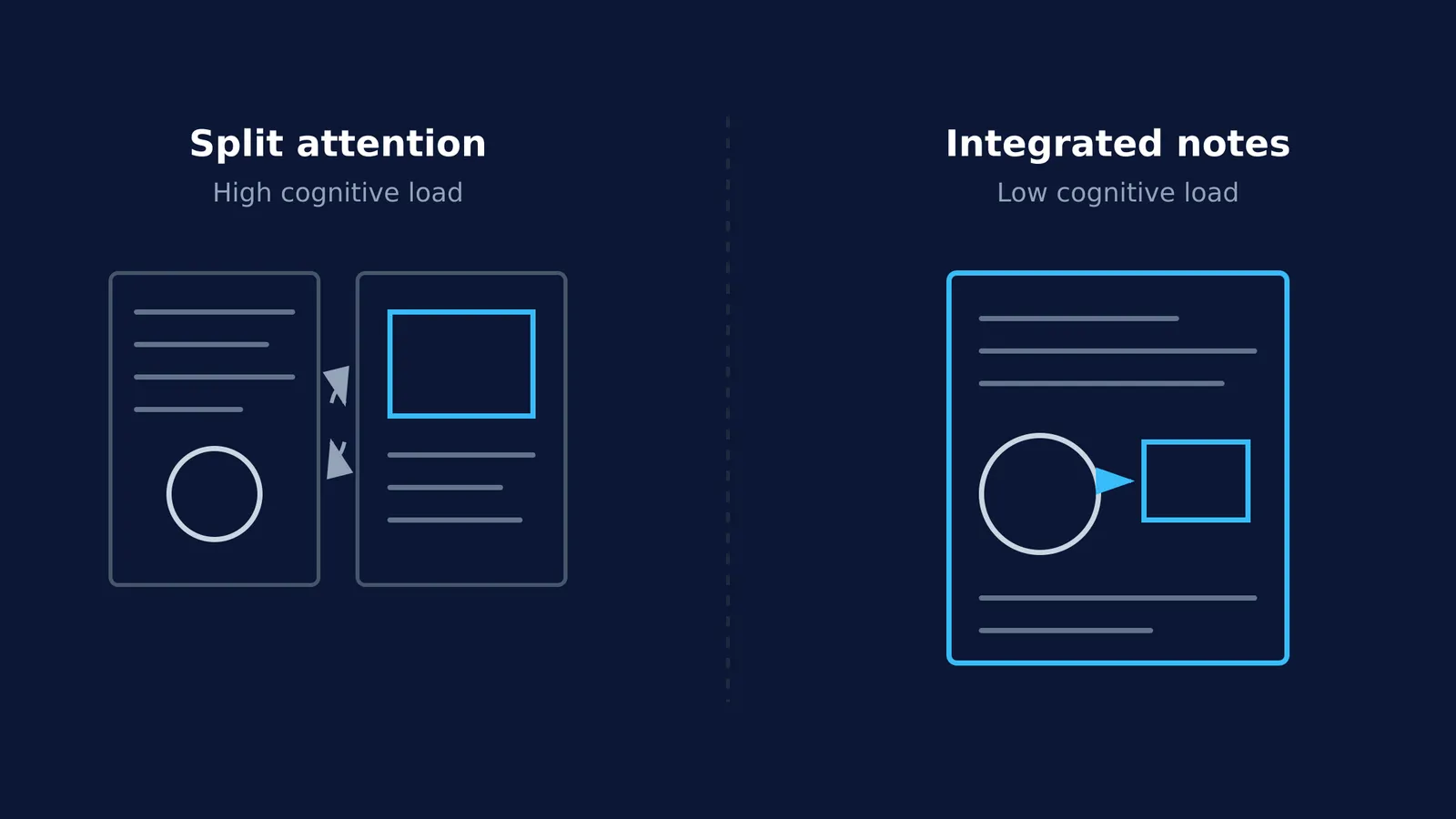
If you try to keep three separate notebooks, you force your brain to work harder than it needs to. When you sit down to solve a problem and have to check NCERT for a definition and then flip through a coaching module for a formula, you experience what cognitive psychologists call the split-attention effect.
When you mentally integrate multiple, physically separated sources of information, it increases your extraneous cognitive load—mental effort that does not contribute to learning. A landmark 1991 study by researchers Paul Chandler and John Sweller found that students who learned from physically integrated materials scored significantly higher on a follow-up test compared to those who used conventional separated materials (Chandler & Sweller, 1991).
Rather than keeping your knowledge scattered, bring it together. Choose one base text and integrate everything else into it.
Why is keeping separate notebooks a problem?
Your working memory has limited capacity. When you split your attention between a textbook and a separate notebook, your working memory spends its limited resources managing the logistics of where information is, rather than understanding the concept itself.
This was demonstrated in a 1988 study on geometry students by Rohani Tarmizi and John Sweller. They found that even when students were given step-by-step worked examples, the examples failed to improve learning if the diagrams and the text were separated (Tarmizi & Sweller, 1988). Only when the text was integrated directly into the diagrams did the students' performance improve.
If your notes are separate from your diagrams, or your NCERT facts are disconnected from your coaching module's practice problems, you are creating an artificial barrier to your own learning.
How do you build a single source of truth?
To build a single source of truth, you must avoid simply copying everything from every book. Writing the exact same definition twice is a form of redundancy that clogs your working memory and hinders retention.
Instead, pick a "base" text depending on the subject:
For Biology and Inorganic Chemistry (NEET-UG): Make NCERT your base. Read a section, and then add extra facts, exceptions, or diagrams from your coaching module directly into the margins of your NCERT book (or on sticky notes attached to the page).
For Physics and Maths (JEE Main and JEE Advanced): Make your class notes or coaching module your base, since they are structured around problem-solving. Then, review NCERT to extract specific theoretical definitions or edge cases, and add them to your notes.
If you find a concept in your coaching module that feels entirely disconnected from the NCERT text, look it up in the Fermi Concept Library. It maps every concept in physics, chemistry, biology and mathematics, providing a clear lesson that bridges the gap before you commit it to your unified notes.
What should you include in your unified notes?
Your single source of truth should be the only document you need to open when revising a chapter. It must contain:
The core definitions and theoretical constraints (usually from NCERT).
The step-by-step logic and derivations (usually from class notes).
Problem-solving frameworks and shortcuts (usually from coaching modules).
How should you review your consolidated notes?
Once your notes are merged, they become a powerful tool for active recall. When you revise, you no longer have to cross-reference multiple books. You can use techniques like Dual coding: combine words and diagrams in your science notes to test whether you can recreate the chapter's core concepts from memory. If you are still structuring your layout, the Cornell note-taking method provides a proven format for keeping the theory alongside your own questions.
When your notes are complete but you are struggling to apply them to a specific problem set, bring a scanned assignment to Fermi's AI tutor. The tutor will work out what you already know, build a plan for the session, and teach through it by writing on a board and drawing figures, helping you solidify the knowledge in your single source of truth.


