

On this page
It is a common middle school mystery: your child opens their backpack to reveal entirely blank notebooks. If you are wondering why they do not write notes in class, it is usually because the task demands more cognitive effort than their working memory can handle. When faced with the overwhelming challenge of listening to new information while simultaneously writing it down, many students cope by simply dropping the pen.
Before you conclude that they are simply avoiding work, it helps to understand what happens in the brain when a student tries to listen, process, and write all at once.
Why do students stop taking notes in middle school?
The transition to middle school brings faster teachers and more complex ideas. Writing things down suddenly becomes a high-stakes balancing act.
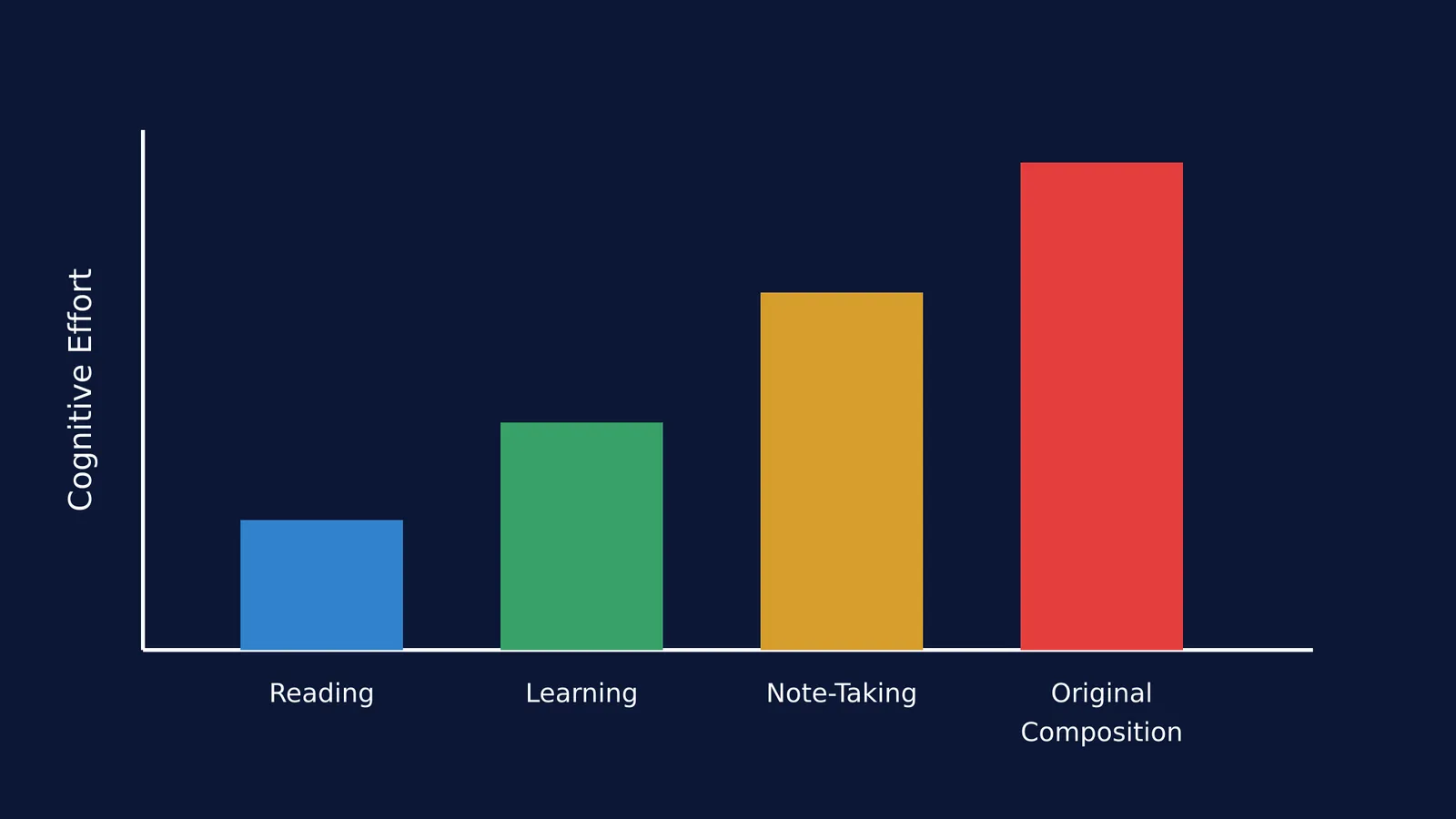
Taking notes requires simultaneous comprehension, selection of information, and written production. Because of this, note-taking demands more effort than reading or learning (Piolat et al., 2005). A 12-year-old must listen to a sentence, decide if it matters, hold it in their working memory, and write it down, all while the teacher is already speaking the next sentence. For many children, this cognitive overload is too much, so they drop the hardest part: the writing.
Does typing notes on a laptop work better?
Many schools now issue laptops, and typing is generally faster than handwriting. It seems like the perfect solution to the speed problem.
However, faster is not always better for learning. In three studies, researchers found that students who took notes on laptops performed worse on conceptual questions than students who took notes longhand (Mueller & Oppenheimer, 2014). Because typists can record lectures almost word-for-word, they tend to transcribe verbatim rather than processing the information. Writing by hand forces a student to summarize and reframe the ideas in their own words.
If you are debating which tools to buy for the new term, you can read more about choosing a laptop or notebook for notes?.
Which note-taking habits actually work?
Instead of telling your child to "take more notes," focus on what they do with them. A 2012 study of 131 middle school students found that simply teaching a structured note-taking method did not improve math scores on its own. However, the researchers discovered that students who reviewed their notes moderately or highly scored significantly better on posttests than those who reported little review (Wilkinson, 2012). The real value of notes lies in returning to them.
The most reliable system is the Cornell method, which divides the page into a narrow cue column on the left and a wider notes column on the right. You can show them the Cornell note-taking method with a worked example. For visual learners, encourage them to sketch diagrams next to definitions; you can learn more about how to combine words and diagrams in your science notes.
How can you check their notes without policing?
Middle schoolers crave autonomy. If you demand to inspect their notebooks every evening, they will likely view it as an invasion of privacy. Instead, use a simple, low-pressure routine that focuses on the learning, not the handwriting.
The 3-Minute Friday Review
Try this script on a Friday afternoon:
The warm open: "Show me the most interesting diagram or fact you wrote down this week." This assumes they wrote *something* and treats the notes as a record of interesting ideas, not a compliance check.
The gap check: If the notebook is mostly blank, ask: "When the teacher wrote on the board, what did they write?" This reminds them that board work is the minimum standard for what belongs in the notebook.
The fix: If they admit they missed the main ideas, do not send them to copy a textbook.
This is where a dedicated tool helps. If they missed a detail in class, they can look up the topic in the Fermi Concept Library, where every concept in physics, chemistry, biology, mathematics and computing has its own lesson.
If they are completely lost, Fermi's AI tutor can step in. Instead of just handing them an answer sheet, the tutor works out what the student already knows, builds a plan for the session, and teaches through it—drawing figures and checking understanding as it goes. It gives them the structured interaction they missed in class, without you having to play the role of the teacher.


