On this page
Your coaching sends a result sheet after every mock: marks, rank, and a percentile such as 82.4. It looks like the number on a JEE Main scorecard. It is not quite the same thing, and the difference matters when you use it to judge how ready you are.
What does percentile in a coaching test series mean?
A percentile is a position, not a mark. It uses the same idea as NTA's percentile score: a test series percentile of 82 usually means about 82 in every 100 students who took that mock scored at or below you. It says nothing directly about how many questions you got right, and it only compares you with the people who sat that paper.
Coaching institutes may not all calculate it the same way. The pool might be only your centre or every online student, and students who missed the test may or may not be counted. If your result sheet does not say who is in the pool, ask.
How is NTA's JEE Main percentile different?
NTA uses percentiles to compare candidates who wrote different papers in different shifts. According to the JEE (Main) 2027 Information Bulletin, a candidate's percentile score is the percentage of candidates in their shift who scored equal to or below them. The same bulletin says the topper of every shift gets 100, percentiles are worked out to 7 decimal places to reduce ties, and "the percentile score is not the same as the percentage of marks obtained."
NTA's own worked example in Appendix IV of that bulletin makes it concrete: in a shift of 41,326 candidates, a student with 121 raw marks gets a percentile of 90.1224411, because 37,244 candidates in that shift scored 121 or less.
The bulletin says candidates are distributed into shifts randomly, with an approximately equal number in each, and that this ensures no bias in who sits which shift. Also, your total percentile is not an average of your physics, chemistry and maths percentiles. For the full shift-by-shift process, see our explainer on how JEE Main normalisation works out your percentile.
Why does the candidate pool change your number?
A test series pool is not random. It is the students who joined that institute, chose that series and showed up that week. It can be stronger than the national field (a top batch), weaker (an open online series), or simply much smaller.
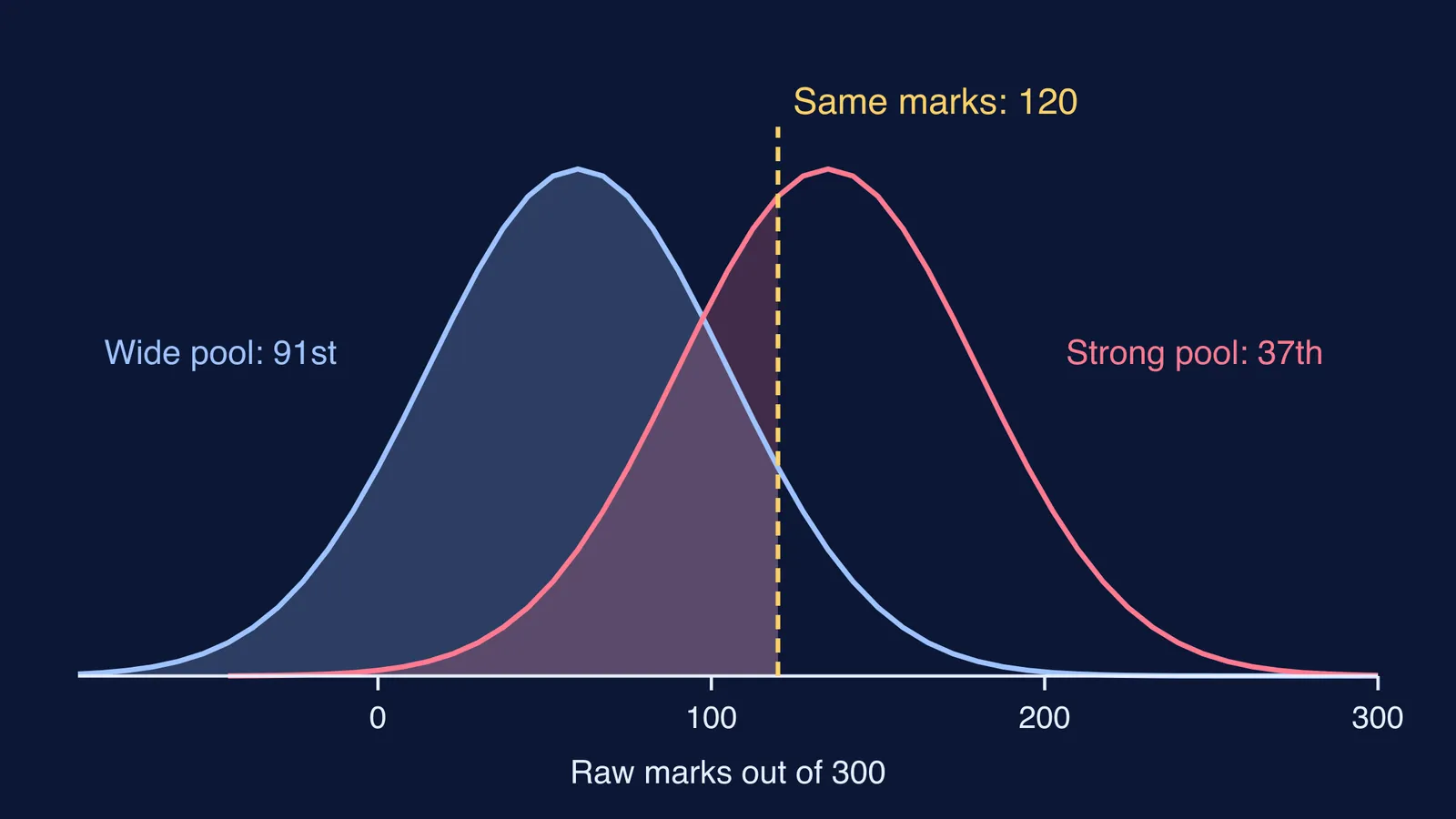
Here is a worked example with two made-up pools, the same ones drawn in the diagram above, both bell curves with a standard deviation of 45 marks. Say you score 120 out of 300.
In a wide pool where the average is 60 marks, 120 puts you at about the 91st percentile.
In a strong batch where the average is 135, the same 120 puts you at about the 37th percentile.
Your paper, your marks and your preparation are identical. Only the people beside you changed. So a drop from 91 to 37 after moving into a tougher batch is not the same as getting worse.
How should you read your own test series percentile?
Before you react, ask four questions.
Who is in the pool? Your centre, your city, or every online student? A few hundred people or many thousands?
Was the paper harder or easier than usual? Check the topper's marks and the average. If both fell, your percentile may have held steady while your marks dropped.
What does the trend say? One mock is noisy. Look at your last four or five together, as we explain in why mock test scores fluctuate so much.
What do the marks say, section by section? A percentile hides where you lost marks. Your physics, chemistry and maths raw scores tell you what to fix.
What should you do with the number this week?
Use it to choose what to practise, not to predict your rank.
On one notebook page, log each mock's marks, percentile, topper's marks and pool size.
Tag every wrong or skipped question as one of three types: did not know the concept, knew it but used the wrong method, or ran out of time.
For concept gaps, go back to the idea itself. The Fermi Concept Library has a lesson for every concept in physics, chemistry, biology and mathematics.
For wrong-method mistakes, redo similar questions slowly. The Fermi Problem Library has worked problems with a step-by-step solver that explains the reasoning rather than printing an answer.
Next week, compare your marks in those chapters, not only the percentile.
For parents: a falling percentile after a move to a stronger batch can come from the new pool alone, so it is not proof of decline. Ask "which chapter cost you the most marks?" rather than "why did your percentile fall?" Our guide to reading coaching test ranks in context has more on that conversation.