On this page
Your child comes home and says "Rank 390." Last week it was 260. The marks dropped by six; the mood dropped much further. If coaching ranks are demotivating your child, a pep talk rarely helps. What helps is reading the rank for what it is, watching your child's own marks across several tests, and keeping the talk after each test short and calm.
Why do coaching test ranks feel so demotivating?
A rank compares your child with a room full of strong students. Psychologists call one result the big-fish-little-pond effect: students in academically selective schools tend to rate their own academic ability lower than they would in a non-selective school. A study by Herbert Marsh and Kit-Tai Hau of 103,558 fifteen-year-olds in 26 countries found this negative effect in every one of the 26 countries (Marsh and Hau, American Psychologist, 2003).
A coaching batch is a selective pond. A child near the top in school can land mid-list and decide "I'm not good at this", even while they are still learning.
What does a coaching test rank actually tell you?
Less than it seems. A rank moves with who sat the test, how hard that paper was and how bunched the scores were. In the crowded middle of a list, a few marks can move a student a long way up or down.
India's Ministry of Education has addressed how coaching centres handle results. Its Guidelines for Regulation of Coaching Center (January 2024), sent to states and union territories to consider through their own laws, say a coaching centre shall not make assessment-test results public; it should keep them confidential and use them for regular analysis, with counselling for students whose performance is falling. The same document says batch segregation on academic performance "leads to excessive pressure on the students affecting their mental health". How far your state has adopted these rules varies, so ask your child's centre how it shares results.
For the rest of the sheet, see how to read your child's coaching test report and rank.
How do you track your child's own score trend instead?
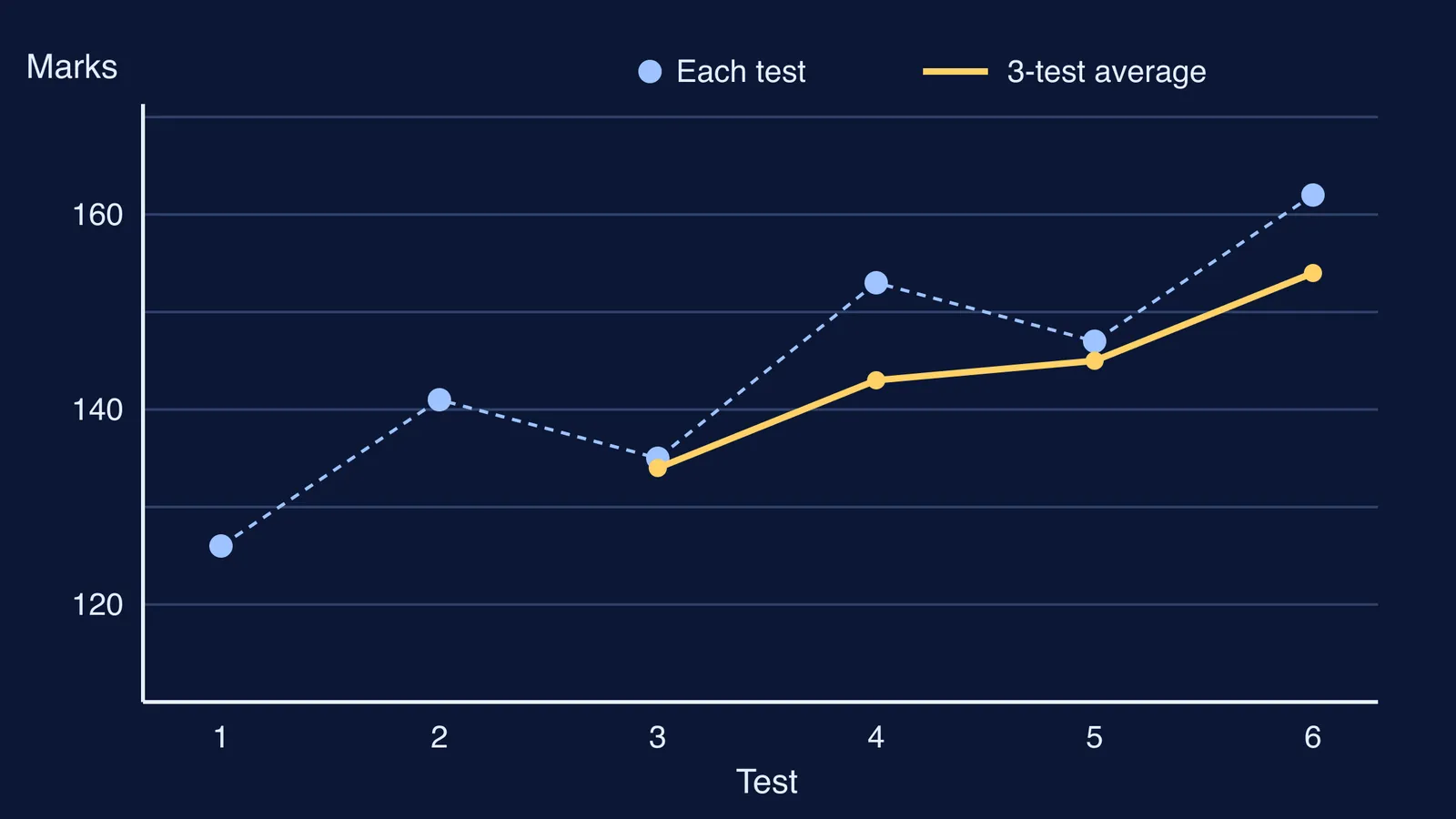
Here is a worked example with made-up marks from six coaching tests, each out of 300.
Test 1: 126 marks, rank 412
Test 2: 141 marks, rank 298
Test 3: 135 marks, rank 455
Test 4: 153 marks, rank 260
Test 5: 147 marks, rank 390
Test 6: 162 marks, rank 240
By rank alone, Tests 3 and 5 feel like disasters. Now average each run of three tests: 134, 143, 145, 154. That line only goes up, and it is the number worth watching.
Then, after each test, sort the lost marks into three piles:
Concept gaps: your child did not know the idea.
Method slips: they knew the idea but set the problem up wrong.
Exam-room losses: careless errors, running out of time, or skipping questions they could do.
The biggest pile tells your child what to work on next week. For concept gaps, the Fermi Concept Library covers every concept in physics, chemistry, biology, mathematics and computing, each with its own lesson. For method slips, the Fermi Problem Library has worked problems with a step-by-step solver that explains the reasoning rather than printing an answer.
What should I say to my child after a bad coaching test?
Across six studies, Claudia Mueller and Carol Dweck found that children praised for intelligence showed less persistence, less enjoyment and worse performance after a failure than children praised for effort (Mueller and Dweck, Journal of Personality and Social Psychology, 1998). "You're so smart" praises ability, and "Why can't you be like the topper?" is a comparison; neither gives your child a next step. Talk about what your child did and will do next.
A short script for the evening after a test:
"How are you feeling about it?" Then listen. Don't fix anything yet.
"What went better than last time?"
"Which pile did most of the lost marks fall into?"
"What's one thing you'll do differently this week?"
"Okay. Let's eat." Then leave it until the weekend.
Skip comparisons with cousins or batchmates, questions about who topped, and sharing the rank with relatives; see why you should stop discussing your child's marks with relatives. For the really hard days, see what to say when your teen fails a coaching test.
When is it more than test stress?
Feeling low for a day or two after a bad result is normal. Talk to the coaching centre's counsellor, your family doctor or a mental health professional if your child stops eating or sleeping well, withdraws for weeks, says they are a burden, or seems hopeless. The government's Tele MANAS helpline is toll-free, 24x7 and available across India (PIB backgrounder, October 2024).
After the next test, ask the one question, update the three-test average, and let the rank be one more number on the report.