

On this page
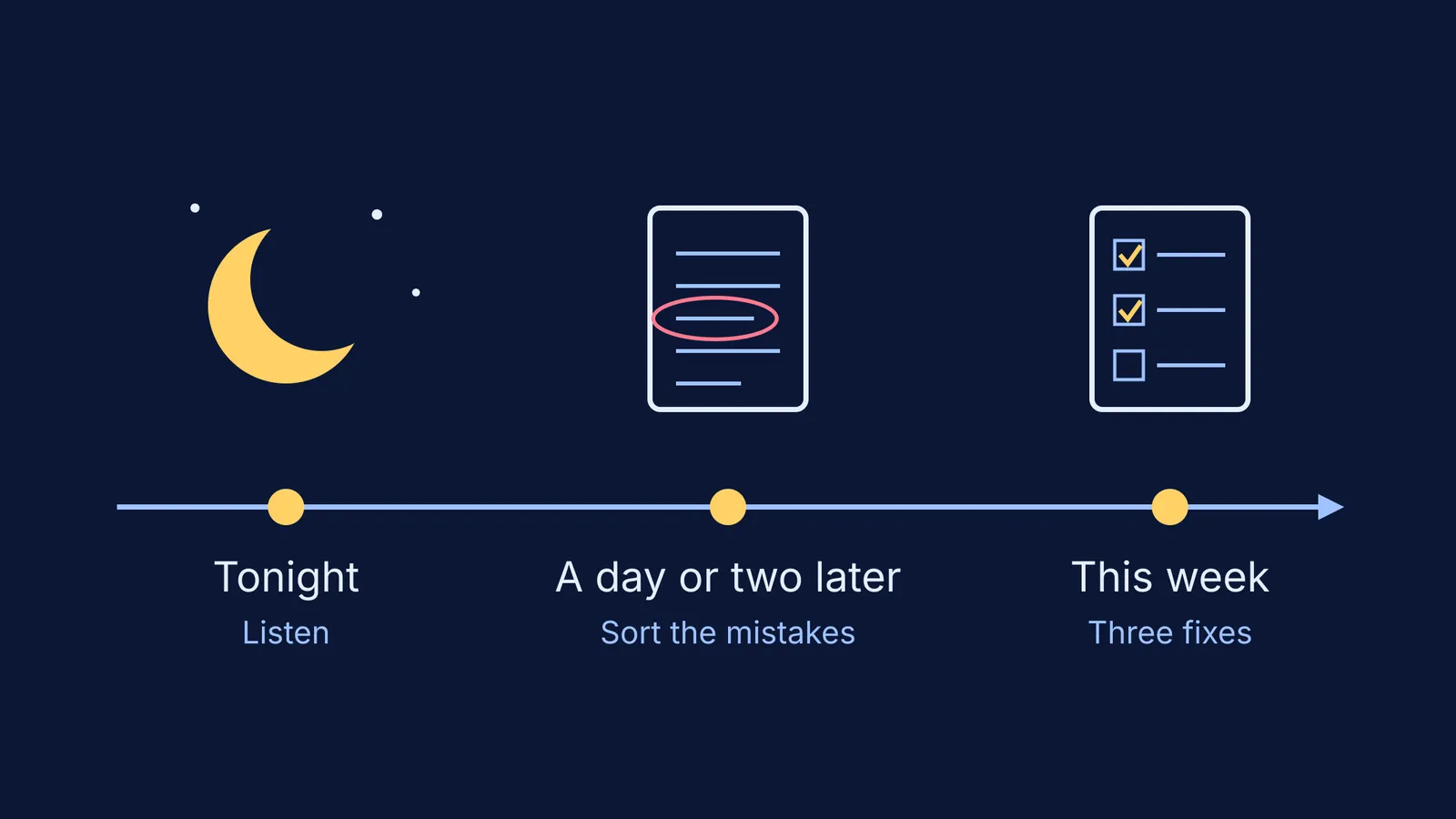
The marks often reach you on the coaching app before your teen is home. What you say in the next ten minutes matters less for the marks than for whether they show you the next paper. Split the job into three parts: tonight, a day or two later, and the week after.
What should I say tonight when my teen fails a coaching test?
Tonight is not the time for analysis. Your teen has probably just seen a ranked result at the end of a long day, and their attention is on what the score says about them, not on question 14.
In a large review of feedback research, Kluger and DeNisi (1996) analysed 607 effect sizes and found that feedback improved performance on average, but over one third of feedback interventions made performance worse. Their analysis suggests feedback works less well as attention moves away from the task and towards the self. “Why are you always so careless?” is about the self. “Question 14 had a sign error” is about the task, and that conversation can wait.
A short script you can adapt for tonight:
“I saw the result. You look really low about it.” (Name the feeling, not the number.)
“We don't have to talk about it now.”
“Do you want to eat first, or have some time to yourself?”
“Let's look at the paper together on Saturday morning. Not to scold, just to see what happened.”
In a brain-imaging study, Lieberman and colleagues (2007) found that putting feelings into words reduced the response of the amygdala and other limbic regions to negative emotional images. You are not fixing the feeling tonight, just giving it a name.
If results have started going missing, read why children hide test marks and what to say next.
Does my reaction to failure really matter?
It seems to. In a series of studies, Haimovitz and Dweck (2016) found that parents who see failure as debilitating focus on their children's performance and ability rather than on their learning, and their children tend to believe intelligence is fixed. The same paper found that children could accurately read their parents' views of failure, but not their parents' views of intelligence.
Your teen reads your face on result night more closely than any speech about hard work. “What was your rank?” signals performance; “Which part surprised you?” signals learning, but even that is better asked later.
How do I go through the test paper without blaming my teen?
A day or two later, sit side by side with the paper and the answer key. Your teen holds the pencil; your job is to ask, not to mark.
In a review of the research, Janet Metcalfe (2017) concluded that making errors followed by corrective feedback helps learning, and that feedback which analyses the reasoning that led to the mistake is crucial. She suggests that low-stakes situations, like a weekly coaching test, may be the place to make and correct errors.
Sort each wrong or skipped question into one of four piles:
Concept: the idea itself is shaky.
Method: knew the topic, chose the wrong approach or formula.
Slip: sign error, units, misread the question.
Time: never reached it, or rushed it.
A made-up example: your teen got 20 questions wrong or skipped. Sorted, they come out as 4 concept, 5 method, 8 slips and 3 time. The biggest pile is slips, so the fix is a checking habit, not another chapter of theory. The conversation changes too, from “you're weak in physics” to “eight slips, mostly signs in mechanics”. Good questions while sorting are “What were you thinking at this step?” and “Which pile does this one go in?”
What should the plan for the next test look like?
Let your teen choose no more than three fixes from the piles. For slips, it might be re-reading each question's last line before marking an answer. The concept and method piles need actual study. For a shaky idea, the Fermi Concept Library has a lesson for every concept in physics, chemistry, biology and mathematics. For wrong-method mistakes, the Fermi Problem Library has worked problems with a step-by-step solver that explains the reasoning rather than printing an answer. Questions that are still unclear can go to the teacher; here is how to discuss a test paper with your coaching teacher.
After the next test, sort the paper again and compare the piles, not just the total.
When is it more than a bad test?
One bad evening is normal. Watch for changes that last: low mood for weeks, sleeping or eating very differently, pulling away from friends, or talk of hopelessness. If you see these, talk to the school counsellor or your family doctor. You can also call Tele MANAS; see this Tele MANAS information page from IIT Kanpur's counselling service.
Tonight's only goal: your teen goes to bed knowing the result has not changed how you see them. The paper can wait.


