

On this page
When you get a test paper back from your coaching institute, the first instinct is often to look at the score, check the rank list, and file it away. But the real value of the paper begins when you sit down with your teacher to discuss it.
In an influential 2007 review, researchers John Hattie and Helen Timperley found that feedback has an average effect size of 0.79, nearly double the 0.40 effect size of a typical year of teaching (Review of Educational Research). However, this massive boost does not come from simply finding out which answers were right or wrong. It comes from discussing the underlying process and strategies.
This guide will show you how to prepare for the doubt counter, what questions to ask your teacher, and how to turn those discussions into higher marks on your next paper.
Why is process-level feedback so powerful?
Hattie and Timperley's research divides feedback into four levels, with the two most common being task-level and process-level.
Task-level feedback tells you about the final product. It is the red cross next to option A, telling you that option B was correct. While this helps you correct a specific error, it does not stop you from making a similar mistake on a new problem.
Process-level feedback targets the methods and reasoning you used. Instead of focusing on the answer, it looks at how you set up the physics equation, why you misread the chemistry graph, or where your maths logic broke down. When feedback hits the process level, it changes how you think. As the researchers noted, this is where feedback becomes one of the most powerful influences on student achievement.
This approach is central to effective teaching. Fermi's AI tutor relies on this exact principle: it works out what you already know and builds a plan for the session, teaching through problems step by step rather than just printing an answer.
How to discuss a test paper with your coaching teacher?
Coaching teachers have limited time at the doubt counter, often with a queue of students waiting. If you just hand them the paper and say, "I got question 14 wrong," you will only get task-level feedback.
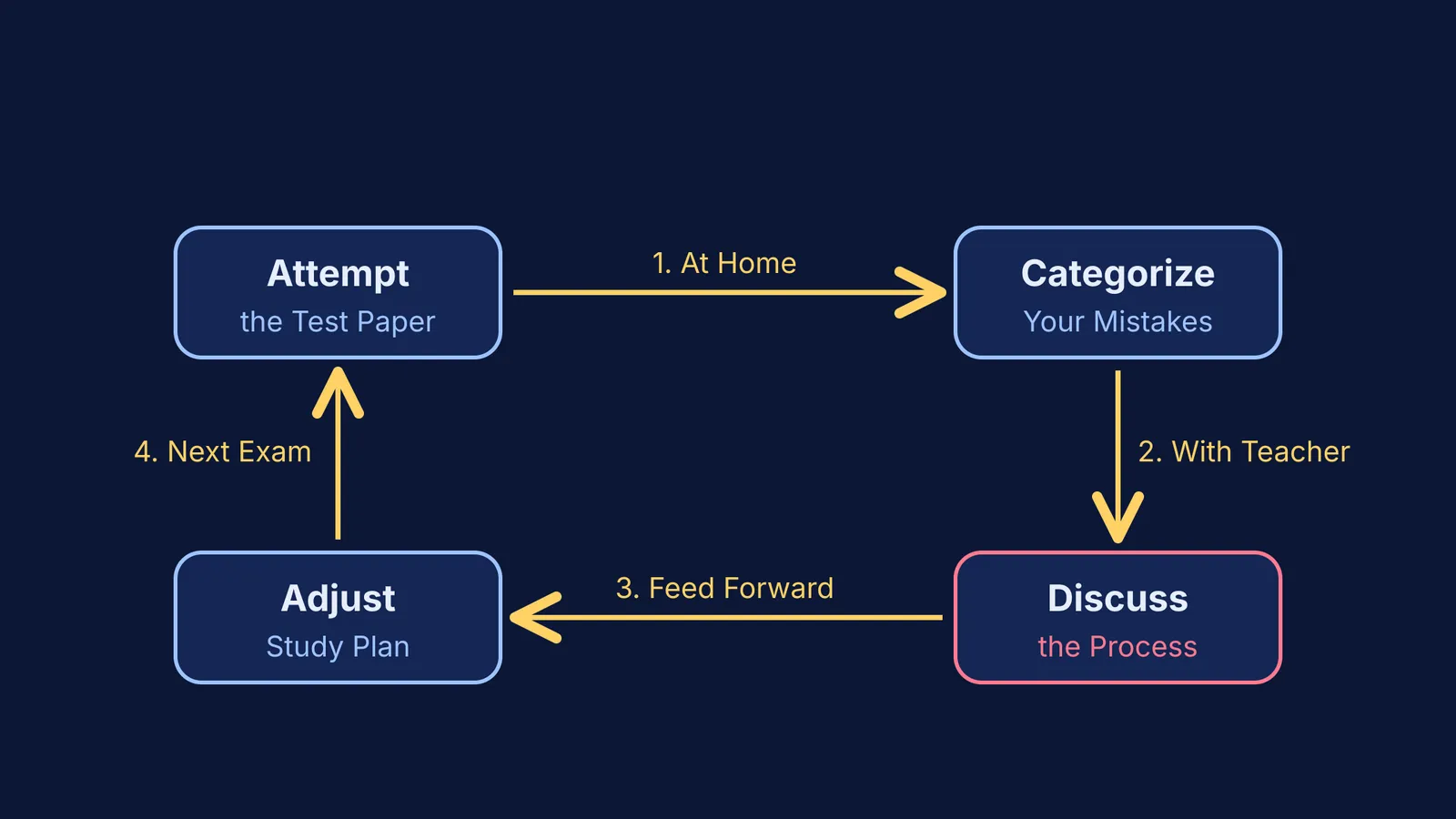
To get process-level feedback, you have to show them your process. This means doing a "test autopsy" before you approach the desk.
Sort your mistakes: Go through the paper at home and group the errors. Was it a silly calculation mistake, a failure to understand the concept, or did you run out of time?
Bring your rough work: The teacher cannot correct your thinking if they cannot see it. Bring the exact sheet where you solved the problem during the exam.
Pinpoint the breakdown: Find the exact line in your rough work where you got stuck or went wrong.
What questions should you ask during a test review?
The questions you ask decide the quality of the feedback you receive. Avoid asking questions that end with a simple "yes," "no," or a single number.
Instead of asking, "How do I solve question 14?", try these:
"I started question 14 using conservation of energy, but got stuck on line three. Was that the right approach?"
"I keep making sign convention errors in optics. Can you show me how you set up the first step for this mirror problem?"
"I narrowed it down to options B and C, but I always guess wrong. What is the key difference between these two concepts?"
By asking these questions, you give the teacher a window into your reasoning. This is exactly why making mistakes helps you learn, and how to use them: the error itself is the map that shows the teacher where to guide you next.
The three-step script for your next doubt session
If you feel nervous approaching the teacher, follow this simple script:
Step 1: The Context. "Sir/Ma'am, I am trying to understand where my process broke down on this rotational mechanics problem."
Step 2: The Evidence. "Here is my rough work. I drew the free body diagram like this, but my torque equation gave the wrong acceleration."
Step 3: The Feed-Forward. "To fix this, what specific type of problem should I practice before the next test?"
That final step is what Hattie and Timperley call "feed forward"—using the feedback to adjust your future study plan. If the teacher identifies a fundamental gap in your knowledge, you can tackle it immediately. For example, if you realise your underlying theory is weak, you can review the specific lesson in the Concept Library before attempting more questions.
Once you have your strategy, compare your performance not just against others, but against your own past mistakes. This helps you use coaching rank lists and comparison as a tool for personal growth rather than a source of stress. When you treat the coaching teacher as a partner in refining your process, every test paper becomes a stepping stone.


