

On this page
You find the answer sheet folded at the bottom of a school bag, or the parent portal shows a unit-test mark nobody mentioned at dinner. The first feeling is usually hurt, then anger. Before acting on either, know what hiding often means, because what you do next can shape what you hear next time.
What does it mean when a child hides test results?
Much of what parents know about a teenager's life comes from what the teenager chooses to tell them. In a study of 703 Swedish 14-year-olds and their parents, parental knowledge came mainly from the child's own disclosure rather than from parents' tracking and surveillance (Stattin and Kerr, Child Development, 2000). So a hidden mark is often a sign that telling you feels riskier to your child than staying quiet. The risk is often not the mark itself but one of these:
Your reaction: shouting, a lecture, comparison with a cousin or sibling, or losing the phone.
Shame: the mark feels like proof that they are "not smart", and saying it out loud makes it real.
Hoping to fix it first: "I'll do well in the next test and then tell them."
Feeling the mark is the whole story: they cannot explain what went wrong, so they avoid the question.
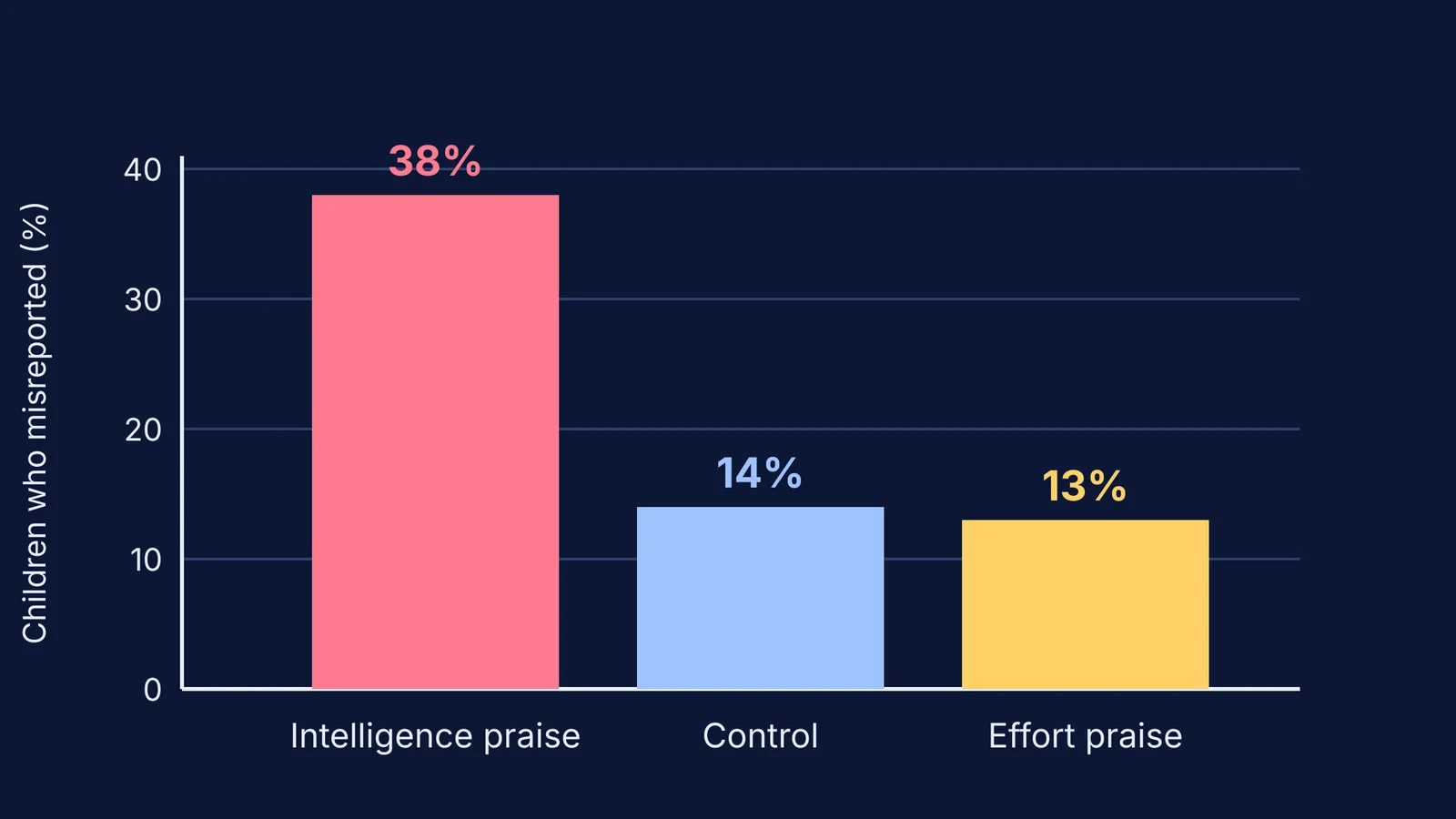
Research on praise points the same way. In one experiment with 88 fifth graders, after a hard set of problems, 38% of children who had been praised for being clever overstated their scores, compared with 13% of children praised for effort and 14% in a control group (Mueller and Dweck, Journal of Personality and Social Psychology, 1998). They did this even when reporting to an unknown child at another school. When marks feel like a verdict on who you are, hiding them can be a form of self-protection.
Does my reaction change whether they tell me next time?
Research suggests it can, and this is the part you control. A Swedish study that followed 982 young people across three waves found that parents' negative reactions to what children told them were linked to the children feeling more controlled and less connected. That in turn predicted more secrecy and less disclosure later, while positive reactions predicted feeling more connected and, through that, more disclosure (Tilton-Weaver and colleagues, Journal of Adolescence, 2010).
How do I bring it up without a fight?
Pick a calm time, not the moment you find the paper. Then go in this order:
Say what you know, without a trap. "I saw your physics unit test. I'm not going to shout about it."
Name the hiding gently, once. "I'm guessing you didn't want to tell me. I'd like to know why, so I can be easier to tell."
Listen to the reason. If they say "you always get angry", don't argue. Say "That's fair. I'll work on it."
Move from the number to the paper. "Show me two questions you lost marks on. What happened there?"
End with one small plan, made together. "What would help before the next test, and what do you need from me?"
Here is a worked example. A Class 9 student hides a maths test with 14 out of 40. Going through the paper together, you find that of the 26 marks lost, 10 came from one chapter they never understood and 6 from careless sign errors. That gives two concrete fixes instead of a vague "study harder": relearn the chapter, and check signs before handing in. For more on these conversations, see our guide to talking to teens about marks.
If the gap is a concept they never understood, the Fermi Concept Library gives each concept in physics, chemistry, biology and mathematics its own lesson, so they can relearn it at their own pace.
What should I do when the next result comes in?
Plan your reaction before the result arrives:
First minute: thank them for telling you. "Thanks for showing me" comes before any comment on the mark.
Same evening: look at the paper together and sort the lost marks into the chapter they didn't understand, careless slips and questions they ran out of time for.
That week: agree on one change your child chooses. For why letting them lead matters, read our piece on autonomy-supportive parenting.
Praise: the strategy and the honesty, not cleverness.
A low mark that you hear about is worth more than a good mark you can't trust. For ways to make setbacks ordinary at home, read how to talk about failure at home.
When is hiding marks a sign of something bigger?
If hiding comes with other changes, such as pulling away from friends, sleeping badly or saying "there's no point", talk to the school counsellor or your family doctor. You can also call Tele MANAS, the free 24x7 national mental-health helpline, on 14416 or 1800-891-4416 (IIT Kanpur Counselling Service). You don't have to wait for a crisis to call.


