

On this page
The report arrives on a Sunday evening: marks, a percentile, a batch rank and a subject table. Here is what each number means, an example report, and the patterns that deserve a calm conversation.
What does a percentile on a coaching test report mean?
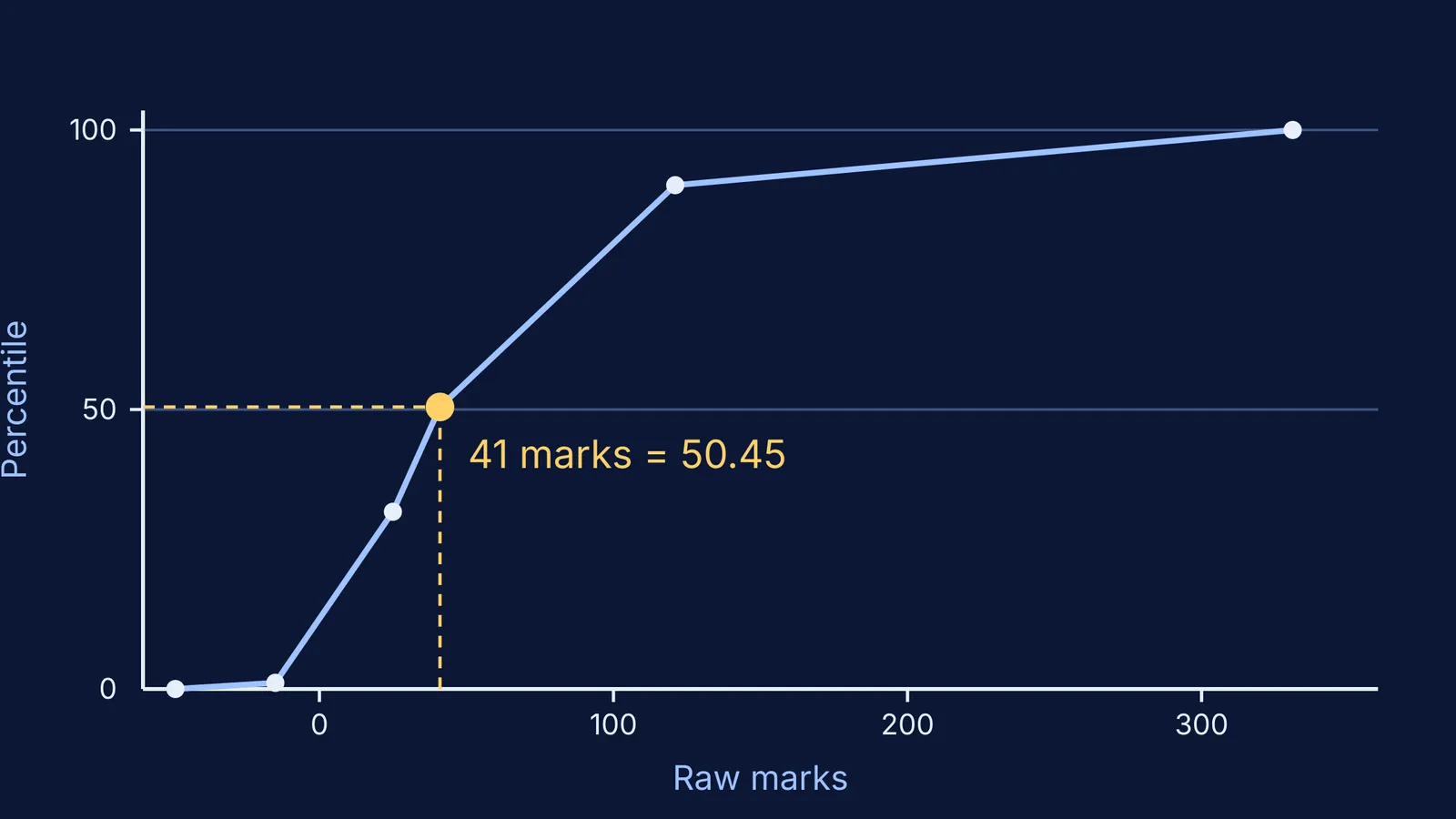
The National Testing Agency defines a percentile score as the percentage of candidates who scored equal to or below a given candidate in that session (NTA normalisation procedure). It is not the percentage of marks obtained.
In NTA's own worked example, a candidate with 41 raw marks was at the 50.45th percentile of 41,326 candidates, because about half of that session scored 41 or less. The topper of every session gets 100.
NTA also notes that the total percentile is not an average of the subject percentiles. So a report showing 85 in physics, 70 in chemistry and 60 in maths does not mean an overall 71.7.
On a coaching report, check the group behind the percentile: the batch, the centre, or every centre. The 90th percentile of a small top batch and of a whole city are different facts. If unsure, ask.
Batch rank or percentile: which number matters more?
A rank only makes sense next to the number of students who took the test. Rank 40 of 60 and rank 40 of 400 are very different, so divide rank by batch size before comparing tests.
Ranks also move when the group changes: a student promoted to a stronger batch can drop in rank while learning more. Neither number tells you why; the subject breakdown does.
How do I read the subject breakdown?
Here is a made-up report for three weekly tests, each out of 300 (100 per subject):
Test 1: physics 52, chemistry 61, maths 38. Total 151. Batch rank 34 of 120.
Test 2: physics 48, chemistry 66, maths 41. Total 155. Batch rank 41 of 120.
Test 3: physics 40, chemistry 63, maths 44. Total 147. Batch rank 38 of 120.
The totals are almost flat and the rank stays in one band: nothing to discuss. Maths is creeping up. Physics has fallen at each of the three tests, from 52 to 40. That is the trend worth a conversation.
Then check the attempted, correct and wrong columns for physics, and which chapters were tested. Marks lost to wrong methods, careless slips and blank questions each need a different fix.
Which trends deserve a conversation?
Worth raising, gently:
One subject falling across three or more tests in a row.
More wrong answers for about the same number attempted, which costs marks under negative marking.
Many blank questions in one subject, test after test.
The same chapter weak in tests weeks apart.
A sharp fall alongside changes in sleep, mood or attendance.
Usually not worth raising on its own:
A rank moving within a band.
One bad test after an illness, a school exam week or a hard paper.
A drop just after moving to a stronger batch.
If scores swing a lot, our guide on why mock test scores fluctuate explains the usual causes.
What should I say to my child about the report?
Avraham Kluger and Angelo DeNisi's 1996 meta-analysis of 607 effect sizes found that feedback improved performance on average, but over a third of feedback interventions made performance worse (Psychological Bulletin abstract). Their results suggest feedback works less well as it moves attention away from the task and towards the self. A 2007 review by John Hattie and Helen Timperley in Review of Educational Research adds that the type of feedback and the way it is given can make a difference.
A script that keeps the focus on the work:
"Can you walk me through this test? What went well?"
"I noticed physics went 52, 48, 40. What do you think is going on?"
"Is it chapters you haven't finished, method mistakes, or running out of time?"
"What is one thing you want to try before the next test, and how can I help?"
Skip comparisons with cousins, rank talk at the dinner table and questions that start with "Why can't you".
What should we do after the conversation?
Take the physics paper to the teacher; our guide on how to discuss a test paper with your coaching teacher shows what to bring. If marks were lost to a misunderstood idea, the Fermi Concept Library has a lesson for every concept in physics, chemistry, biology and mathematics, so your child can rebuild that chapter. If the method is the problem, the Fermi Problem Library has worked problems with a step-by-step solver that explains the reasoning rather than printing an answer.
If a report ends in tears, read what to say when your child cries over low marks. If your child seems low, anxious or hopeless for weeks, talk to a doctor or counsellor, or call Tele MANAS, the free 24x7 government helpline, on 14416 (PIB).
Next Sunday, skip the rank and start with the subject that has moved three tests running.


