

On this page
When your child walks in the door crying over a low mark in a mock test or board exam, your instinct is likely to fix the situation immediately. You want to ask what went wrong, look at the paper, and build a new study schedule on the spot. But those first ten minutes define how your child will handle academic pressure and setbacks for years to come.
Why does connection beat correction in the moment?
Your child is already stressed, and adding to that pressure in the immediate aftermath of a failure is counterproductive. Across participating countries, 66% of 15-year-old students reported feeling stressed about poor grades (OECD, 2017). In that heightened emotional state, their brain is literally unable to process a logical lecture on time management, study habits, or long-term career impacts.
The same OECD report found that students who perceive their parents as interested in their school life are significantly less likely to feel anxious about schoolwork. If you launch straight into problem-solving or questioning their effort, you risk replacing their internal drive to learn with an external fear of disappointment. Over time, punitive reactions lead to children hiding their grades or lying about their performance to avoid conflict.
To build resilience, you have to prioritize connection. Lowering their anxiety in the moment shows them that your love is not conditional on their academic output.
What to say in the first ten minutes?
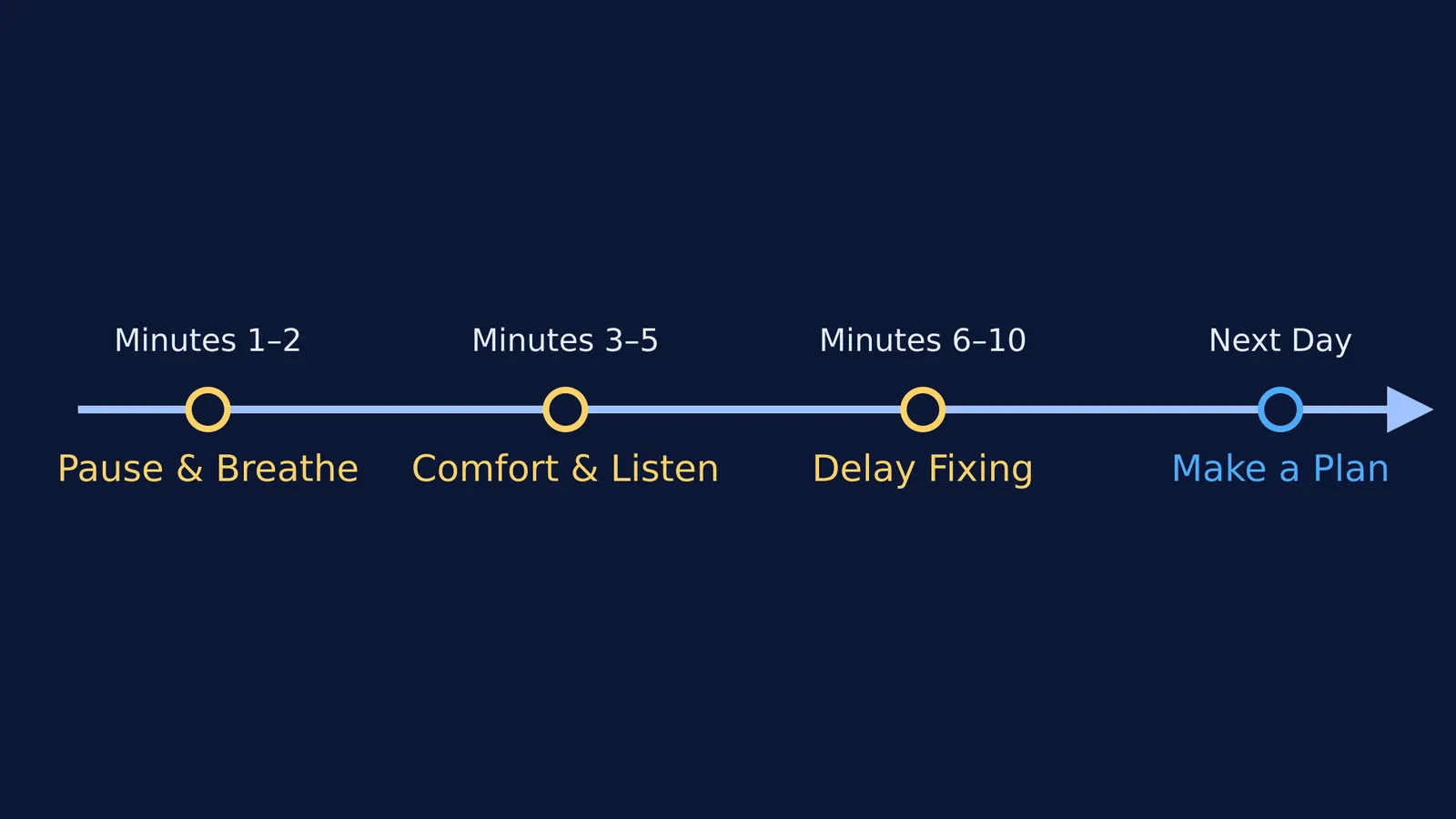
Instead of asking questions, your goal is to de-escalate the situation. Here is a framework for the immediate aftermath.
The first two minutes: Pause and breathe Before you speak, regulate yourself. If you are feeling angry, frustrated, or anxious about their future, take a moment. Your child is looking to you to see if their failure means a loss of your approval. Remind yourself that a test score is merely a data point, not a reflection of your parenting or their worth.
Minutes three to five: Empathy without blame Comfort them first. Acknowledge their emotional pain without rushing to find the cause of the low marks. Validate what they are feeling so they feel heard and safe.
Avoid: "Why didn't you study harder?" or "I told you this would happen if you played video games."
Try: "I can see you are really disappointed by this result. I know how hard you worked, and I am here for you."
Minutes six to ten: Delay the autopsy Let them cry or vent if they need to. Do not pull out the question paper and start looking for where they lost marks. If they try to show you the mistakes, gently close the book. The immediate aftermath is not the time for an academic review.
Try: "We do not have to figure this out right now. Let's put the paper away for tonight. We can have dinner, rest, and look at it tomorrow when we are both feeling calmer."
How to move to a plan the next day?
Once the emotion has settled—usually by the next afternoon—you can shift from emotional support to academic strategy. By waiting twenty-four hours, you show that the problem is manageable, not an emergency. Sit down together at a neutral time and look at the paper. The goal now is to separate their identity from their performance.
Identify the specific gaps. Ask open-ended questions about the test. Are they losing marks because they misread the questions under time pressure? Is there a fundamental concept gap they have been hiding? Did they make a calculation error? When you know the specific barrier, you can find the right tool to overcome it, rather than just telling them to "study more."
Equip them with the right tools. If they are struggling to picture the physics or understand the chemistry behind a low score, Fermi's AI tutor can help. It works out what they already know and builds a plan for the session, so they sit down to a clear next step. For mathematics and physics calculations, the Fermi Problem Library has worked problems with a step-by-step solver that explains the reasoning rather than printing an answer.
Focus on the process, not the outcome. To avoid future anxiety, praise their willingness to review their mistakes. Normalize the failure by sharing a story of a time you failed at something important and what you learned from it. If you need help managing this conversation, learning how to talk to your teenager about marks without a fight is a critical step.
As you separate high expectations vs pressure in your household, remember that a low mark is just feedback. Your reaction dictates whether that feedback becomes a roadblock or a stepping stone.


