On this page
The teacher reads every name and score aloud. Yours is lower than you hoped, and you feel thirty pairs of eyes on you. Here is what to do with the number, and a polite script for asking your teacher for private feedback.
Why does it feel so bad when marks are read out?
Reading marks aloud turns a private result into a public ranking. In a meta-analysis of 607 effect sizes, Avraham Kluger and Angelo DeNisi found that feedback improved performance on average, but over one third of feedback interventions made performance worse (Psychological Bulletin, 1996). Their proposed explanation: feedback works less well the more it pulls attention towards the self ("Am I stupid? What do they think of me?") and away from the task ("Which step went wrong?").
An earlier classroom experiment points the same way. Ruth Butler randomly assigned twelve classes of fifth- and sixth-grade pupils to receive grades only, comments only, or grades plus comments (British Journal of Educational Psychology, 1988). Interest and performance were highest after comments alone; grades, and grades with comments, had similar and generally undermining effects. In that study, adding a grade seemed to cancel out the benefit of the comment beside it.
The CBSE takes a similar line on public rankings. It does not declare a merit list for board results or award divisions; its examination controller, Sanyam Bhardwaj, said this follows an earlier board decision "to avoid unhealthy competition among students" (Education World, May 2025).
How do you separate the number from the feedback?
The score tells you where you stand; the answer sheet tells you what to do. Try this sort on the day you get the paper back, before the feeling hardens into "I'm bad at this subject".
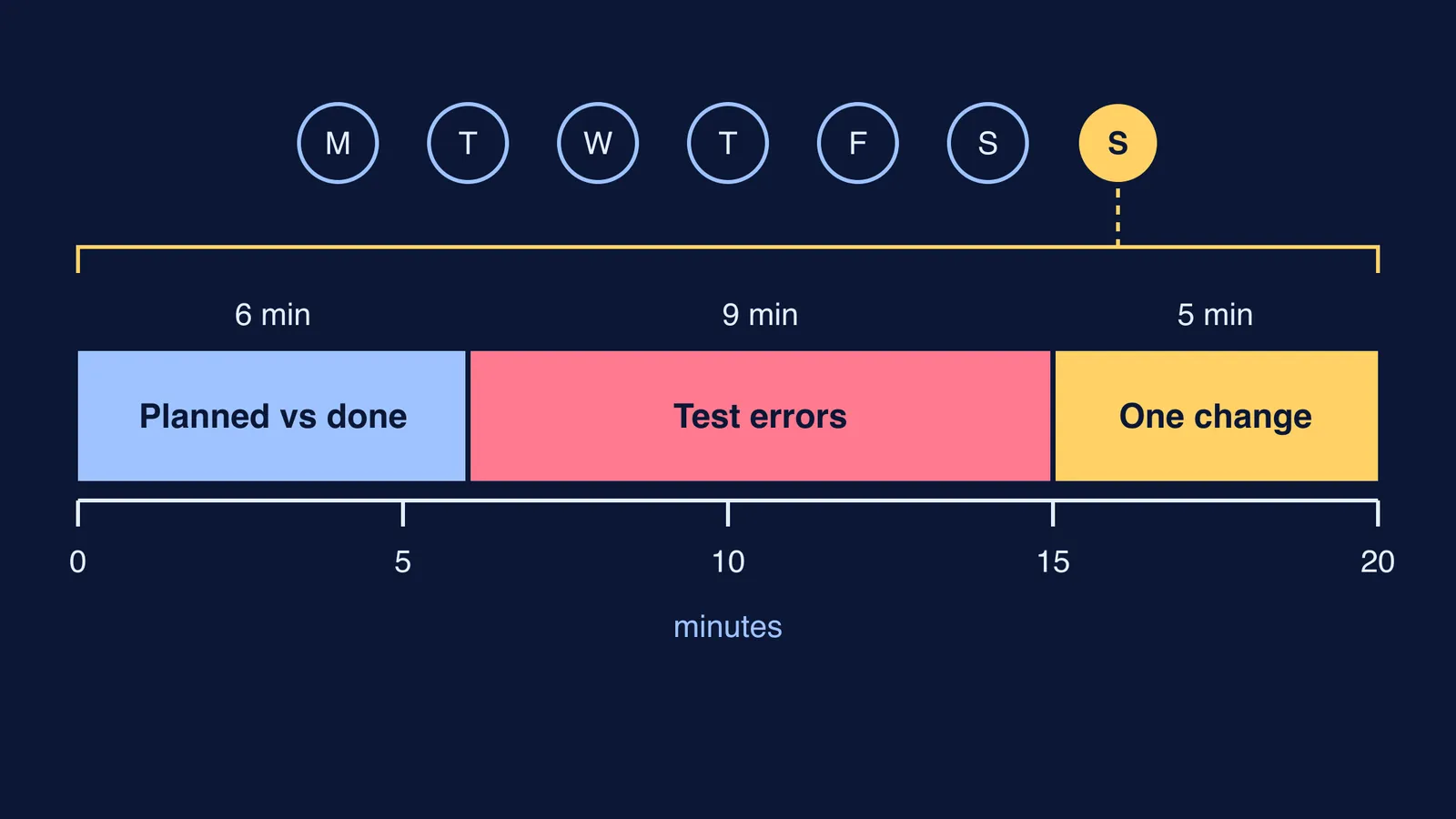
Number: Write the score once at the top of a page. Then stop looking at it.
Pattern: Go through every mark you lost and put it into one of four buckets: concept gap (you did not understand the idea), method (right idea, wrong steps), slip (copying, sign or unit errors) or time (you did not reach the question).
Next step: Pick the biggest bucket and choose one action for the coming week.
Here is a worked example. Riya scores 14 out of 30 in a physics unit test, and her score is read out after a classmate's 27. She sorts her 16 lost marks: 7 from a projectile question where she used the wrong formula for range (method), 5 from two questions on relative velocity she left blank (concept gap), and 4 from sign and unit slips. Her biggest bucket is method, so her one action is to redo the projectile question and two similar ones, step by step, before Friday.
If your losses cluster in one place, an error notebook stops the same mistake costing you twice. For concept gaps, the Fermi Concept Library covers every concept in physics, chemistry, biology, mathematics and computing, each with its own lesson. For method mistakes, the Fermi Problem Library has worked problems with a step-by-step solver that explains the reasoning rather than printing an answer.
That pull of the first number has a name, and our guide to anchoring bias in marks and prices explains how it works.
How do you ask a teacher for private feedback?
Asking about your answers, rather than your score, keeps the conversation on what you can fix. Choose a calm moment, such as after class, not while papers are being handed out. Bring your answer sheet and your sorted list.
You can say something like this:
"Ma'am, do you have two minutes? I went through my test and most of my lost marks were in the projectile question."
"I think I used the wrong method here. Could you show me where my working went off track?"
"What is one thing I should practise before the next test?"
If the public announcement itself is what bothers you, it is fine to say so, briefly and respectfully:
"Sir, I find it hard to focus on the feedback when marks are read out. Would it be possible for me to see my marks privately, or come to you for feedback after class?"
Keep it about what helps you learn, not "You embarrassed me". If nothing changes, a parent can raise it gently with the class teacher; our guide for parents on schools that celebrate only toppers covers how.
What if the feeling does not go away?
A bad day after results is normal. If the embarrassment keeps you from class, sleep or meals, or you start avoiding a subject, talk to someone you trust: a parent, your class teacher or the school counsellor. You can also call Tele MANAS; its details are listed on the IIT Kanpur counselling service page.
Next time papers come back, note the number, then look for the pattern. That is the part you can change.